

Option E: Domestic Sewing Machine Motor

Option E: Domestic Sewing Machine Motor
See the parent article: Choosing a Motor
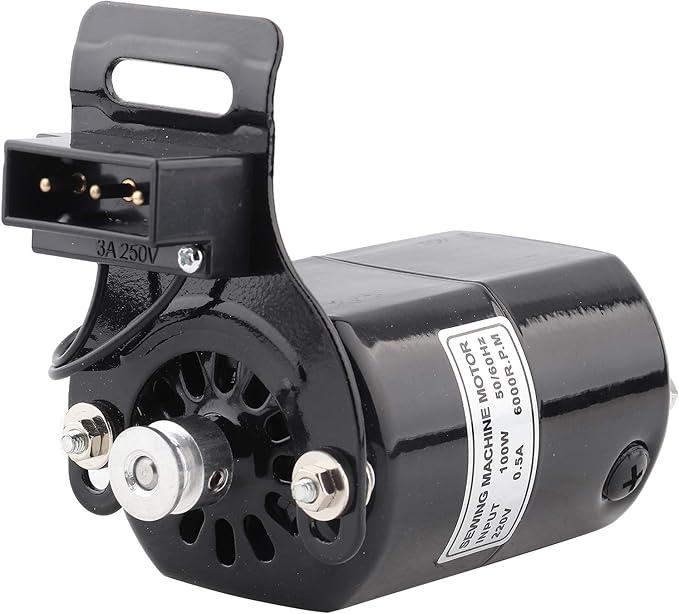
A domestic sewing machine motor is a small, compact universal motor that is typically used on domestic sewing machines.
1. What is a Domestic Sewing Machine
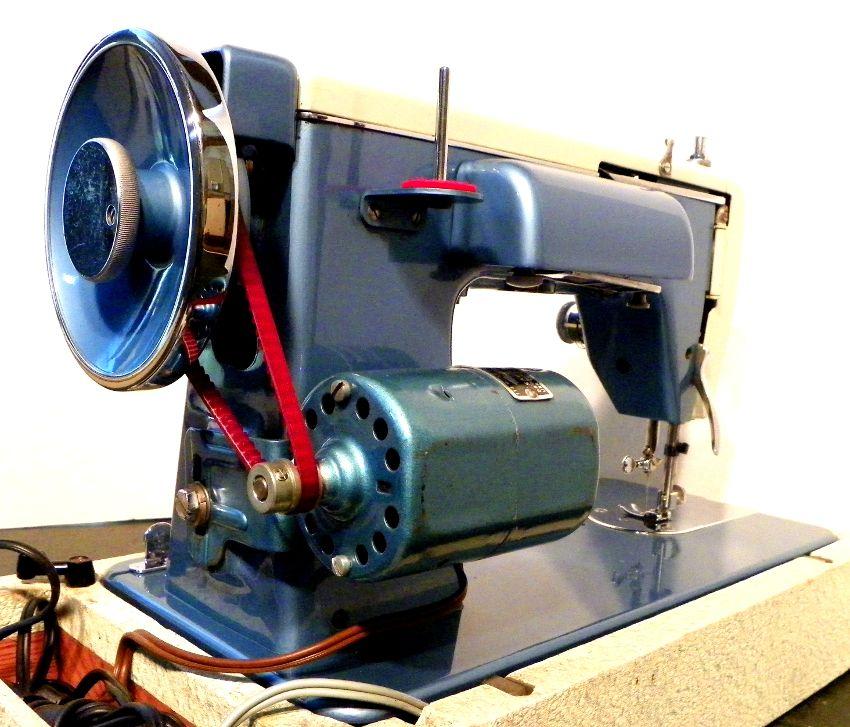
In this case, “domestic” means “for home use”. But you can think of it as a “dainty” sewing machine. That is, often used for sewing thin materials together with skinny needles, TEX 20 - TEX 70 thread. On this photo you see a common configuration, with the motor mounted directly to the body of the machine.
2. What is a Universal Motor
In a nutshell: it’s a motor that can run on AC or DC voltage, and whose speed and torque can be varied together by varying the input voltage. See this page on wikipedia: https://en.wikipedia.org/wiki/Universal_motor
Note universal motors always have brushes.
Typical universal motors seen on domestic sewing machines draw 1-amp @ 115 volts (or ½ amp at 230 volts), and have a maximum speed of 5000 - 7000 rpm. Some are a little beefier.
3. What Kind of Speed Controller
A domestic sewing machine motor typically comes with a foot pedal that has a built-in variable speed controller. Some use a “carbon pile”, meaning a pile of about 50 carbon discs, and when a spring pushes them tighter together, more current flows through them. Carbon piles do get warm in use.
Others use a TRIAC speed control. See this page on wikipedia: https://en.wikipedia.org/wiki/TRIAC#Application
You can usually replace the foot pedal (speed controller) separately from the motor. So if your foot pedal does not provide a good linear response, try a different one.
4. Is a Domestic Sewing Machine Motor the right Motor for me?
Domestic sewing machine motors are a compact, inexpensive alternative for powering your industrial sewing machine. They are intuitive to drive. They will excel in situations where not a lot of torque is required. So pretty much any non-walking foot sewing machine could be a good candidate for a domestic motor, especially if you gear it down.
5. How to Gear Down
You can improve the pedal response of a domestic sewing machine motor by gearing it down. This gives the machine better low-end response so it won’t bog when crossing thick material at low speed.
The motor pulley that comes with a domestic sewing machine motor usually fits well with 5mm polyurethane “PU” belt, which can be cut to length and hot-fused.
You can put an oversize handwheel pulley, see examples:
https://leatherworker.net/forum/topic/132445-domestic-motors/
More info on making wooden pulleys:
https://preciousww.com/making-big-v-belt-pulleys-from-plywood/
Or you can add an intermediate gear reducer, see example:
https://leatherworker.net/forum/topic/132447-glove-sewing-machine-advice/#findComment-789023
0 Comments
Recommended Comments
There are no comments to display.
Join the conversation
You are posting as a guest. If you have an account, sign in now to post with your account.
Note: Your post will require moderator approval before it will be visible.