



beefy
-
Posts
41 -
Joined
-
Last visited
Content Type
Profiles
Forums
Events
Blogs
Gallery
Store
Everything posted by beefy
-
Can a worn case/hook prevent adjustment of case opener lever.
beefy replied to beefy's topic in Leather Sewing Machines
Finally got around to the hook swap thanks to pulling my lower back and not being able to do higher priority work LOL. The new hook (cheap Chinese off Ebay) was not identical to the worn out hook in the machine. Problem is I don't know if the original worn out hook from the machine is OEM or not because it does not have any Singer markings anywhere. The case had Singer markings but that could be an original case in an aftermarket hook, no idea. The V-slot in the shaft of the new Chinese hook was in a different position, see this thread: Something else I checked was the position of the eccentrics on both hooks, relative to the position of the hook point. As can be seen in the attached photo the new hook (left in the photo) had the highest point of the eccentric more advanced than the old hook. The blue marking on the hooks indicates where the eccentric sticks out the most. This was checked with a dial indicator. This advanced position of the eccentric on the new hook seems to have been beneficial to the case opener arm operation, and the case opener arm now releases earlier, and I don't get the problem I explained earlier, where the thread could not get past the case opener arm and the triangular outcrop of the case. Also attached a video of the the case opener operation and the material passing the latch. A point of note is I've also ground a chamfer on the front / operator side of the needle plate slot, as this was acting as a pinch point with the new hook. So far the operation seems good now, but I have to try it powered to be fully sure. It just on the bench at the moment while I'm doing various jobs in my workshop. AFTER HOOK CHANGE.mp4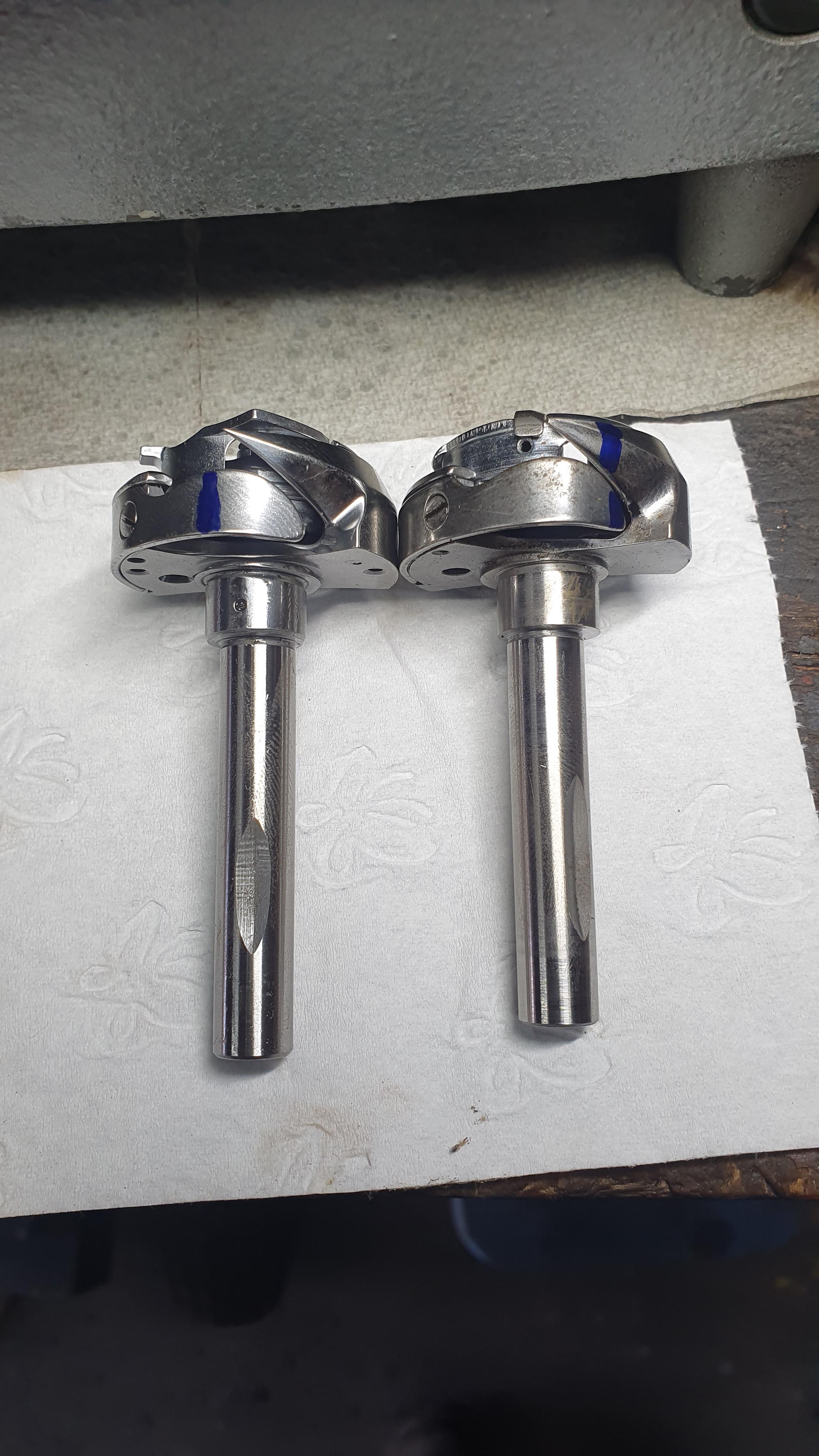
-
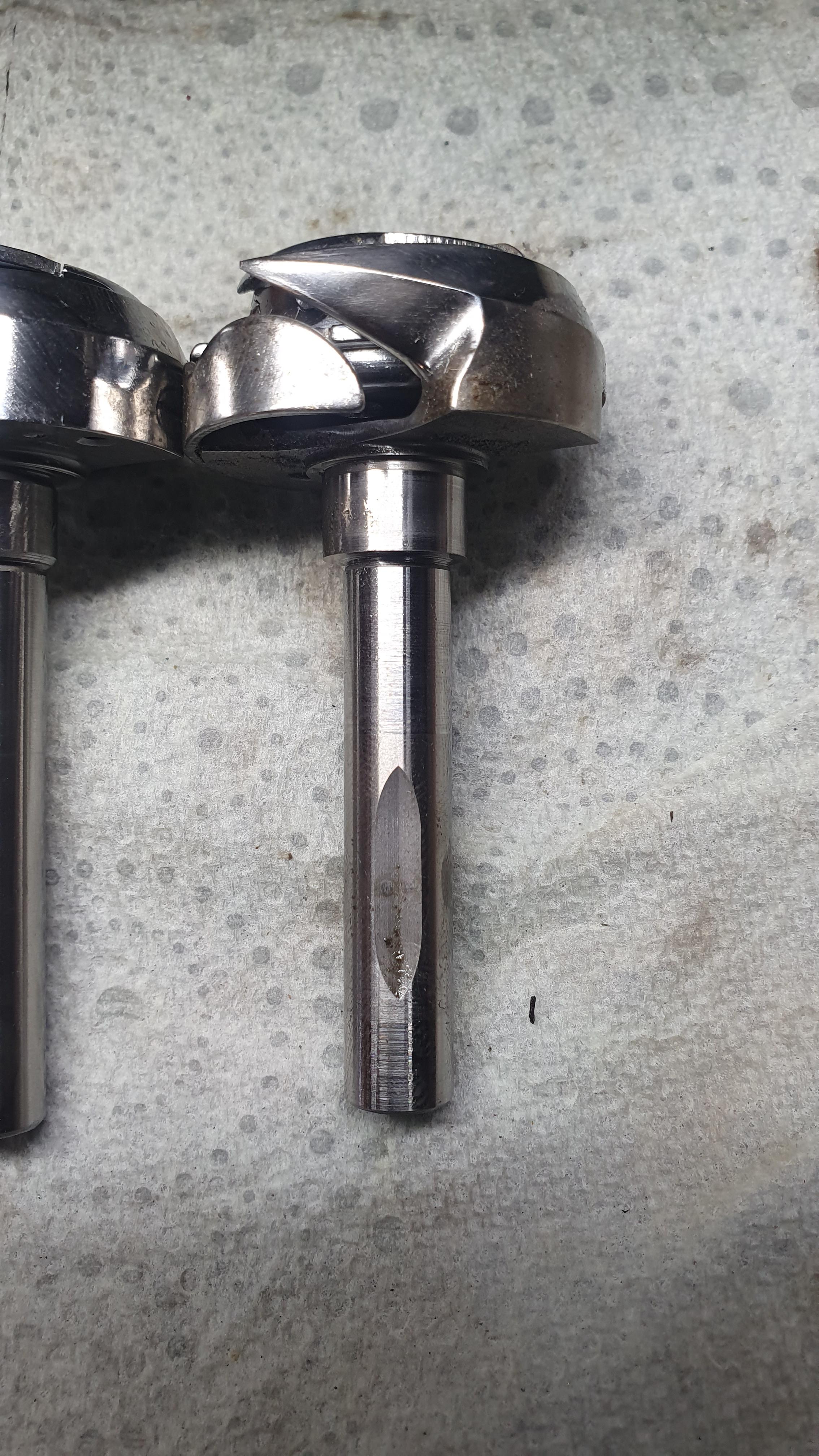
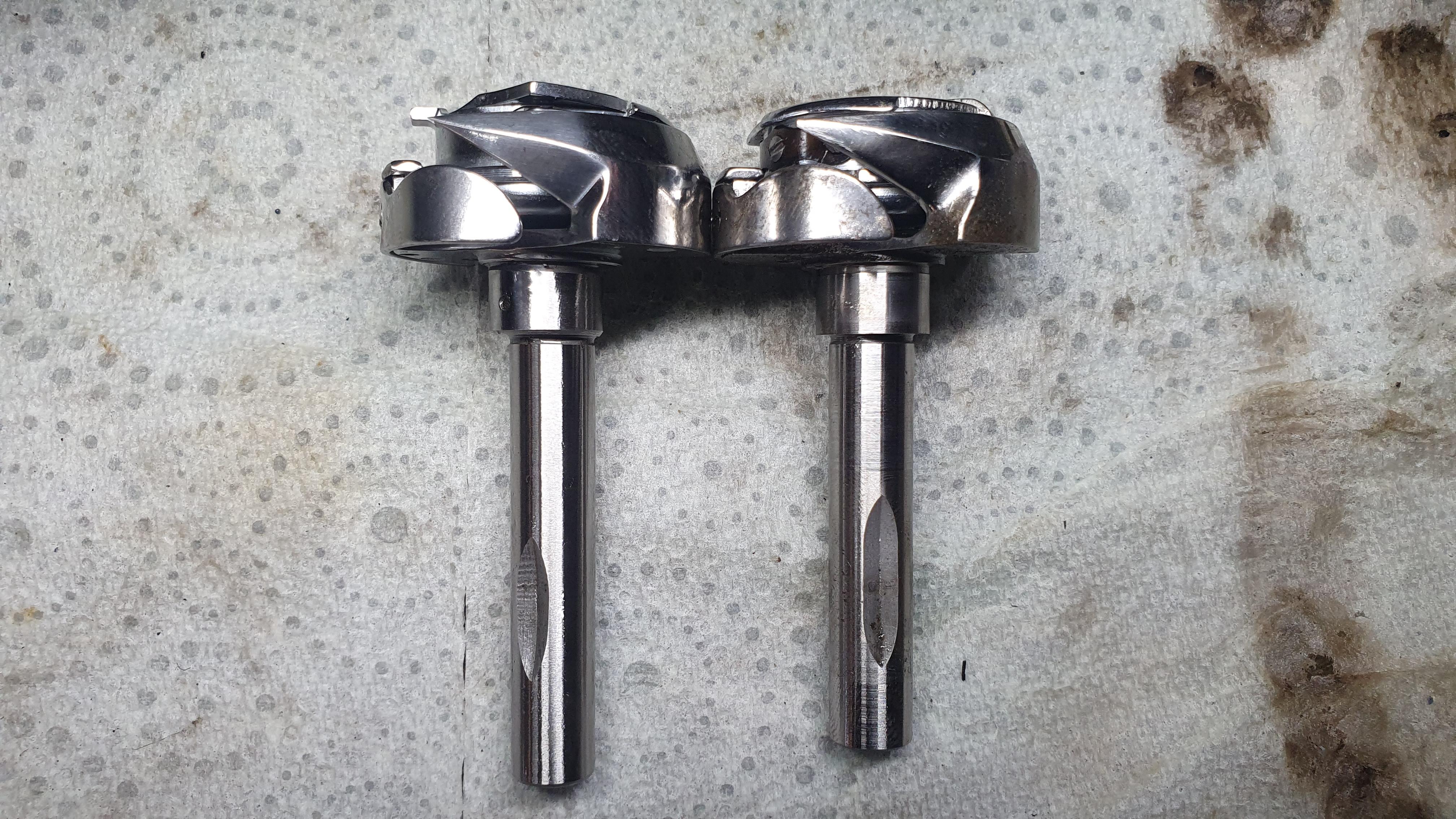
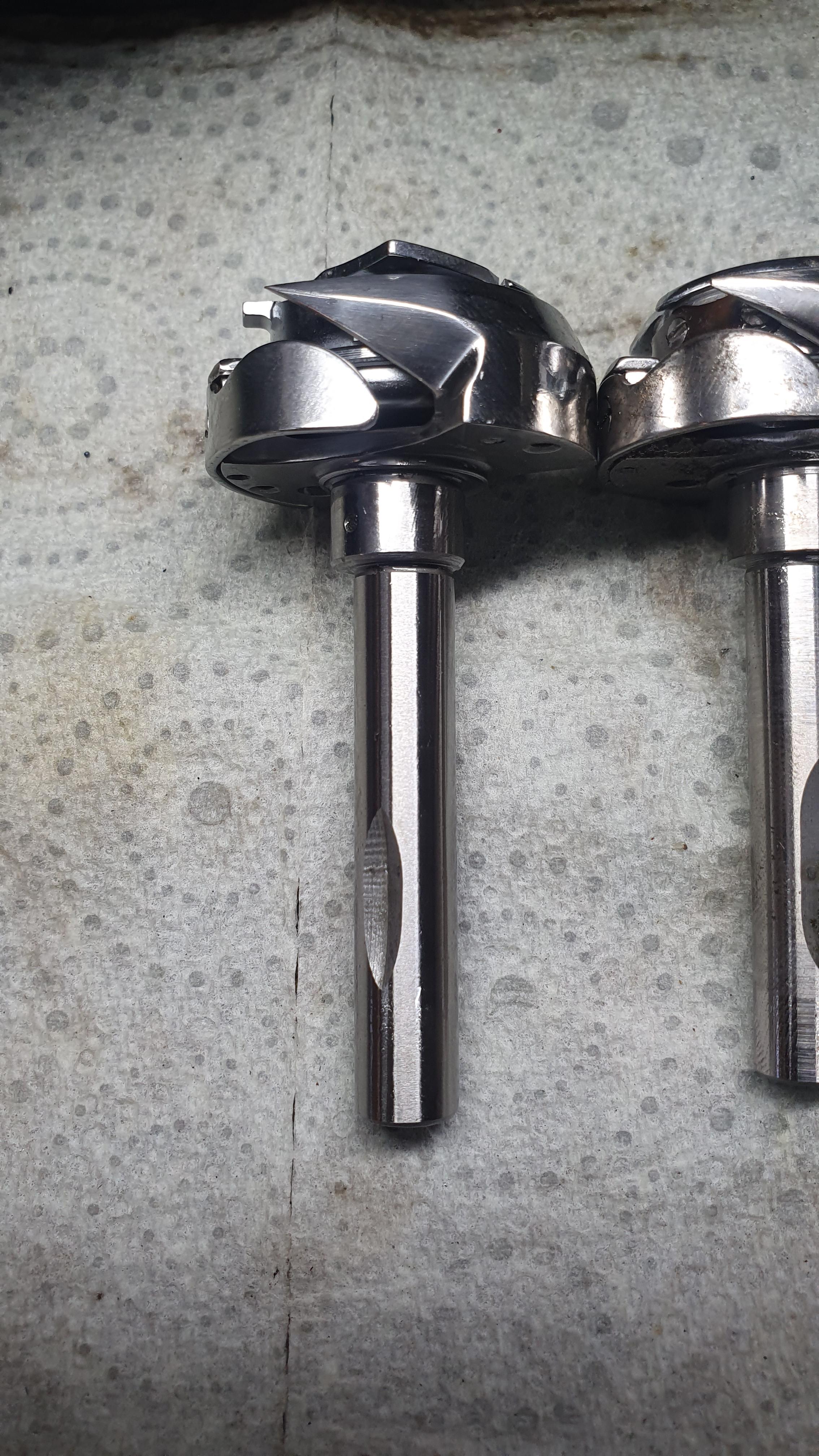
Just started installing a new hook on my Singer 211G156. First thing I noticed was the hook timing was way off, and the large gear could not be moved sideways enough to correct the timing. I have not ran this machine yet so thought the timing must have been off when I purchased it, and I'm only just finding this out now. However, I pulled the new hook out and put it side by side with the original hook. As can be seen in the pictures, the V-slot in the new Chinese (supposedly a CKPSMS) hook https://www.ebay.com.au/itm/262943436183 is in a completely different position. I had to advance the small gear on the hook shaft one tooth to be able to time the hook. So my big question is will a hook for a Juki LU-562 drop straight in to a Singer 211G156. Up to this point I'm under the impression the answer is yes, but am I wrong. It will not be a big deal so long as the large gear is still fairly centrally aligned to the center of the hooks vertical shaft, i.e. I don't have to move it sideways too much to get the timing correct. I haven't fine tuned it yet but it seems to be OK in that regard. Tomorrow I need to check the positioning of the eccentric on the Chinese hook and see if it's the same as the original hook. If that is way out of rotational position that's going to affect the timing of the case opener arm. Looking at the photos it initially appears the eccentrics positions may be different but I'll check with a dial gauge. Chinese hook is on the left and original hook on the right.
-
Can a worn case/hook prevent adjustment of case opener lever.
beefy replied to beefy's topic in Leather Sewing Machines
Yeah, I'm trying to get at my sewing machines but a few other tasks are ahead. Apart from that, excess heat is my problem here in Australia LOL. Would a 5Kw Chinese diesel heater be big enough to heat your craft area. I love those little toys. Want to put one in my boat when I make the fabric cabin so I can go out in freezing winter and be toasty warm. -
Can a worn case/hook prevent adjustment of case opener lever.
beefy replied to beefy's topic in Leather Sewing Machines
I remember one guy's Youtube video, where he reckoned the case opening mechanism is only important for thinner thread. I think he said the thicker (stronger) thread will just pull the latch open. Whether what he said is correct or not I have no idea. -
Can a worn case/hook prevent adjustment of case opener lever.
beefy replied to beefy's topic in Leather Sewing Machines
Thanks AIZilla. Looks like your case opener arm is not adjusted correctly, as it does not even contact the triangular outcrop on the case to pull the case anti-clockwise and open the latch on the rear/far side. It appears the thread itself is simply pulling on the tab of the case and thus forcefully pulling it anti-clockwise then the thread goes through the latch. -
Can a worn case/hook prevent adjustment of case opener lever.
beefy replied to beefy's topic in Leather Sewing Machines
Fantastic, great to be on the same page as everyone. Yes, I agree. The new hook arrived a couple of days ago but I won't get a chance to swap it out until hopefully this weekend. I will create video #2 (the "after" video) when it's done, and hopefully I have a flawlessly working machine. The best part of all this is what I'm learning from you guys, so thanks very much everyone for your kind help. -
Can a worn case/hook prevent adjustment of case opener lever.
beefy replied to beefy's topic in Leather Sewing Machines
This is the before Friquant. It's the old wobbly case. Won't get to install the new hook/case until maybe this weekend. Thread is Coats Dabond V138 for which the machine is rated. I've tried adjusting the case opener arm both ways in tiny increments. I cannot find a happy medium that pulls the case anti-clockwise enough to open the gap enough on the rear/far side of the case tab, yet opens the gap between the case opener arm and the triangular outcrop on the case when the thread goes around the other side of the hook. I can get one or the other but not both. This is why I'm suspecting the slop in the case and how it leans towards the needle plate, to be a potential cause of the problem. Regarding the latch. I'm kind of guessing at the moment at what part is referred to as the latch, so I'd better not go further before I make sure I'm on the same page as everyone. The curved arm that's operated by the eccentric under the hook, I've been calling that the case opener arm. The case opener arm pulls against the triangular outcrop on the case to rotate it anti-clockwise. This is where the biggest problem is as the gap between these two comes too late and the thread gets stuck there a little. Then there's the tab of the case that sits in the slot of the needle plate. So is one of those being referred to as the latch. -
Can a worn case/hook prevent adjustment of case opener lever.
beefy replied to beefy's topic in Leather Sewing Machines
You've lost me on that one Wizcrafts. The case opener arm is at the same height as the triangular outcrop on the case on which it pulls against. -
Can a worn case/hook prevent adjustment of case opener lever.
beefy replied to beefy's topic in Leather Sewing Machines
OK here's two videos. One is me moving the pulley very slowly so the action of the case opener on the case/tab can be seen, and how the case opener itself is still in contact with the case when the thread tries to pass through at the end. That's where the problem lies. As mentioned earlier, if I back off the case opener slightly to allow the thread to get through, the case tab is not rotated anti-clockwise enough to let the thread past the front side of the tab. The 2nd video is to show how much "rocking" there is in the case as it rotates. It's floppy as hell. 20260128_183115.mp4 20260128_183357.mp4 -
Can a worn case/hook prevent adjustment of case opener lever.
beefy replied to beefy's topic in Leather Sewing Machines
will have to make a before and after video. -
Can a worn case/hook prevent adjustment of case opener lever.
beefy replied to beefy's topic in Leather Sewing Machines
Hi Friquant, sorry for the late reply, I thought no more posts were coming to this thread. No email notifications have came to me, and I've only just seen your reply. I'll make a video tomorrow. My new hook arrived today and wow, what a difference as far as wear goes. The case on the new hook has very little play within the hook so I'd say the huge amount of wear in the existing hook/case may be a big contributor to the problem. -
@Wizcrafts Thanks for that very long and detailed reply. I'm happy to know I've got it correct. I know you guys have probably heard this a million times before, but the helpfulness and the quality of the responses and information the members of this site give, is truly amazing. I'm always wondering if I'm delving too deep into understanding the machine first before I "really get sewing", but I'm starting to think doing things this way will save me a lot of time in the future.
-
Thanks AIZilla, I'll have a read of that after work.
-
Can a worn case/hook prevent adjustment of case opener lever.
beefy replied to beefy's topic in Leather Sewing Machines
Using V138. I listened to the advice yourself and other gave in a previous thread and decides not to go any thicker with my machines. Thanks for the help guys. I might just buy a new hook/case and see if that helps. That will at least prove/disprove my theory of wear in the hook's cam, or the race of the hook/case. -
Can a worn case/hook prevent adjustment of case opener lever.
beefy replied to beefy's topic in Leather Sewing Machines
That's exactly it, I'm trying micro adjustments until the thread can just get through but then the other side has too little. I would like to have much larger clearance gaps but don't have that luxury. There is a little bit of play in the arm but not much. However, you've made me ponder something. I should check the play at various rotational positions of the hook to see if this play varies. It appears this machine was not well maintained and had more dry dust than oil, so I wonder if the cam that operates the case opener arm could be worn. I can also see the case actually tilt towards the hook sometimes as the thread pulls through, further indicating wear in the hook/case. -
I've been trying to adjust the case opener on my newly acquired Singer 211G156. If I adjust the case opener so that it pulls the case back to allow the thread to pass on the forward side of the case tab, the problem is that when the thread comes around the case and needs to pass between the case opener and the case, the gap there is not large enough to let the thread pass freely. If I adjust the case opener so the thread can can pass freely between the case opener and the case, then the opening of the gap on the forward side of the case tab is then not large enough. I can get one gap or the other large enough, but not both. Make one large enough the other closes up too much. It's almost as though the cam that operates the case opener is not made correctly, and the case opener "lets go" of the case way too late. Once it "lets go" the gap eventually gets quite large. The only other thing I can think of is that the case has some play/rock/wobble in the hook, so I'm guessing there's some wear. Could this cause the above problem.
-
I was reading an amazing thread from this site about the humble check spring. It seems there can be 2 or sometimes THREE different adjustments on the check spring mechanism: TENSION - pretty sell explanatory. The STROKE or where the spring STOP is positioned. This determines when thread tension is released on the needle down stroke. The THROW, which adjusts how much length of slack thread is given out before the tension comes back on. It seems the purpose of the THROW is to allow enough slack thread while it is wrapping around/under the case, before it is pulled taught again to pull the thread off the case. Viewing various threads and Google search results I've seen people suggesting adjusting the THROW so the thread becomes taught just as the needle eye enters the material. That appears incorrect to me, and I think they are talking about adjusting the STROKE or the spring stop position. Could anyone confirm that I have the 3 listed adjustments above correct, or if I'm completely wrong. Please be blunt with me LOL.
-
Singer 211G156 vs Seiko STW-8B (Consew 226R) for heavier thread.
beefy replied to beefy's topic in Leather Sewing Machines
Ah, is that so. Thanks for letting me know. It makes me feel a lot better because I didn't know the K6 was not a unison feed. Put that together with no reverse and it looks a lot less attractive. So that "loss" turned out to be a blessing in disguise. -
Singer 211G156 vs Seiko STW-8B (Consew 226R) for heavier thread.
beefy replied to beefy's topic in Leather Sewing Machines
Cheers AIZilla, I do a little boat fishing and there's these things called sea anchors or drones. They are a conical tube, and I was wondering how the hell would I stitch one on a flat bed machine. The post bed machine seems like the perfect machine for that type of thing too. Also looks like it would be easy to add a platform around it if I needed a temporary flat bed machine. -
Singer 211G156 vs Seiko STW-8B (Consew 226R) for heavier thread.
beefy replied to beefy's topic in Leather Sewing Machines
Thanks Dikman, come to think of it I've never seen a used really heavy duty machine for sale, except through a dealer. -
Singer 211G156 vs Seiko STW-8B (Consew 226R) for heavier thread.
beefy replied to beefy's topic in Leather Sewing Machines
Thanks very much guys. Really appreciate the detailed responses. I don't yet have a maximum thickness I expect to sew of anything. It's more a case of I've acquired an extra machine so just wondered if one could be set up for heavier work, rather than having 2 machines that can only do the same work. I'm really still at the beginning of this industrial sewing machine game. It started with my wanting to make a bimini and side covers for my boat but I'm finding I'm falling in love with these industrial machines, especially the walking foot ones, and I find I'm looking for extra things to make LOL. I think it's just a matter of time before I start playing with leather too. Based on what you have explained to me it seems I'd be pushing the machine beyond it's design limitations. I may be better off getting one of the extra machines in a nice working condition with a servo, speed reducer, and needle positioner, and selling it at a profit and putting the money away for a more appropriate machine for leather. I've been absolutely kicking myself for a while now. Seen a Singer 132K6 going for a steal not far from me, but shrugged my shoulders because it didn't have a reverse. Never realised the value of these machines at the time. Needless to say it went very quickly and 2 days later I see the same model machine advertised for A$1000 more. I bet it was that one. I wouldn't have sold it though. Regarding the bobbin conversion I've read/viewed every resource I can on the conversion and understand what's involved. I don't expect this will increase the thread size capability, just want the extra bobbin size. The existing bobbin case seems to wobble a lot so I thought it might be worn out and instead of just doing a direct replacement I decided to jump in the deep end and do the modification. I'm a mechanical fitter and have a lathe and milling machine, as well as access to a CNC mill, so I'm lucky enough in that regard. Regarding the extra torque with a pulley reduction system I've retrofitted my machines with 4 pulley reduction systems and servos, and wow, the torque will smash things. Before I got my Seiko STW-8B I was using my basic lightweight Mitsubishi DB-189 with V138 thread (that's not a typo LOL) and got some needle deflection with the thick stuff I was sewing, and the needle hit the plate. Wow, what a solid crunch as the needle buckled and snapped, I was sure something must have broken or at least went out of adjustment. Nope, just continued sewing OK. That's when I started looking harder for a triple feed walking foot machine. -
Something I've only heard mentioned once is the use of a VFD (variable frequency drive) for a 3 phase synchronous motor. The guy claimed the control with this setup totally outshines any servo motor. You can get these drives with single phase input and variable frequency 3 phase output, so you don't need a 3 phase supply to run a 3 phase motor. These drives are often used in industry and have many adjustable settings. Some that may be of interest are: Current limit - this will limit the torque of the motor and could be used as an electronic safety clutch. No need for a mechanical clutch. Max speed - these drives go from 0 hz to a frequency you would not want to run your machine at LOL. However, the max frequency can be set. External braking resistor option to reduce stopping time. This is a guess but I bet they also have a ramp up option which will be adjustable. Likewise my guess is they will have a ramp down option although this may not be wanted/needed. Probably some other settings that would be useful. Google and find a user manual and you'll get an idea. Something I should add is that I've heard running at very low rpm can cause motor heating as the internal fan of the motor is not doing anything useful. I'll leave anyone interested to do further research on that one. However, if the current limit is turned down and thus the current is low relative to the normal operating current of the motor, perhaps this heating effect will not be of any concern.
-
I can't believe I've now got two medium/heavy walking foot sewing machines. Came across a good price on the Singer so just grabbed it. Would anyone say one machine would be better suited than the other to thread heavier than V138. I'm waiting for parts to convert the Seiko to a large U size hook (the one used in the Juki LU-563), but I also realise that Juki lists an optional U sized hook for "extremely heavy" thread. So I'm toying with the idea of having one machine set up for V138 thread, and the other one for larger thread >>IF<< it would be OK to do that. Just don't know if one machine is better suited to the heavier thread than the other.
-
What would your ultimate needle positioner/synchroniser do.
beefy replied to beefy's topic in Leather Sewing Machines
Thanks for explaining that AIZilla. Had a little laugh with what you said, "Simple to do, but apparently takes a lot of words to explain..." That's just like the programming of my needle positioner. Seems such a simple task yet the coding takes a lot of time and focus, and keeps getting longer. -
What would your ultimate needle positioner/synchroniser do.
beefy replied to beefy's topic in Leather Sewing Machines
Hi Toxo, Thanks for posting that picture. I might actually use the design method of that one to make my own but with magnetic hall sensors instead. Only problem I can foresee is a hall sensor on on disk may pick up the magnet field from a magnet on a neighboring disk. No I've never seen your old type, as I am very new to this industrial sewing machine stuff. I've only seen the ones all over Ebay, Aliexpress, etc. My guess is the sensors on your old one are infra red receiver/transmitter types. What I like about that physical design is it's easy to build (I've got a lathe). Downside is it's a bit more bulky as more position disks are added. Did dust ever cause the optical sensors to work correctly ? Yep, seems many Chinese sellers think the need for instructions is just plain silly. The instructions that came with mine are just completely wrong, and probably based on some other controller. And when you hassle them enough to give you some instructions it's still terrible and not complete. That's what has made me give up on them and play with this idea instead.