



ThisIsMyFirstRodeo
-
Posts
149 -
Joined
-
Last visited
Content Type
Profiles
Forums
Events
Blogs
Gallery
Store
Everything posted by ThisIsMyFirstRodeo
-
So Chuck, I have used the tape before (on wider straps and other pieces) with somewhat mixed results. For straps, mainly that there’s no hiding the tape in the edge profile of the strap (was taping across the width, edge to edge). Perhaps that might be where edge paint comes into play… (squirrel runs off…). I’ve also tried tape without going all the way to the edges, and on other projects, a combo of glue and tape which gave my best edges when sanded. I’ve even used tacky spray (great concept, terrible results as far as adhesion is concerned). But, if you’re recommending tape, then I assume I’m using it wrong. Are there basic guidelines that a less-experienced worker would miss, or is the tape as obvious as it seems? (Sometimes the blatantly obvious is lost on me. Something about the forest and trees…) Thanks, AZR
-
Okay, sorry if my tone is a bit different in this post, but I just ruined 2 straps (4pcs) in a row because the straps were nudged ever so slightly and the grain got glue on it. I would be able to bevel it off on a wider strap, but taking ⅛” in on both sides of a ½” strap is what I would call unacceptable. So just how do you glue a ½” x 60”+ strap without getting glue on the grain? AZR
-
Thank you, I’ve been trying to step my game up on finishing techniques, but I need to learn more about this filler that you speak of. Always great to hear from pros (not knocking any amateur in the slightest, but when someone’s livelihood is dependent on the quality of their work…). AZR
-
Thanks, wasn’t quite sure.
-
So to start, outside of a few coasters that I made months ago, I’ve never used edge paint, so I have some basic questions… Do I still slick the edge with gum trag before applying (I also spit shine after the gum trag)? Will I need to buff to a shine again, or will the neutral/clear paint (EcoFlo Edge Flex) let the shine through? If I have to to buff again, do I need to worry about accidentally damaging/cracking/removing the paint? Do I use my slicker or something else? Sorry, it’s my first rodeo with edge paint. Thanks for any and all advice and wisdom, and may you never burn your bacon, AZR
-
Pigskin liners
ThisIsMyFirstRodeo replied to ThisIsMyFirstRodeo's topic in Exotics, Reptiles, Furs and others
I had just finished a bag with a flap-over enclosure, but I had it lined with (tooled) 3oz vegtan. Needless to say, it bubbled on the bend, so I’m looking for options for the next customer who wants a lined (maybe tooled) interior as well as a grain-side exterior. My only thoughts were to go lighter, or maybe use a laser burner to etch any “tooling” (now that I finally have one available to me). -
Hey all, quick question… Been looking for a liner for a purse I’m working on, but I’ve been rather disappointed with the options I’ve found. Does veg-tanned pigskin (or lamb skin for that matter) tool/dye like veg-tan cattle leather? Thanks, AZR
-
To sand the edges or not to sand
ThisIsMyFirstRodeo replied to ThisIsMyFirstRodeo's topic in Leatherwork Conversation
I guess it’s a related question… Will edge paint (such as EcoFlo Edge Flex) mask my mistakes, or will it make them more obvious? Never used an edge paint before. I forget why I didn’t bevel the panels or gusset of the bag first, but I’m already ~75% assembled, and don’t feel like cutting the stitches loose. I’ll definitely be sanding, but if there’s a faster way to the finish line (besides do it right the first time), then I’m all ears. — AZR -
To sand the edges or not to sand
ThisIsMyFirstRodeo replied to ThisIsMyFirstRodeo's topic in Leatherwork Conversation
At this particular project, I guess the sanding is to level 2 layers for burnishing? I did get a pretty decent burnish with it, but I don’t know if that’s from sanding the edges or because I’m finally becoming more competent. Anyway, thank you for the various reasons to sand. When you do sand, is there a particular series of grits that you use? I feel like there’s a limit to how finely you can sand an edge before it’s pointless. I definitely saw results with up to 600g, but I don’t think I saw anything whatsoever with 800g/1000g. -
Ok, so I’ve noticed that a lot of people recommend sanding your edges down, presumably for a cleaner, more professional look. But most people seem either to not sand, or they don’t mention it. I’m thinking there has to be an obvious difference between the two, but does anyone have a side-by-side pic or such to point it out to me? I have experimented, but I’m not sure what I’m really looking for… May you never burn your bacon, AZR
-
Pinkie protection…
ThisIsMyFirstRodeo replied to ThisIsMyFirstRodeo's topic in Leatherwork Conversation
Thank you for the ideas, guys. I’ll start experimenting here. -
Hey all, Okay, so it’s definitely a rookie question… I have yet to really grow my callouses on my pinkies, and my thread is starting to cut through my skin as I pull and tighten my stitches (I only hand stitch…). Any advice on how to protect my fingers while my callouses form? Thanks, and may you never burn your bacon, AZR
-
Thank you for all of your input guys, and Bruce, thank you for your cheat sheet with thread sizing. Absolutely not knocking your advice, but thread sizing is rather lost on me. I’ve never even used a sewing machine, and I hand-stitch with almost always .8mm Ritza, though obviously the same principles apply. Not sure right at the moment who mentioned the saddle creaser, but it’s definitely on my list of tools to get (and I know they’re generally pretty cheap). In the end, I actually had to rework the strap anyway because I trusted my cuts to be exact, which they weren’t, and I bonded it with another strap wider so I could simply trim to fit properly. It actually allowed me to sandwich a strip of cushy chrome tan, so added bonus on finish features. Thank you again everyone. I will definitely keep everyone’s advice in mind as I keep working and learning. Happy holidays to all, Preston
-
It’s not necessarily “personal” nor a “sale item”, but a gift for a friend that I hope will also give business leads as he brags about and shows off the bag, so that line of perfection lies in somewhat of a murky area. If it were the body of the bag (already restarted twice), it wouldn’t be a question, but it’s “just” the strap. I would hope that the bag will steal the show and nobody will notice the strap, but I know it can also be the difference between a $50 bag and a $150 bag. Again, it’s only a gift for a friend, but he’s also a walking billboard. I want to roll with it, but my unrealistic demand for perfection says otherwise… — AZR
-
I lightly case the leather and mark with my wing dividers, and typically run over the groove 2-3x for a nice deeper groove without cutting through, so only my irons (and maybe my awl) actually pierce the grain. — AZR
-
Hey all, OK quick question… Let’s take a hypothetical here: Let’s say that we’re stitching something long and straight like a belt or purse strap, and our stitch groove has a wobble or so. Is it aesthetically better to keep a straight stitch line, or to follow the groove that isn’t necessarily straight? May you never burn your bacon, AZR
-
If the header didn’t give it away, I’m back to my first rodeo… I haven’t worked with fur before. Are there any tips or tricks for working with a rabbit pelt? I’m making Dieselpunk’s elf hat, and I intend to use the pelt for the trim, so nothing beyond basic. I’m just unsure of new materials these days… Thanks, and may you never burn your bacon! — AZR
-
How to prevent overglue?
ThisIsMyFirstRodeo replied to ThisIsMyFirstRodeo's topic in How Do I Do That?
Guess I should add in that regardless of what kind of adhesive, I stitch everything… -
How to prevent overglue?
ThisIsMyFirstRodeo replied to ThisIsMyFirstRodeo's topic in How Do I Do That?
So I didn’t get the lid closed enough on my cement (weldwood) and while attempting to thin it out with some acetone yesterday, it almost seemed to seize up on me. (Today, it actually looks quite usable though… 😉) Although I was working a different project yesterday (on a timeline), I still had to glue/cement/adhere a few pieces. But, because of the issues with the cement, I wound up using Gorilla wood glue. Seems like it did the trick in a pinch, even if less than ideal. Hopefully I’ll clear my production board so I can move back to my belt and keep going… Thanks guys, AZR -
Hey all, So I’m making a padded belt, but I’m wary of getting cement on the face/grain of the strap. Is there a way to protect/prevent it? I had the thought of just masking it off with tape, but in the past, tape has seemed to deglaze the grain. Thoughts? Thanks, and may you never burn your bacon. — AZR
-
Hey all! Hope everyone had a great thanksgiving yesterday. Well, I was using a scrap of veg-tan (from a mixed bag of remnants) that I believe is heritage based on the color and texture. Anyway, as I was buffing it to a high sheen, the pebbled texture became smooth. I haven’t yet worked with heritage, but is this normal and something I should expect? (I’m hoping the side-by-side pic actually uploads this time…) Just my first rodeo with heritage leather, AZR IMG_7951.HEIC Ok, not how I was hoping it would upload, but I’m not gonna troubleshoot anymore this morning…
-
Real Leather Brown Canvas Cartridge Bag
ThisIsMyFirstRodeo commented on Bantoro craft's gallery image in Gallery- Our Leatherwork
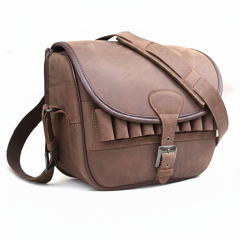 That looks to be a very fine piece. Some day, perhaps, I may achieve such skill. Absolutely beautiful. — AZR
 -
Must be Monday…
ThisIsMyFirstRodeo replied to ThisIsMyFirstRodeo's topic in Leatherwork Conversation
Well, I admit that stitching the strap by hand took considerably longer than I expected. Yesterday I finally finished the other piece of the strap (2pc for a crossbody bag) with only a few more snafus, but it’s done, and it’s for the missus, so the flaws aren’t a concern. I hope… Hope everyone had a great thanksgiving, and may you never burn your bacon! — AZR PS ok, well 3 times I attempted to post a pic of the final piece, but I failed. There’s some irony here… -
I’m calling a Mulligan. Just pierced my thread on the first backstitch. Im going back to bed… Catch y’all on the flip side, — AZR
-
2 follow-up questions: — After thinning, do I need to wait before using it? — And should I expect any difference in how it works? I added acetone to the cement can, and I *think* I stirred it in well enough, to an even consistency with no liquid pooling. Definitely thinner, though I am on the fence about thinning further. But, as a tester, I glued up a small tab for a box (maybe ½ sq.in. if it matters), and something seemed… different somehow. Wish I had the words to describe it. Thanks again, — AZR