bruce johnson
-
Posts
4,401 -
Joined
-
Last visited
Content Type
Profiles
Forums
Events
Blogs
Gallery
Store
Everything posted by bruce johnson
-
Best Place To Buy Jeremiah Watt Or Weaver Master Tools
bruce johnson replied to simontuntelder's topic in Leather Tools
Besides Weaver you can buy Jeremiah Watt tools directly from him as well at www.ranch2arena.com . Only Weaver sells the Master tools and that is their "house brand". You still may be able to buy from Weaver directly with a Danish license. -
FWIW, I think the original Heritage tools were/are cast overseas and came with the deal when Weavers bought Mast a few years ago. The friendly phone folks at Weaver may not always be particularly knowledgeable about their products. Several years ago I added a maul to an order. I asked if Barry King made them because they looked just like Barry Kings. She told me they were made by a local Amish craftsman. Yeah, uh uh. Barry King stamped on the top when I got it. Same with the Heritage tools. They told me that the skivers were made in PA too. Finish wise the draw gauges can be a little rough but comparable to current Osbornes in finish or lack of. At least the bars are solid and not hollow back aluminum like the newer Osbornes. Like I wrote in the other thread you will need to work on the Osborne blades, They don't come ready to use, but come with a fourth of the price tag of blades that are. Once you get them right they do hold a pretty good edge.
-
If you ever get over the Altamont, I'm in Oakdale and you'd sure be welcome to stop by.
-
Anybody Ever Heard Of A Tom Taylor Bench Skiver?
bruce johnson replied to biglew's topic in Leather Tools
Same info as Kevin. I haven't heard of the bench skiver before. Got a picture or a link? -
The Heritage are OK and would be a step up from the other two you mentioned, but then again they are about twice as much money too. They use set screws in the front instead of the traditional slotted screws on the old CS and HF Osborne Latta draw gauges that they are patterned after. The handles are a bit "clunky" with squared edges but you can reshape them some on a sander if you don't like that. Blade that come with it is an Osborne blade. It'll require some work to cut once you get it. SCRATCH ALL THAT! I was thinking about the Master draw gauge Weaver sells and not the Heritage. I have had a few of them and the Heritage are OK. Same Osborne blade in the ones I had.
-
Another hat-trick!
-
Congrats, we ought to have a certificate or something. As one who has been around from the start, Thank You!!! When this started and we hit 1000 members, we were thinking that we may be on to something. Time has proven it, due in total to each and everyone posting here..
-
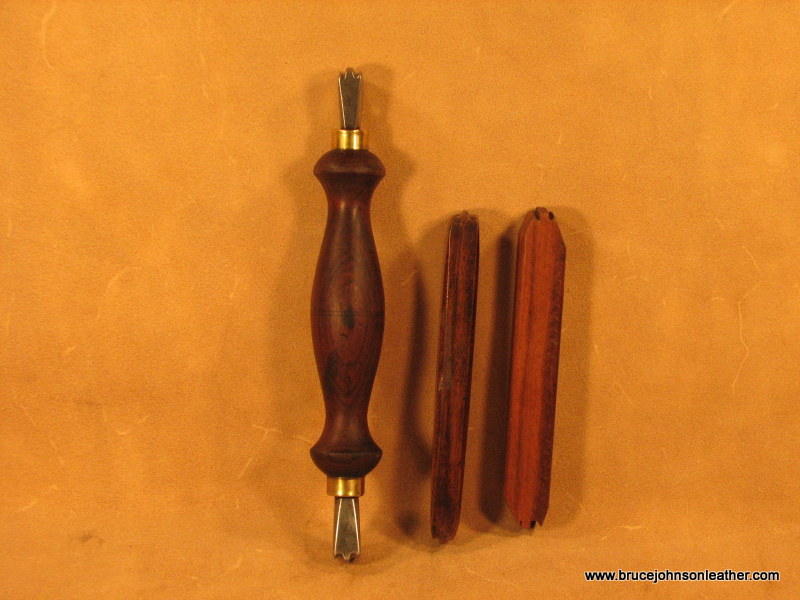
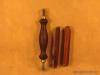
I have a few creasers. Wood is historic, metal can be historic and functional. I have attached a couple pictures of two views of them to compare similar types - apples to apples. Timely topic because the metal and CS Osborne stick in the center both were sold and getting packed up tonight. Downside with wood is that it can chip. Once that happens, you're toast. Metal is durable and if you get a snag, it can usually be polished out. Some people lightly heat the metal creasers to get a better burnish to the crease line. I suspect they originally used chipped and broken wooden creasers for that source of heat. WIth the dedicated single size handled creasers, you can lay into them more to get a crisper line too. Metal can be reworked to get a more rounded profile, wider crease line, narrower crease line, etc.
-
Welcome, from a former Logansport, IN resident!
-
Greg, Usually the magazines have the dates for events. ShopTalk is one and Leather Crafters Journal too. Here's a page from Leather Crafters Journal website - http://www.leathercraftersjournal.com/events.html
-
Chuck, Some of the newer Osborne tools bear little resemblance to even their own older tools. Creasers and bisonette edgers are shining examples.
-
Why No Polyester Thread From Our Sewing Machine Vendors?
bruce johnson replied to silverwingit's topic in Sewing Leather
Campbell Randall has poly too. -
After a few hundred I think I have cracked the code or at least have some pretty good averages. On the regular single line creasers, the size number is +/- 1/32 of an inch. ie. a #2 is 2/32" and #5 is 5/32". This applies to Gomph, CS Osborne, and HF Osborne. The next size range up for Gomph is called "round edge creasers" and for the Osborne bros - "layer creasers". These start with a #1 being +/- 6/32" and each number up from there is approximately 1/32" additional. Double line creasers pretty much follow the size for the single line creasers. The distance between the edge guide and center line is that number in 32nds of an inch. The center line to the inside line usually follows that rule pretty closely, although some maybe be a bit narrower. There is a bit of variation between some individual tools due to manufacturing or wear, but these are pretty good rules of thumb I have found.
-
That would be easy enough to make up from a creaser. I repurpose creasers into push beaders, bevelers, thread countersinks, etc. This fall right in there. I have several sizes of creasers and the tools to do it with.
-
Here is how I do them - http://brucejohnsonleather.com/tutorials/ . Today that page is displaying a bit wonky, but if you click the download link it will given you the complete instructional.
-
I just checked and the Douglas bisonettes are no longer listed in Sheridan Leather Outfitters site. You might call them and see if they have any left that aren't listed. A lot of the information in this thread is a couple years old. To update my portion - I have since put together a pretty complete set of Rosecrans and sold my Douglas set. Nothing wrong with the Douglas ones, I just didn't need two sets. The Douglas ones are closer to the Rosecrans patterns than others.
-
Good job. I'd agree with the perceived hardness on the Rose knives. An old guy told me that "A Rose knife is harder than a whore's heart and stays sharper than a mother-in-law's tongue". He was colorful and very accurate.
-
Sharpening Awl--Point So Fine It Bends--How To Remove?
bruce johnson replied to thekid77's topic in How Do I Do That?
Once you get out to that foil edge you may need to raise your angle a bit to strop that off and leave the sharp edge. -
My apologies for the confusion as well. I had seen a video of a gang type that cut three or four strips at once. I assumed this was the same one - similar but not the same.
-
What is in the link I believe has roller type blades and spacers between them. It is like a gang set up rotary knife. Since the original thread came up I have heard from two people who use(d) similar setups. One had fixed arced blades that cut like a round knife. They had a slot to adjust blade height and account for wear. The other was a shop-made gang rotary knife. I'd be interested if Simon can take a few pictures of his. As of yet, nobody has any.
-
C.s. Osborne Round/head Knife Stamp Order?
bruce johnson replied to leathertoolz's topic in Leather Tools
Joseph English started making tools in about 1826. There are English tools marked only in his name and some marked in partnerships with other tool makers. He sold to Wm Dodd in 1856. Some say sold, and at least one respected source says that English died in 1856 and Dodd took over. CS Osborne was either brother-in-law or son-in-law to Wm Dodd depending on source. Sometime after 1858 Dodd sold to CS Osborne. Even though the lineage of tool making goes back to 1826, CS Osborne was no part of it until at least 30+ years and two owners later. As far as I can tell from most people who have tried to research this, there is no definite lineage of markings either. They may have been variously reused at times to keep things fresh. They added the star mark at one point for a while, usually attributed to the later 1880s-1890 something. The Osborne company was good at marketing. The corporate address changed from Newark to Harrison NJ in about 1906. The knife was part of their trademark and logo, on all their stationary,etc. - "corporate branding" if you will. They may have continued to mark the knives with the Newark stamp up until as late as the World War One. -
Here you go - (828) 505-8474
-
Finally, A Chance To Visit.
bruce johnson replied to BondoBobCustomSaddles's topic in All About Us and Off Topic
Bob, We were there last month. Hall of Fame was nearly a full day for us. We visited a couple shops while we there in the Stockyard area. I worked in Edmond 30 some years ago and things have changed a bunch. A lot of my landmarks were gone which I expected. Tener's is just kind of another store now, I remembered as being a little more upscale. I found more stuff that appealed to me at Langston's. Had a nice talk with a lady in the old National Saddlery store site. We are about the same age and she filled me on what's still going and what's gone. One of the best meals we had on the whole trip was at Gage's Steakhouse in Guthrie. Didn't make it to Cattleman's at the stockyards for brains and eggs but will do that next trip. -
Looks really good!
-
I bought a Boss when they were $1600 and the next powered machine that sewed close to them was about $4000. Simple to use, will sew whatever you can cram under the foot, and mine was from backj in the iron days. I stepped up to an Adler 205 when I could afford it, but still kept the Boss for heavy work. Swapped up to a Ferdco 2000 later on and that is when I sold the Boss. When Artisan brought out the short arm Juki clone for under $2000 a couple years later, that was the game changer for the hobby and small shop market for everyone. I've had three servos and two clutch motors on powered machines, I'd never go back to a clutch. Mine adjust the top speed by a dial. I have speed reducers to increase torque and rarely reach up to hand wheel a tight area. Last year I turned a 12 year girl loose on my 1245. I had it dialed down and she sewed her projects straight as a string. Zero learning curve for her with a servo.