



Digit
-
Posts
117 -
Joined
-
Last visited
Content Type
Profiles
Forums
Events
Blogs
Gallery
Store
Everything posted by Digit
-
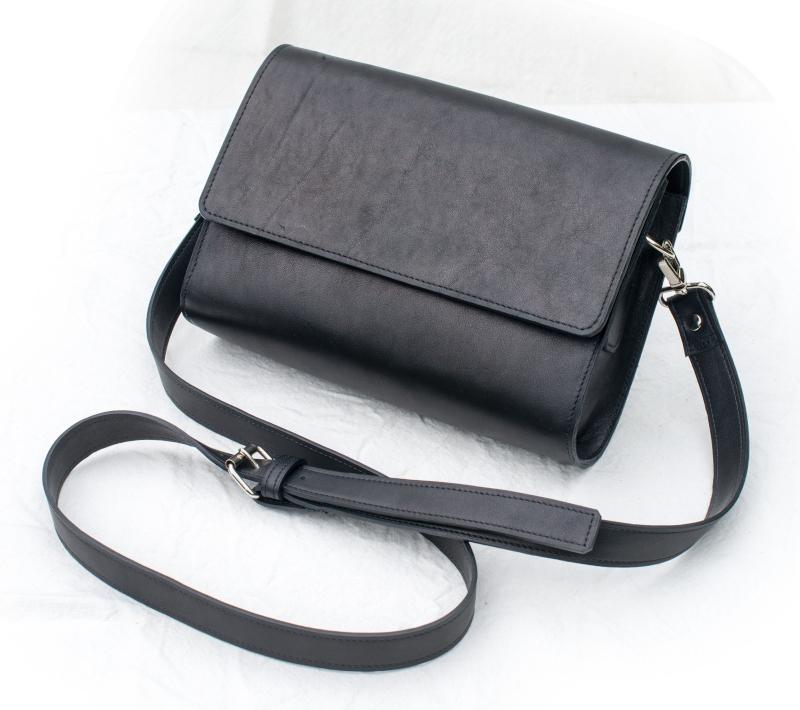
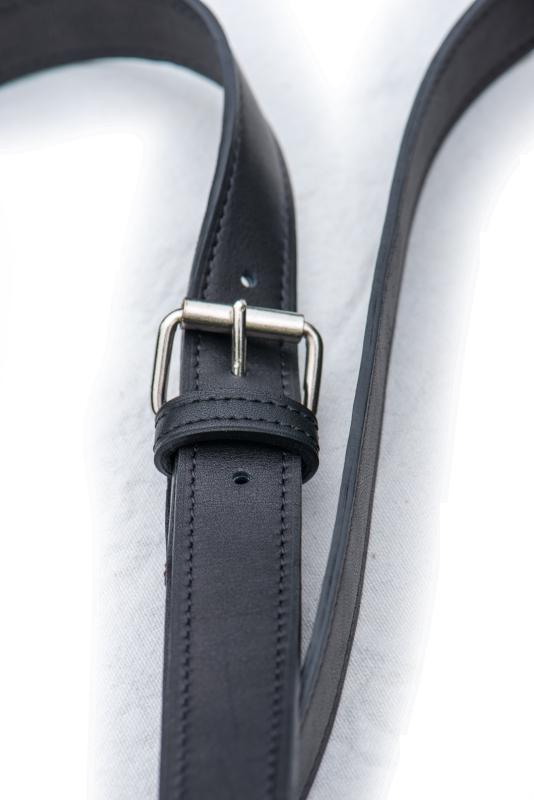
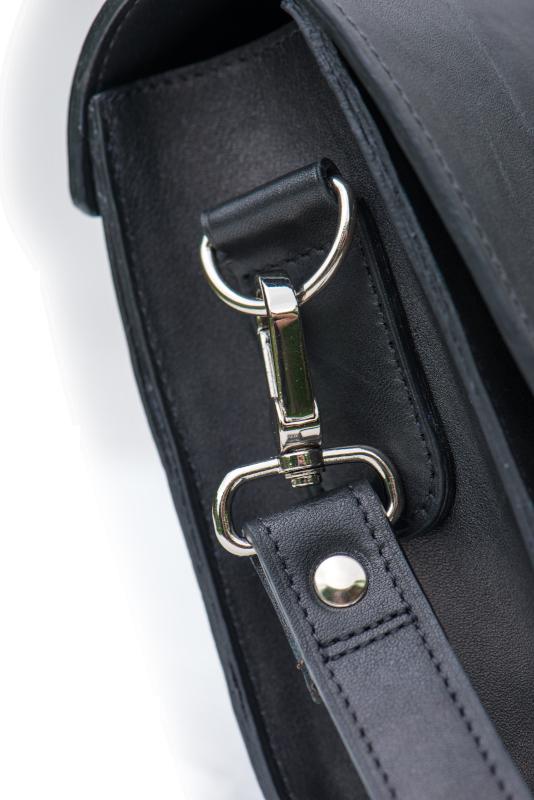
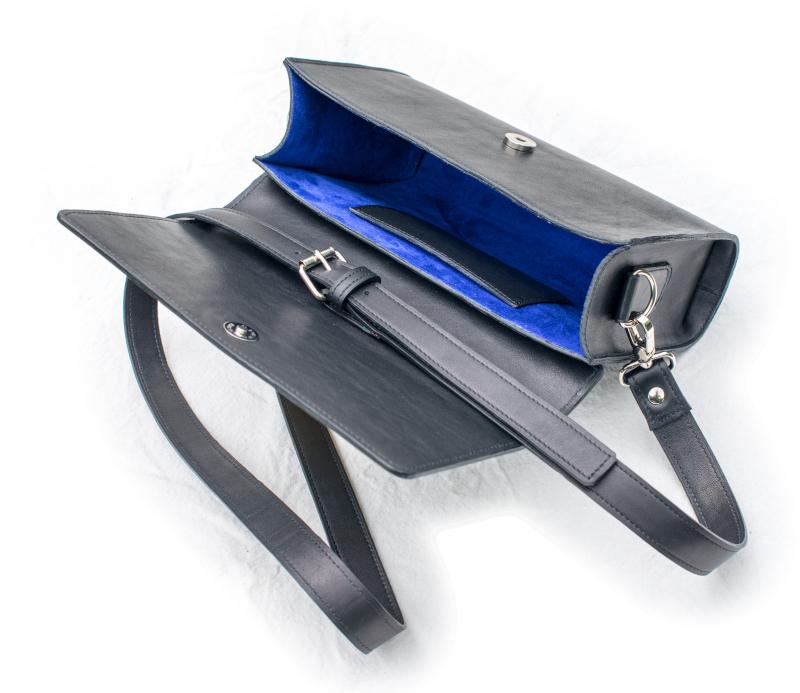
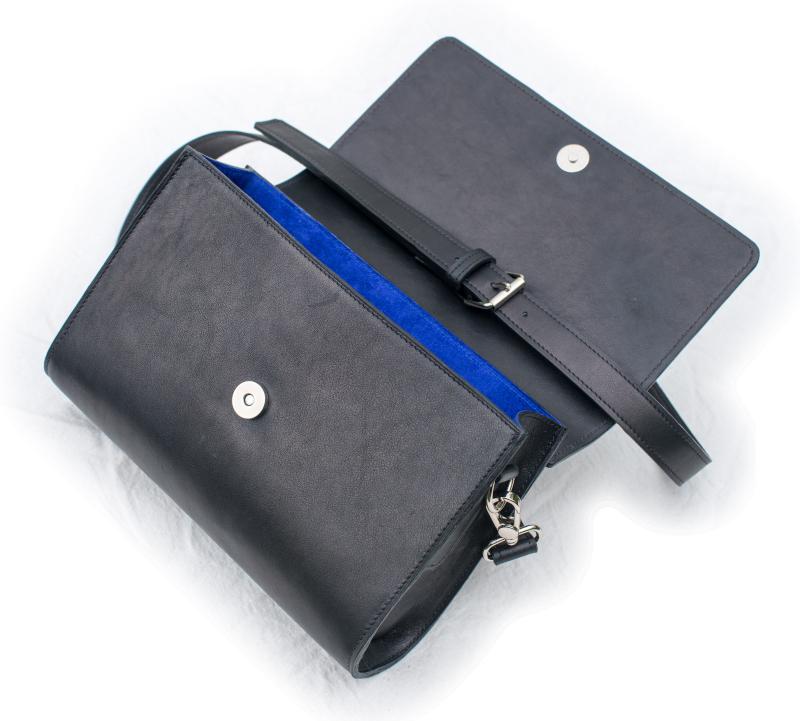
Yesterday I finished my first handbag. It was the last assignment at school this year and I look forward to next year's projects. It's made from black chrome tan cowhide and blue pigskin suede liner. Reinforcement of the body and closing flap with 0.4mm salpa; the leather carrying strap is reinforced with a textile anti-stretch tape.
-
Europe is a big place and there are lots of suppliers. Do you have a favourite country? Most of the shops I order with I found by googling though.
-
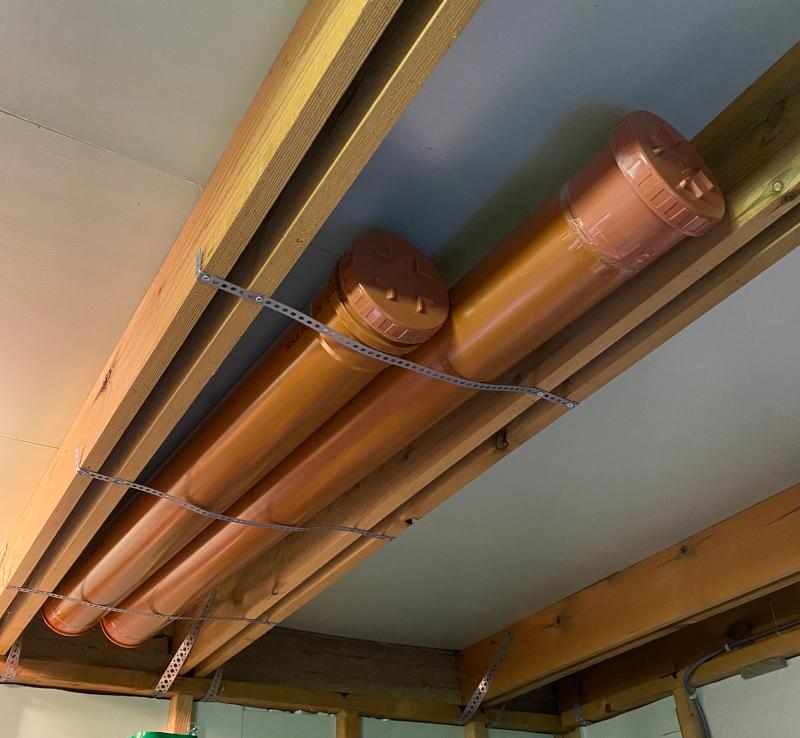
I use PVC sewer pipe (11 or 12.5 cm ~ 4 1/3" or 5") with end caps (one end fixed, one end with a screw cap). They come in 3m lengths and I cut them into two pieces of 1.5m (5'), which perfectly fits a half hide. I stow them away near the ceiling of my garden shed; that's the only place where I have some space left This is an old photo; there's six or seven pipes hanging there by now
-
For closure you could add a button stud. The closing flap looks a bit rough and unfinished to me, but that's a matter of personal preference. I would suggest to do smaller cuts on the roundings so you don't end up with a sequence of straight cuts in the curves. As for giving the bag more volume, you can try the suggestion made by @toxo or you could vary in leather ticknesses: thinner/more supple leather for the gusset and thicker/sturdier leather (or reinforced leather) for the font and back panels. With thinner gusset leather it will fold closer to the stitching line instead of having a gradual curve over the width of the gusset. And sturdier leather on front and back panels will make them resist curving inwards.
-
Adler 68NT Seized - Any assistance/advice gladly welcomed
Digit replied to Ian B's topic in Leather Sewing Machines
I think you'll have to go through a distributor for that. Start with the UK importers at https://www.duerkopp-adler.com/contact/sales-partners/europe/#c4133 and also search for (or ask them) if there are smaller resellers that could help you out. In Belgium there are a few businesses selling industrial sewing machines that have access to parts but I found those by googling and word of mouth; they aren't listed by Adler as reseller. -
Adler 68NT Seized - Any assistance/advice gladly welcomed
Digit replied to Ian B's topic in Leather Sewing Machines
This sliding sleeve is component 068000180, yes? According to the schema there's also part 990420055 nearby: a cotton wick. Probably that wick was supposed to deliver lubrication for the sliding action. If the machine ran dry and heated up, this wick might have burnt and thrown soot around. If so you'll probably need to change the wick and carefully clean up all charred residues. -
Adler 68NT Seized - Any assistance/advice gladly welcomed
Digit replied to Ian B's topic in Leather Sewing Machines
Could it be that the whole blue-green-red assembly is only held in place with the blue bolt? From what I understand from your explanation there should only be vertical motion, not lateral; so one bolt at one end of the assembly could be sufficient to hold everything in place. It's slotted at least, so you could try to loosen it and see if you can wiggle that assembly about. -
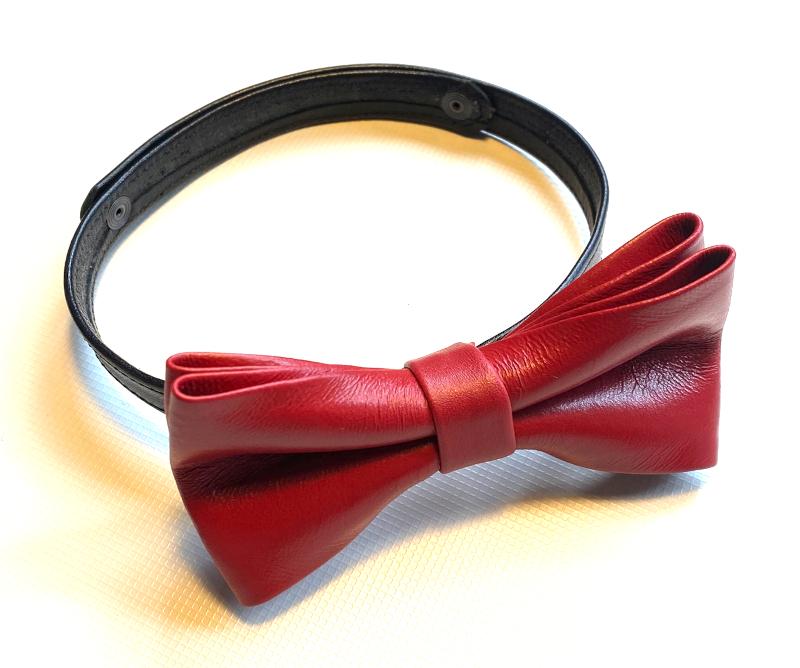
Yesterday I joined the Ghent edition of the Distinguished Gentleman's Ride and for the occasion I wanted to dress up a bit, so the day before a made myself a bow tie. Red sheepskin for the bow and black cow for the collar, both chrome tan. Edges skived and folded over and the collar received an edge stitching all around. Closure with two black 9mm s-type snaps.
-
Renia Colle de Cologne vs Syntic Total a Superfix
Digit replied to Yukonrookie's topic in How Do I Do That?
At school and at home I use a water-based CA. I have no experience with anything else, but I'm happy with the water-based stuff I use (Ecostick 9015st): it hardly smells and it does its job, namely keeping pieces together until they're stitched. I'd never rely on glue alone to keep things together; you always have to sew to make it last. Then again, I have no experience (yet) with wet molding. Is molding glued-together pieces a thing? Most of the stuff I see here look as if they're molded first and then glued/sewn together... -
My Fortuna skiver is mounted on an old flat-bed sewing machine table. The huge cut-out of the flatbed was partially covered with an 18mm (3/4") chipboard, screwed on the original table top and with a cutout for the skived leather bits to fall down through. The Fortuna is hinge-mounted on top of this chipboard.
.JPEG.6416ad19f58b4f9e9d85abfe82139f2b.JPEG)
-
I've recently finished one of the more complex assignments at school: a purse with card holders and coin pocket. It's made from chrome tan goat leather: smooth black outer and suede red liner.
.JPEG.8f95287b1a0a17f3fd7648aeee719225.JPEG)
.JPEG.fb602c6fa86aad6f1add1f08afacb7d3.JPEG)
.JPEG.34155be0cc8292a3e9e1698645702d4f.JPEG)
-
As Hans already referred to, in densely populated Europe, the three-phase power that exits the power plants gets transported all the way to the homes. AC power transmission is three-phase everywhere in the world because using three wires is more efficient than using two to transmit the same amount of power. It’s the last mile from substation to customer that is most expensive and where utility companies need to do the math: is is more cost-effective to put down four or five wires (three phases plus neutral in TT systems or the same plus additional ground in TN systems) or put down two wires? in densely populated areas it’s more efficient to lay down three phases as it allows for more power to be distributed before you need additional substations. In less densely populated areas, you can get away with two wires at higher than distribution voltage and the occasional transformer (eg a pole pig as I believe it’s called in the USA) that transforms down to distribution voltage in split phase (eg 2x120V, allowing for larger machines to be hooked up to 240V).
-
Slight nuance: in the industry motors are built to specifications. If a motor needs to be able to run between a range of rpms, the cooling system is calculated to those rpms. Clutch motors are not designed to provide a range of rpms at the axle; that's what the clutch is for: transform a fixed rpm to a range of rpms (plus heat dissipation on the clutch plate). I'm not saying that a clutch motor can't be speed-regulated; they can, just like any motor; but that's taking them out of their spec and into the realm of safety margins. As long as you don't venture into extremes you're safe. The older the motor, the more likely it has been overdesigned and can take some thrashing.
-
Do you happen to know if those clasps can somehow open or not? If they don't open then I think this seems to be a variation on a hook and eye closure. If they do open they could be a variation on a firefighter closure. If I search for fireman closures I only find carabiner-like closures though. Variations on hook-and-eye seem to be named hook-and-bar, but that seems to be more targeted for pants. Maybe you could search for large/elaborate hook-and-eye/bar closures and combine the hook part of it with an eyelet to achieve a similar look?
-
That's something you get when everyone chips in with their own situation and experiences in mind and little to no knowledge about the OP's. I have one three-phase clutch motor that I managed to drive (at constant speed) using a cheap VFD and I have one sewing machine powered by a servo. I love the servo but a VFD was cheaper to convert my clutch-motor-powered skiver to single-phase than buying a servo for that machine. You have single-phase clutch motors, so you advise in that direction and Hans has a whole shop full of three-phase motors so he advises on a plug-in VFD setup. Everyone's situation is different, so everybody will come up with different solutions. The good thing is that in this way we can all learn from each other. The best the OP can do is to distill all the advice he got and apply it to his situation.
-
@Tigweldor I believe @dikman suggests to replace the clutch pedal with a pedal that controls the VFD and somehow lock the clutch motor into a direct drive (because the OP finds the clutch impossible to control). As I mentioned: this risks overheating the motor because it is not designed to run at slow speeds. If you're going out of your way to transform a clutch motor into a servo-ish motor, then I think it's better to replace it with a proper servo.
-
I've had a positive experience with a cheap Chinese VFD (see Powering three-phase skiver motor), but note that clutch motors are designed for continuous running at a constant speed. Their built-in cooling fan is designed to provide adequate cooling at that speed. If you lower rpm for any prolonged time, the motor will draw more current (increasing heat production) and lower the fan speed (decreasing cooling). The combination will risk your motor to overheat and burn through. You say the clutch isn't operating smoothly. Could it be that it's clutch plate deteriorated from long-time use at slipping speeds? I have no experience with clutch motor clutches, but does anyone perhaps know if these are wet or dry? And if wet, maybe the oil has leaked out and needs replacing?
-
As far as I'm aware there are two different snap designs: s-type and ring-type. An s-type snap has a ball on the male side and an opening on the female side in which two parallel spring bars are visible (on the inside these form an s-shape, hence the snap type name). A ring-type snap has an upright rim on the male side and a loose-fitting circular spring on the female side. S-type snaps have two small contact areas between each spring bar and the ball, so they come apart easily. These are mostly used in clothes for closing pockets or a zipper cover in a jacket. Ring-type snaps have a full circle of contact area and are harder to open and close. Depending on the material from which the spring is made, they come in different hardnesses. My supplier has snaps with a brass ring ('normal') and with a copper ring ('hard'): https://www.lederhuis.com/nieten/drukknoop.php?l=e&action=warenkorb&L=Nieten_Druckknopf If you're using s-type snaps, try switching to ring-types. If you're already using those, try finding ones with different spring material, or larger ones (large snaps have more contact area between rim and spring, so they are stronger). If they still come loose too easily, try doubling up or tripling up on snaps.
-
I doubt it. My teacher used to work in the prototyping department of Delvaux. After prototyping a new bag it goes to the factory in Brussels where people in aprons and white gloves work in complete silence on an assembly line, each performing one specific task over and over again. In Belgium this story was fact checked and considered misleading. Luxury brands typically require subcontractors to sign NDAs. Some of those luxury parts can well be made in China and some assembly done too, but not by the people in the video clips (one of those manufacturers apparently has a website registered only in Feb 2025 and and used to sell Chinese electric cars a year ago).
-
is says "N° SERIE" (the numero symbol), which would more appropriately read as "numéro de série" (French), "número de serie" (Spanish), "numero di serie" (Italian) or any other romance language or English. In German (as in Dutch) I would expect "serienummer" with 'nummer' abbreviated as 'Nr'.
-
A very hard and durable type of wood found easily in Europe would be the invasive Robinia Pseudoacacia (false acasia, black locust). Easiest found commercially as fence posts over here in Belgium, which gives you a nice base to cut (smallish diameter) discs from to then lathe some grooves on.
-
needing some help or guidance
Digit replied to ShortApacheWrangler's topic in Patterns and Templates
For cutting out panels I use a heavyweight paper (200-250g/m²) to create a template to the final size of the leather, place the template onto the grain side, trace around it with a silver pen, then cut out the leather on the inside of the ink. On smooth leather the silver rubs off easily with a damp cloth. -
I've got several of those lying around. One of them is currently powering a workplace heater (a Chinese Webasto clone) off a tranfsormer. As long as the incandescent bulb keeps working I'll use that one. I'm not a fan of flickering LED lights (even with a cap on the rectifier they still flicker).
-
Skill Building for New Sewing Machine Owners?
Digit replied to AEBL's topic in Leather Sewing Machines
If you don't have a needle positioning system, then experiment with turning the handwheel to find the 'correct' position before changing stitching direction or you might undo the last forward stitch on the first reverse stitch. The needle should be down and the interlock made. If the needle is down but the lock isn't made, you're going to pull the top thread right back out and you'll have a hole without any thread in. -
Skill Building for New Sewing Machine Owners?
Digit replied to AEBL's topic in Leather Sewing Machines
Practice makes perfect. Use scrap pieces of leather or very thick textile (folded over to match leather thickness) to test your stitches and thread tension. Experiment with thread sizes and stitch lengths, just make sure your needle size is adjusted to the thread size and your stitch length is adjusted to the material thickness (larger stitches for thicker material). Use different color upper and lower thread while testing thread tension: correct tension means you don't see bits of the lower thread color on top and no bits of upper thread color on the bottom stitch. You mentioned your machine has a servo motor. Does it come with a needle positioning system? If so, practice stitch-by-stitch sewing to get a feel of the pedal control. Also practice stitching at the slowest possible speed. Try to visually align the edge of your piece with the needle plate or presser foot and practice making straight stitches that are perfectly parallel with the edge of the piece or other stitches. When sewing two or more bits together, keeping things in place is the hardest part. With textile you can use pins, but those leave a mark on leather. With leather you can use contact adhesive or double-side tape to set your pieces together before stitching them (just make sure your glue is dry before stitching and don't stitch through tape; both can mess up your needle).