Members LMullins Posted January 10 Members Report Posted January 10 Hey folks, I've been getting pretty deep into holster making as of late. Lot of orders coming my way, primarily for revolvers. It's not too bad to guesstimate pancake holster stitchlines, but there's gotta be a method I'm unaware of to consistently calculate the distance based upon the dimensions of the firearm. Any good resources dedicated to this topic? Would be interested to know how you folks do it. thanks! Quote
Members Dwight Posted January 11 Members Report Posted January 11 If you don't know how to make them . . . you probably shouldn't be taking orders . . . May God bless, Dwight Quote If you can breathe, . . . thank God. If you can read, . . . thank a teacher. If you are reading this in English, . . . thank a veteran. www.dwightsgunleather.com
Members Thadrick Posted January 11 Members Report Posted January 11 This is the book I purchased when learning how to make holsters. I would tell you all about how I do mine but would take all day, start here and itemize your questions in the future. https://tandyleather.com/products/how-to-make-holsters-book?_pos=2&_sid=0419dee1e&_ss=r Quote
Members LMullins Posted January 11 Author Members Report Posted January 11 2 hours ago, Dwight said: If you don't know how to make them . . . you probably shouldn't be taking orders . . . May God bless, Dwight I never said I didn't know how to make them. There's several ways of patterning a holster for a firearm, which I won't be listing here because I could go on and on. Especially for SA Revolvers... I'm simply asking for ways to make the process more efficient and discuss different methods of achieving that goal.. which is a normal part of refining a workflow. That assumption doesn't add any insight to the topic at hand. That’s like responding to a question about better edge finishing by saying someone shouldn’t sell belts if they’re asking. Quote
CFM chuck123wapati Posted January 11 CFM Report Posted January 11 I start with my closest pattern, then use various measuring devices to adjust for the differences, usually keeping the top stitch line of my design as a constant. My most used holster design originated with a 1911 pattern that I made, and I have altered it to accept anything from a Colt Anaconda to a Taurus G3C. The basic methodology was taught to me in grade school, lol, back in the day we were taught to use rulers, compasses, protractors, and such in Geometry class and i didnt forget how i guess. Quote Worked in a prison for 30 years if I aint shiny every time I comment its no big deal, I just don't wave pompoms. “I won’t be wronged, I won’t be insulted, and I won’t be laid a hand on. I don’t do these things to other people, and I require the same from them.” THE DUKE!
Members LMullins Posted January 11 Author Members Report Posted January 11 (edited) 31 minutes ago, chuck123wapati said: I start with my closest pattern, then use various measuring devices to adjust for the differences, usually keeping the top stitch line of my design as a constant. My most used holster design originated with a 1911 pattern that I made, and I have altered it to accept anything from a Colt Anaconda to a Taurus G3C. The basic methodology was taught to me in grade school, lol, back in the day we were taught to use rulers, compasses, protractors, and such in Geometry class and i didnt forget how i guess. Sounds like you and I approach it very similarly. in my experience, semi autos are very straight-forward to work with. 1911 style pistols, Glocks, etc. are always pretty predictable as far as stitch lines and adapting goes. Larger revolvers are where pancake holsters become more nuanced for me. While I haven't had any issues producing a proper fit, accommodating the cylinder does require just a bit more consideration compared to something flat. I'd made a pancake holster for a 5.5 barrel .45 Vaquero and it came out really nice. Revolvers definitely are the prettiest when paired with leather. Edited January 11 by LMullins Quote
AlZilla Posted January 11 Report Posted January 11 15 hours ago, LMullins said: not too bad to guesstimate pancake holster stitchlines, but there's gotta be a method I'm unaware of to consistently calculate the distance based upon the dimensions of the firearm. So, are you making fold over type holsters for these revolvers? Or the pancake? Maybe a picture of what you're currently making would help get focused responses? Quote “Those who can make you believe absurdities can make you commit atrocities.” - Voltaire “Republics decline into democracies and democracies degenerate into despotisms.” - Aristotle
Members LMullins Posted January 11 Author Members Report Posted January 11 20 minutes ago, AlZilla said: So, are you making fold over type holsters for these revolvers? Or the pancake? Maybe a picture of what you're currently making would help get focused responses? I usually make pancake and bucket styles for revolvers. I’m mainly curious about how others standardize stitch-line spacing for consistency and efficiency. Some earlier replies steered the conversation away from the topic, but this is really just about refining the process. Everyone has their own method, and I’d like to hear what works for different people. Maybe there is some techniques I can pick up on. That's why I'm on the site. 😎👍 Quote
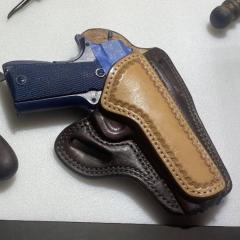
Members Dwight Posted January 11 Members Report Posted January 11 21 hours ago, LMullins said: Hey folks, I've been getting pretty deep into holster making as of late. Lot of orders coming my way, primarily for revolvers. It's not too bad to guesstimate pancake holster stitchlines, but there's gotta be a method I'm unaware of to consistently calculate the distance based upon the dimensions of the firearm. Any good resources dedicated to this topic? Would be interested to know how you folks do it. thanks! There is no real "calculation" you can make . . . what you have to do is take the holster . . . that has been wet formed . . . and then fully dried . . . give it a light coat of neatsfoot oil and let that dry . . . then add your contact cement to both sides of the inside of the holster . . . wait for it to dry . . . place the weapon in the holster and squeeze the sides together. I have a pair of tin bending pliers I use to squeeze the sides together. The holster stitch line has to be as close to the weapon as you can get . . . and again there is no "formula" for it. You use your sewing machine . . . mine is a Cowboy 4500 with only a half foot on it . . . allowing the needle to get up close to the intersection where the two pieces of leather are bound together with the contact cement. As you can see on this holster . . . I got up real close. I have a hand held stitch maker (from Tandy) which makes those lines next to the weapon. All outside stitch lines are made with a typical gouge set for a determined distance . . . then you simply connect the two . . . and you have your holster finished. There is no (A x C) / 3 = stitch line formula . . . or calculation . . . you simply sew it where the leather comes together. Most of the time this will produce a tight holster . . . the customer can loosen it with the freezer bag trick if he wants it more loose. May God bless, Dwight Quote If you can breathe, . . . thank God. If you can read, . . . thank a teacher. If you are reading this in English, . . . thank a veteran. www.dwightsgunleather.com
Members Hags Posted January 12 Members Report Posted January 12 Long answer. For pistols, I trace the pistol, measure the width of the slide. 1/2 of that plus 1/2 that of the leather used. Allow for mag release on the back ect. Shorten just a tad at the lower end of the trigger guard. This is for a pancake holster. 1 inch to the inside of the belt loops. The stitch line stays the same for a drop holster. For a chest holster, I figure the balance point and place attachment points accordingly. For a revolver. There was a very good video of this and if I find it I will attach it. I build up behind the top of the front sight to the height of the sight to the back sight. I use thin plywood or a dowel rod, tape it down. Then trace the gun. I take 2 narrow pieces of leather the same thickness I'm using for the holster, and connect them at one end. Rivet or stitch. Draw a mark where they connect when parted. That becomes your line of reference at the sight line. Hold this along the sight line and starting at the trigger guard, make a mark where the leather touches. Proceed down the revolver every place it narrows to the end of the gun. Go to your tracing and transfer your marks. Placing the sight line mark on the sightline working from top to bottom. This will be your stitch line. I believe it was Adam's leatherwork that did the revolver video. Just my 2 cents worth. Quote Not so retired RN. Living on the Washington Peninsula.


Recommended Posts
Join the conversation
You can post now and register later. If you have an account, sign in now to post with your account.
Note: Your post will require moderator approval before it will be visible.