.jpg.d60258221c476480a6e073a8805645bb.jpg)

bruce johnson
-
Posts
4,407 -
Joined
-
Last visited
Content Type
Profiles
Forums
Events
Blogs
Gallery
Store
Everything posted by bruce johnson
-
"close contact" western saddles
bruce johnson replied to bruce johnson's topic in General Saddlery Discussion
Rod, I think in many cases it is a marketing ploy. Also I think "close contact" means different things to different people. Some of it goes back to the day of the big skirted show saddles, and heavy plugged skirts. Add a full stirrup leather, lined fenders, and thick pad and you do have to make an effort to hit the horse. I also think it is a response to the way ground seats are/were put in a lot of production saddles. They use a fiberglass strainer that is exactly the same each time. They use clicked out and lightly skived buildups and each seat is the same as the next. On a spready tree and leaving the buildups full to the bottom of the bars just makes a wider seat. You used to see a lot of western pleasure riders with their feet braced out, and they are sitting pretty straight and shoulders back. Made for a nice picture, but getting a leg on the horse was pretty tough. When they tried to ride that same saddle/way for a reining horse - didn't work. They needed something narrower and less bulky under and in front of the leg. To a lot of cutter/cowhorse people, close contact may mean sitting closer to the horse now. Usually these saddles may have the seat right on the strainer. Thin flexible fenders, half leathers, and a narrower seat from a narrower bar pattern, thinner bars, and minimal groundwork down the bars. I wish I had one of those old Billy Cook cutters from the early 80s to dissect. They were like riding a barrel. I am not sure if the bars were flatter and wider, or if it was a ground seat issue, You were beating your backside, and splitting your hips with a hard stop. Some of this probably has to do with the evolution of the horse and changing bar patterns. We have gone from the flatter-backed old-style horses to the narrower ones. Seems like the majority of the Doc Bar influenced horses are narrower than the old Hollywold Gold and Poco Bueno breeding. Regarding the narrower bars. One thing I found. I ordered a couple trees from a supplier. Both Wades, one was a for a woman. At least some of their trees go into a Wade targeted for women, and this was the tree I got. The overall difference in wdth measured straight down from the top was about 1/2" narrower. Each bar was 1/2" narrower measured across the narrowest point, but the angle minimized the effect. Is that 1/2" narrower measurement significant enough to be noticeable? Don't know. I also am not sure about how thin is too thin. Probably not a factor until you break one. Like Blake responded on the cutting tree pics I posted, some of these break in the stirrup slot area, Probably more from stress of the bridging and unsupported weight of the stirrup leathers than scored rawhide. I am pretty sure that thin bars and throwing a 1" pad on with a top blanket is self-defeating. My thoughts would be thicker bars that really fit and a thinner pad would give a better result. -
Vandy and Luke, Welcome to this forum. For those who have not been in the shop or dealt with Sheridan Leather Outfitters, they are one of the good suppliers out there. They sponsor a social get-together/BBQ during the Sheridan leather show. They stock a lot of exotic leathers, and have a large line of leather conditioners and hard to find things like SS nails in several varieties. They have a full line of saddle hardware and buckles. Tools by Barry King, J Cook, and a good guy named Bob Douglas. Good people to deal with.
-
To carry this thread over from another section.... A few observations I have with some saddles being promoted as "close contact" western saddles. Skirt shape - a lot of these saddles, especially the western pleasure saddles have cut-outs of varying degrees and shapes under the fender. My thoughts are that on at least some of these, the cut-out makes little difference. the width of the horse determines how far in my legs hang somewhat. It is above my knee somewhat in an area I can't bend inward anyway. Some of these have a dee ring rigging (bulky silver clad rings) on the skirts and when wrapped with the latigo can be a barrier to free forward swing of the leathers. Others are skirt rigged with "J" rings that are riveted into the skirts. Ground seat - Some of these are not much more than a narrower ground seat. Some of the saddles shaped specifically for women or the close-contact models have a narrower pinched ground seat. The ground work is tapered out onto the bars higher, rather the maker's normal seats that carry the ground work down to the bottom bar edge. Also the ground work on top of the channel may be thinner than normal, sitting you closer to the bars. A lot of the cutting saddles are like this - a one or two layer buildup in front, and nothing over the strainer but the seat. If the bars are like the cutting tree I showed, and are a good inch plus off the horse, the bars themselves negate getting you closer to the horse with a thinner seat on top. They need to be closer on the bottom to start with. Trees - First off the tree needs to fit the horse. Too wide and it is closer to the horse, but probably riding downhill. Too narrow and it is sitting higher than it should off the horse. Some tree makers have bar patterns that are narrower through the "waist" of the tree than their normal. The bar width might be up to 1" narrower. since the bars are set at an angle, the total reduction is a bit less than the reduced bar width, viewed from the top. Again, is that reduction in width in an area the rider can notice? Seat leather - Some of these show and roping saddles have lined the seat jockeys pretty heavily. Adding a liner of 10 oz leather under a 16 oz seat jockey is not conducive to closer contact. It is one thing to hang out to the right throwing a rope, another to go around a ring showing a pleasure horse. Cutting out a skirt, and having 26 oz edges on the seat jockey are probably self defeating. I have gauged a roping saddle with 28 oz seat jocky edges, 32 oz rear jockey, double plugged skirts at 34, and flanky torn 10 oz rigging leather. The rigging blew out while the horse was tied to the fence, not to a calf. Pads - Bulky pads are another issue, and there are close contact cut-out pads too. Just because it is an inch thick but has a cut-out, seems like it raises you up that high and away at the same time. Does anyone else have any thoughts on what they see or do to make a rider closer to the horse?
-
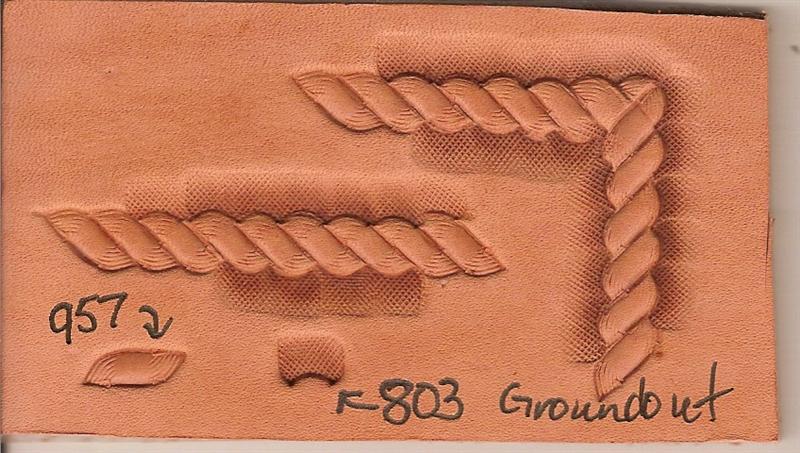
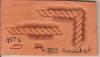
I had a couple off list emails regarding making the beveler. This is NOT the same as the concave bevelers from Ellis or others. The curves on their stamps are not as sharp. You need a sharp curve to match the radius of the rope. The stamp also has to be wider than the curve, to avoid chatter marks, they have to overlap the previous impression. The reason I chose a Tandy beveler was simple, I had some extras to play with and they are inexpensive. Basically grind the proper curve, and "point" the corners a bit to fit into the impression. I polished it up on a wire wheel to soften the edges after grinding. I have made similar modifications on crowner stamps by grinding back the corners and rounding them to steep bevel scallops on flowers and leaves. Bevels on ropes or scalloped flowers and leaves can sure be done with narrow bevelers and walking them around each curve. This gives me the same effect with one hit, and improves efficiency. One other point, the wider bevelers need to be hit pretty level. The example piece I did was on some scrap last night, after a full day of beating patterns. You can see edge marks of the beveler on some impressions where I did not hit square. On a real pice, clean the marks up.
-
Pete, Because of the stamp design, it only slants that way. If you try to go the other slant, the "points" stick out. No left twist stamps available that I know of. (BTW - another of Don King's contributions was being one of, if not the first, to develop left twist ropes for left handed team ropers). To line this stamp up, I prefer to stamp with the guide line vertically and go away from myself. I can visualize the angles better that way. If I have to go horizontal I go right to left. I always want to see the previous impression to line up against. If I go the other way, my hand holding the stamp tends to cover it a bit.
-
Steve, Welcome to the forum Excellent work, thanks for sharing it with us. I imagine he probably will remember this birthday present, beats a pocket knife, shirt, or power tool any day.
-
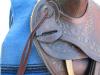
Rod and Denise, The front is pretty interesting. The front of the seat tucks in under that tab on the front jockey. The strings go throught the seat front and front jockey before the latigo carrier and conchos. The front jockey is tacked underneath over top of the front front rigging. Kind of a cool look. It trails back underneath so the stirrup leather rides over the top of it and doesn't butt into it. The EZ dees were a Hamley deal, patented in about 1915-1920. They seemed to be pretty popular back in the day, and I can't recall a bronc saddle that doesn't have them. Kind of like the big ring riggings, some of the old-timers ran their stirrup leathers through the ring to bind them forward. Probably forward of the latigo lump for sure. I am kind of a fan of not having skirt underneath my latigos. Two schools of thought. One is that the skirts protect and distribute pressure of the latigo and ring over a larger area. My thought is that eventually that lump presses through, the edge of the skirt is putting pressure on the horse's side where the latigo crosses it, and it lays up higher to catch my stirrup leathers or buckles. Depends on what a customer likes, but my preference is cut-outs or dropped riggings. Interests me that one some of the "close contact" skirts the riggings lay on the skirts, but the cutout is under the rider's leg. Good theory, but where the cutout ends on a lot of riders is about 2/3 of the way down the femur. I don't have a joint there that would allow me to take advantage of that cutout. It could come down another 3 inches, and I would still be just as much in contact with my horse. If you can get closer contact there, then the front rigging is a pretty good fence to get over to get your legs up forward. Selling a concept and not a reality. There is enough wood, leather and pad between me and the horse from the knee up that I am not sure he knows that I have contact above the knee, I use my lower leg for cueing and contact. Probably need a new thread for close contact huh?
-
Pete, Yep, I do a lot of these. Not that hard to master, but a couple tips. First off I use a scribe line for a border. I don't like a cutline, and want my ropes to look like a rope laying there on the ground, not pushed into the mud. I want it to stand up. I bevel the edges of the pattern. To bevel I took an off-the-rack Tandy beveler and ground out a curve on the face to match the curve of the rope stamp. I used a Dremel with the tapered stone to fit the curve. I have three bevelers for the different rope stamps I have. I also had Barry King make me three custom sizes of his "leaf cutter" stamps that match these curves. Makes beveling leaves and flowers a snap when I use them to cut the pattern. Another story. I lay out the border, and stamp the rope in at the angle shown. I eyeball it, and couldn't tell you an angle. I then go through and match the curve in the beveler to the curve in the rope. It also cleans up an impression if one of the ropes gets a little out of line. The example is exaggerated with the beveling, but you get the idea. I also showed I do a 90 degree corner. Probably at least half of what I do has this border. I like this style of rope stamp. I haven't seen the new TLF ones live, but the impressions and examples don't look like they are what I would like.
-
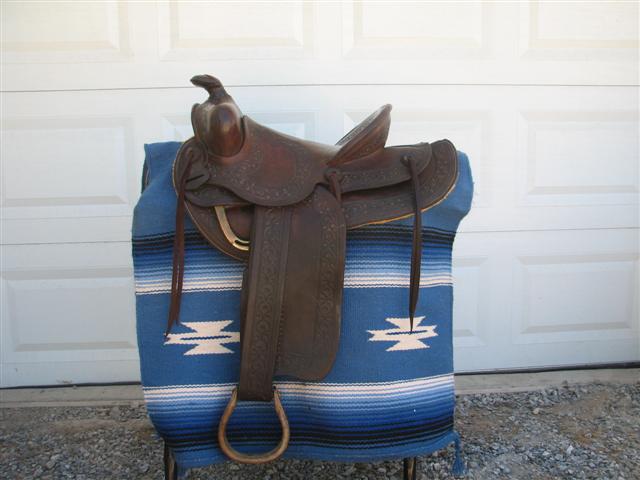
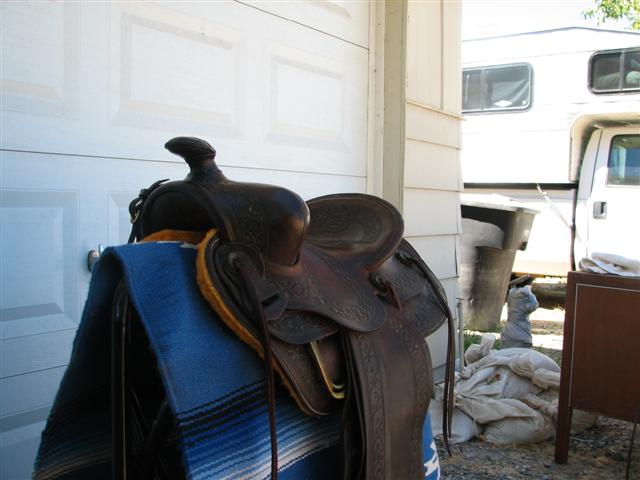
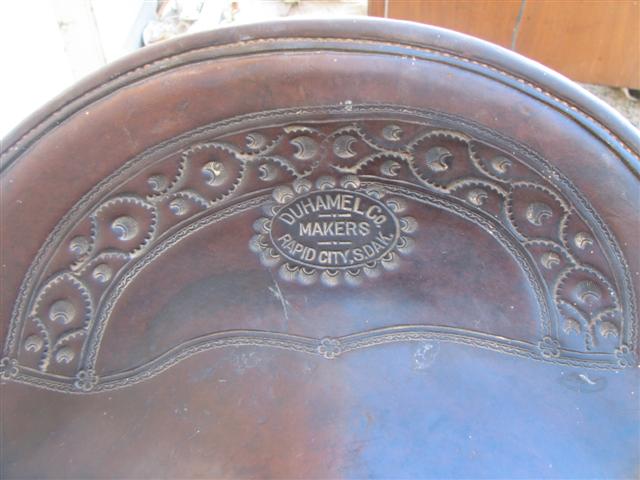
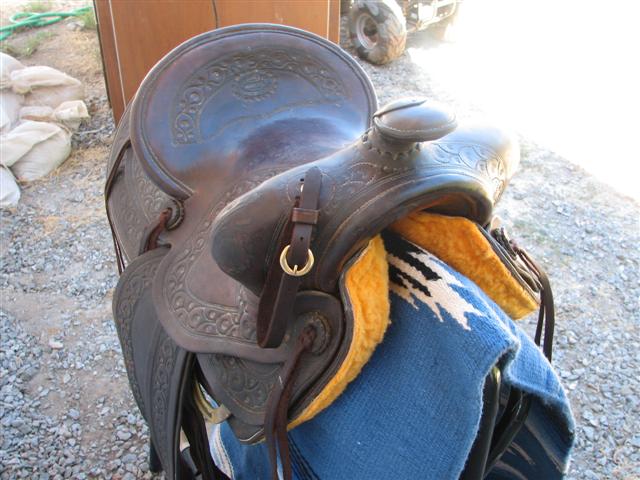
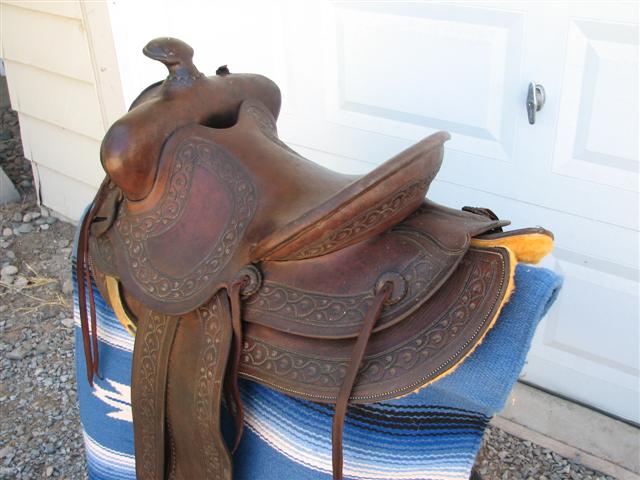
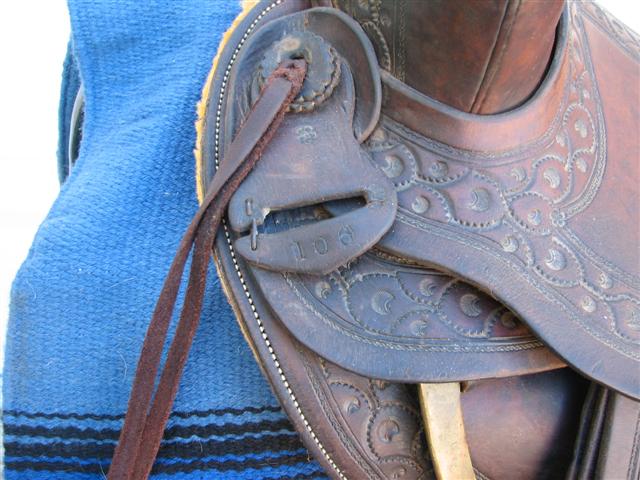
I recently restored my great grandfather's saddle back to as close to original as possible. My great grandfather fed a lot of cattle in southeast South Dakota, and bought feeders from Montana. They would load them at Miles City and ship them. When fed out, he sold them at the terminal markets, usually Chicago. In the early 30s he asked that they send a ranch horse with a load of cattle. The horse came off the train saddled with this Duhamel. The horse was always pretty broncy, and the joke was either the cowboy was glad to lose the horse, or sad to lose the saddle. This saddle has been handed down, and my son made the 5th generation to use it at some point. Duhamels has a general supply type store in Rapid City, with a full saddle shop. They made saddles under their name from 1909 into the 50s. They never serial numbered a saddle, but stamped the tree style on the latigo keeper. They use leather from Hawaiian hides (no grubs), but no mention of the tannery. Their trees came from Ruwart of Denver and Newton Bros of Vernal UT. Reported that both the Newton bothers were blind, but made great trees. One maker recalled that the 106 saddle was made on the Ellensburg tree, and was popular into the 30s. They called the stamp pattern an acorn as a few other old catalogs did, but most shops called it a shell border. These saddles were 3/4 single rigged with EZ dees. This saddle had undergone some changes. AlRay buckles were added later, and I had made some short fenders/leathers for my son when he was younger. I took the AlRays off and and laced the leathers. The stirrups are some brassbound oxbounds I found in the rafters of the hayloft before the buildings were sold. I took the stringwrap off the horn, and the underlying leather is pretty good. Normally I don't like to reline restorations, but the sheepskin was rotten and there was insect damage. Other than the strings, lining, and rope strap, everything is pretty much original. I like to use Hide Rejuventor on these. It seems to condition without getting too oily, waxy, or shiny. I usually just knock the crust off the hardware, and let the age it attained show through. I left the latigo carrier and the baling wire fix on it. It still shows the 106 stamp. For disply saddles, like in a living room, wooden quilt racks work well. Put a blanket over it and it works well. Less expensive than a furniture grade saddle rack.
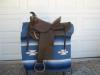
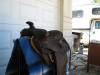
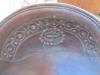
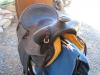
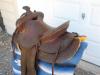
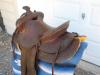
-
I use my heavy maul for setting rivets, driving punches, and that sort of thing. I use my 2# maul for the bigger block stamps. Most of my stamping is with a 1# maul, and the bigger baskets and medium blocks with a 1-1/2# maul. I could probably justify a 12 oz maul at some point.
-
Luke, Sorry for the confusion. The blades from Bob Douglas are for the draw gauges, not the strap cutters. I expect someone could order the blades directly from Bill Buchmann, but I don't have any contact info for him. Bob usually has something or another I have been looking to upgrade, so it was just easier to order through him. Bob's number is (307) 737-2222. If you hve trouble reaching him, his daughter Vandy owns Sheridan Leather Outfitters. She might have them too, or can tell you when Bob might be home. For the strap cutters, I usually use injector razor blades once I have used up the blades that come with it.
-
Pete, The "Original" strap cutter may have the word original burned into the tp of the handle. They may also have "The Strap Cutter". Some of them are on ebay as new in package. They can be bought at some of the independent leathercraft dealers. They have moved around a bit. I have one marked from Palo Alto, CA, and I know they made them down the road in Stockton for awhile. The new ones from TLF have no makers markings on them. Two of the new ones were OK, the others weren't. A guy could shim them to guide OK. They just didn't track the way they came. I have the same trouble with a no-name draw gauge. I just need to let it sit out this winter and rust up, then sell it as "vintage" next spring.
-
WHICH FACTORY MADE TREE IS BEST?
bruce johnson replied to cowboygear's topic in Saddle Supplies, Tools & Trees
At least on Rod's trees, Sheridan Leather Outfitters has a drawing from interested customers when trees come in. They pull your name out of the hat, and you have first opportunity to buy the tree. I got one that way a couple months ago. It was what I would have ordered, so it worked out. I agree with Darcy that Bowdens are probably the most consistant and better quality of the factory trees. I have had some problems with Hadlock&Fox, but they have been bought and moved since then. Superior is not the same Superior that was in Colorado. Enough said there. Other sources to consider that are a step up. Sonny Felkins in Monticello UT and Timberline in Vernal UT are priced a little higher than the factories, but in my hands generally have a better product. My last Timberline was about $250-260, and the last from Sonny Felkins was $325 last fall. Bar and swell patterns seemed to be really close to each other. -
Regarding the roller cutters. use them all the time. They also do well with pinking blades. I cut up to skirting leather with no problems with the 45 mm blades. Sometimes they wont cut all the way through 16 oz if they are riding on a metal straight edge, but the partial thickness cut will guide the roller on a second pass without the straightedge, or use a round knife to complete the cut. Now the wooden strap cutters - another story. I have two of the old maple ones made by the "Original" maker. They work well and track good. I bought a few from TLF from another source - feels like pine? They had them on special, and I figured I could just leave them set up for common widths. The blade slots on 2 were not parallel with the handle. One tracked in and one tracked out. Something to check for. I have a couple of nice older draw gauges - an old cavalry 6" Osborne, and a wood insert handle 4" Osborne. I like them. I got some blades from Bob Douglas for both. The blades were made by Bill Buchmann. They are the real deal. Sharp and hold an edge for me better than the Osborne blades. Draw guages demand respect, but the exposed blade can be started in a cut line in the middle that the protected strap cutter can't.
-
I got to look some more stuff up. On the Wade tree, a pretty good little history of it is at www.cowboyshowcase.com/wade_saddle.htm. Pretty well jibes with what I recalled from a conversation with him quite a few years ago. Interesting they wanted to call it a "Dorrance" and he wanted it called a "Cliff Wade". I didn't know Tom very well, but that fits with what a lot of people say about him. I did find out that the Meanea repair horn was patented in the 1880s also. Darcy, that is a cool saddle. Thanks for posting the pictures. Interesting leaves. A lot of the Visalia leaves don't have a center stem. They had a single cut line, double beveled, and the veiners radiated out of that. Someone could probably almost tell the stamper by that. Any closer idea of the age? Walker died before 1900, but they used the name stamp off and on through the years. I saw one today seat stamped with the DEWalker, and stamped with the SF mark on the cantle back along with the serial number. That seems to be pretty common. The only problem on this particular saddle, they had a shoe repair guy cut about 1-1/2" off the back of the skirts to shorten them up a few years ago. I only have one of the Visalia catalogs, a reprint from 1938. They show a model #858. They call it the "Guadalajara" with a short post horn, so they were putting the post on the 3-B at least before that. Griff Durham could probably pin things down pretty close.
-
Cowboygear, In short - Hamleys made the second one and an improved third one. Cliff Wade was a neighbor of the Dorrances in Oregon. Cliff had a saddle that his dad brought from somewhere else. Tom Dorrance liked it, and had Hamleys copy it. He didn't like the first one they made, and had them redo the tree a couple years later. I think he said this was late 30s/early 40s as he remembered. The Wade has gone through a lot of changes since then. I don't know of anyone who is credited with making Cliff Wade's dad's original saddle. Regarding the metal/wood horns. Wood horns were the norm in original trees. They were not always the post horns like the mexican saddles, but a more shaped horn that was prone to breakage. I think I read that Meanea (of Cheyenne roll fame) patented a metal repair horn that bolted over the broken stump and was sold as a repair horn in the 1880s. Within a few years, the metal horns were the norm, either polished and left plain or leather covered. Anybody feel free to correct me, I am going off a conversation and memory.
-
Greg, LOL. Yep, what ever keeps you in the saddle will keep you out once you get loose. April, 1989 - Riding a "California stocksaddle" with slight equitation build up - keeps you in place front to back in hard stops - net result - fractured L2 and L3 vertebra when the colt decided to buck instead of turn the cow down the fence. November 1993 - Cutting saddle - This colt told me for 3 laps he was going to buck, I over-and-undered him to see for sure, bad move. Fractured pelvis, subluxated sacroiliac, and after he broke my pelvis on the cantle, sucked back and kept me in the buggy. Sixteen inches of pretty flat seat was a good sized target to slide back into. I wish he had bucked me off, then I wouldn't have had to figure out intentionally how I was going to get off him by myself. Finally grabbed the fence and let him go out from under me. Multiple other sprains, strains, and pulls from other wrecks, but that is the basis for getting old and having good stories. Just finished restoring my great-grandfather's Duhamel, my son made the 5th generation to ride it. I have a 1928 Hamley to restore next. It is not a contest saddle, but is built on the Association tree with a single EZ dee rigging. It came with the paperwork - copy of the order and estimate form, and the receipt. Every once in a while I will see a contest saddle in a museum, pretty cool. Did yours still have a horn? I'll get some pics of the Duhamel tomorrow and put it over on the restoration section.
-
Never rode an Aussie, but have seen "The Man from Snowy River" movies several times. Glad it wasn't me going down those hills. Bucking rolls generally sit a little further back than swells would be on a fork. They are softer (usually stuffed with hair, wool, or fiber of some natural or artificial origin), and bruise you less than swells. More to lean into or a safety valve to keep you from contacting the horn if you are pitched forward. Bucking rolls are also loose enough that you can't get quite the grip you might get with undercut swells. Personally I like the look of most rolls on a slickfork, and think they look "naked" without them. Undercut swells will let you get a grip under them and kind of "lock-down" into position. Straight sided swells will not give you much grip, and mainly serve to bruise up your thighs and sort of protect you from going over the front. Kind of a fence to bounce you back into the cantle. Most swell forks are good to lean up into to get forward and rope. Usually swell forks are longer than bucking roll seats and give you more room to rattle around. Biggest problem is that most swell fork saddles have limited forward stirrup swing. It is pretty hard to get forward with your feet enough to get a grip under swells on some of them. There is some debate who did the first swell fork saddle. I have heard Marsden (?) from The Dalles (?), OR credited. The first swells appeared to be like a wooden ball cut in half and screwed onto the fork. Then like everything else, it went to extremes with the Form-Fitter wide swells, deeply undercut and wrapped back over the thighs. Combined with a short seat, and high cantle, made it easier to lockdown and harder to buck off. The high cantles were the back-biters we talked about a while back. Rodeo committees finally got together to standardize the saddles used in bucking horse contests. They came up with the "Association" and Hamley got the first contract as I understand it. The basis of the Association tree originated with the Ellensburg tree. There were standard measurements allowed, and several contractors and rodeo committees used them. In fact, at most of the early rodeos, you rode their saddles, you didn't pack your own.
-
Regarding the increasing popularity of Wades, Rod and Denise hit it on the head. They have been popular in the great basin area for quite a while. Since slickforks were the original saddle tree style, they just maintained popularity. Ray Hunt took the show on the road, so to speak, and introduced Wades to other parts of the country. Other clinicians have followed suit. There are several versions of Wades - slightly different fork styles. Probably the biggest reason for the continued popularity of Wades in the west is the bar patterns on the truer to form ones. Generally more surface area on the horse than most swell forks. The great basin is big pasture riding, and so it followed that the bigger bars put less strain on the horses just getting around. When you have one or two saddles and order them custom, most guys order something that has been proven. Not so much for the off-the-rack buyers. Agreed that some swell fork bars are not a problem, but it is pretty hard to look under any saddle and see if the barpads are adequate. There are some swell forks built on good trees, and some have pretty small bars. There are a few varieties of slick fork bars - Northwest, Wade, etc. Each treemakers patterns are probably a little different. I read something I think Greg wrote that Wade trees are probably the most bastardized of any tree style. There are the Homesteads, Cliff Wades, '58, Denny Hunt, help me out...There are a bunch. With most people it comes down to looks. They see Buck, Ray, Bryan or whoever do some pretty cool stuff with horses, and want to be like them. Yeah, it might be a fad for a lot of people, but there is a definite purpose other than looks for the slick forks to survive.
-
John, I likewise escaped Indiana, but it was 23 years ago. Good old days, no divisons in high school sports, You knew where you you were going to be every Fri night all winter (HS basketball games), and snow sucked. I escaped Purdue on May 14th. On May 16th I was headed west. Where did you slip through the "corncob curtain" from? Glad to have you here.
-
Savage, Phone number I have is (307) 737-2222. There is an email address in ShopTalk's Big book, but we can't post email addresses in open forum. Easiest to get him on the phone, and pick his brain while you get the chance.
-
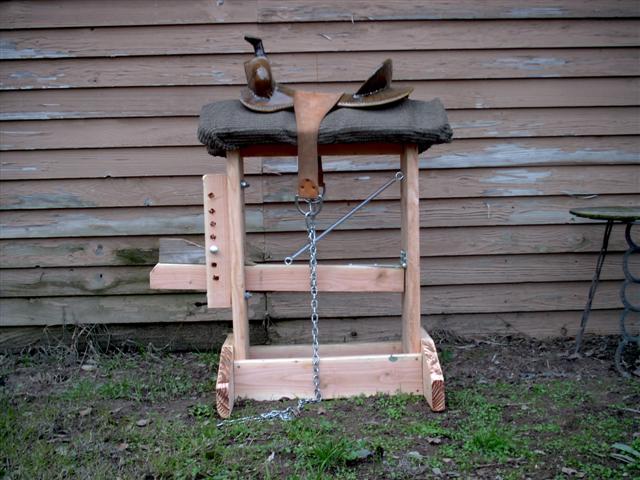
Gay, My stand from Ron's Tools has an arm that raises up to tip the tree at different angles. The actual top doesn't swivel like the Weaver model. The Weaver pivots in two directions. The arm is an OK feature, but not an absolute requirement. There is not a wooden stand that raises up and pivots without raising the base. Millions of saddles have been built on them. If I needed to tilt the wooden stand, I put a something under the front or back. The biggest reason I had two drawdowns of different heights was to make the different things easier. The lower stand was good for shaping ground seats and doing fork covers and cantles. The tall one was good for sewing horns and cantles, installing strings/conchos, stuff I would have been bent over in one postion for a time on the lower one. One thing I would do if I was making my own. Make a contoured top to set the tree in. A rocking tree is exasperating. The shape will hold better. The Weaver has a flat plank with some kind of rupperized cover. Trees rock, and slip occasionally. One of my friends says always at the worst time.
-
Gay, The pictured stand is 46" high I think. I originally made one out of a saddle rack that was 39" high. Between the two, I was able to do what I needed without excess bending. It was nice having the height differences. The issue was that I had two drawdowns, they took up twice as much room, I was always moving from one stand to the other to do what I needed more comfortably, and it there was always a saddle on the other stand. This spring I got a hydraulic stand and would not go back. I sold the lower wooden one, and kept the tall one to set stirrup leathers on repair saddles, or other minor things if the hydraulic was being used. It is still out in the shed I stuck it in. Makes a dandy rack for saddle blankets and pads at the moment.
-
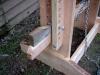
Gay, The metal combs like Greg is describing are pretty easy to adjust, you can just step on the bar and kick it over into wherever you want. Most any welding shop should be able to make one up for you if you don't have the tools. I made mine a little different on the wooden stands. I have attached some pics. The bar hinges off the back. I drilled a series of holes in the front. I put a gatepost bolt or piece of rod through the holes over top of the bar, and then stick a wedge in over the bar/under the rod to provide tension. The further you pound it in, the tighter the tension. Not as quick to adjust, but these parts are all available at the hardware store or lumberyard.
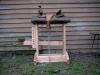
-
Rod and Denise, Even with just hand pressure, the rear points dug in. Quite a lot worse going around corners with more pressure. Pretty sure they probably didn't like it much. Good point about seat length measurements vs. thigh length measurements. Your articles should be standard issue on tree measurements should be standard issue. Greg, Can't agree more. Although looking at the trees from the 30s and 40s, they have been pretty well made and substantial, just designed to fit a different horse. There are probably more junky makers right now for sure. Trees for $99 on ebay, supposedly same maker as some factories are using. Saddles by Billy Shaw for $400. Yep, a lot of bottom enders making for that market. The consumer is mostly ignorant of what is happening on the bottom side of the tree. But it says QH bars on the saddle tag, they own a quarter horse, so it must fit. LOL. Alan, I have to agree. I tried to get my horses to flex up into the tree. didn't happen to any great extent. Also, I am not sure with where the bridging is on that tree, that a horse has all that much flex in their back usually. The only good thing is, I am pretty sure the stirrup leathers are not going to rub. This has made me seriously consider any need for room to round into. A lot of these has been "a guy said..." or "Leddy's trees are like this..." and we just accept it. Yes these horse are doing extreme turns 20-30 times during their event, but are they filling in these areas then?? Are most of the cutting saddles built on similar trees? Mine has more rock in the bars, but haven't tried it bare bottomed on either of these horses. All in all, I look at this tree as a good example of a bad example. I have not built a cutter on this guy's trees, and this was in an inventory reduction deal from another shop that came with some others. I have 3 other trees from him. All his trees are not like this. They have larger pads, a good bar pattern, and much less bridging other than a couple inches back of the stirrup leather slot. Leather rub could be an issue there, as with other AZ bar patterns. The bottom line, is that customers could be riding trees with similar bars, and we are going to see them. The saddles I mean, the vets and chiropracters are seeing the horse.