


Dwight
-
Posts
5,247 -
Joined
-
Last visited
Content Type
Profiles
Forums
Events
Blogs
Gallery
Store
Everything posted by Dwight
-
Need Holster design help
Dwight replied to yldbill's topic in Gun Holsters, Rifle Slings and Knife Sheathes
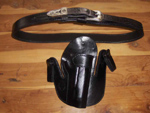
yldbill, . . . looking at the link, . . . the bottom picture (silver scope on belt mounted holster), . . . is the model of one I made some time back for a fellow to use his Ruger .22 auto with a scope. The problem I had, . . . he had one of those big green plastic front sights on his pistol, . . . as well as the scope, . . . and I had to work around both. I wound up building a holster similar to the picture, . . . with the front of the holster cut out far enough down that the weapon actually had to be tilted into the holster, . . . muzzle first. Point the weapon to the ground about 5 feet behind you, . . . in goes the muzzle, . . . tilt back and straighten up the weapon, . . . and it positioned itself so that the entire weight of the weapon was held in place by the front of the trigger guard. I fully lined it with suede leather, . . . contact cemented and machine stitched, . . . and finished it with an "over the top of the grip" snap strap that holds the weapon in the holster. The strength of the whole thing came from the bottom of the holster, . . . from where the trigger guard meets the grip all the way out to the muzzle end, . . . the holster was just shy of a full inch thick. I used my Tippmann sewing machine to make the holes through the leather, . . . but I had to end up hand sewing it, . . . the machine could not work on that thick of leather, . . . kept breaking my thread. I forgot to get a picture of the thing, . . . wish I had, . . . because I really believe it was one of the prettiest ones I ever made. Good luck, . . . it is a project, . . . but it can be done. May God bless, Dwight -
contact cement questions
Dwight replied to UncleGeorge's topic in Gun Holsters, Rifle Slings and Knife Sheathes
Hey, guys, . . . the leather "brush" I made was out of 5/6 or 6/7 leather, . . . and no, . . . I never clean it. After enough (read quite a few, . . . ) applications, . . . it may need replacing, . . . cut a piece of scrap, . . . replace, . . . done. I really don't mess with trying to clean the rascal. Besides that, . . . once I dip it again in the cement, . . . it kinda loosens up and flexes just the way I want it to do. As far as application, . . . don't be too picky about how it looks, . . . but again, . . . no big "puddles" laying around like Lake Erie next to Phoenix. I have never thinned the stuff, . . . just "slap" it on, . . . and if it is a bit thick, . . . that has never hurt, because no one ever sees the glue job any way, . . . they only see that the item stayed together BECAUSE of the glue. The only times I mess around with roughing up a smooth piece of leather, . . . is if it is real shiny. Other than that, . . . it is rough to smooth sides for most everything I do, . . . and the Weldwood holds. May God bless, Dwight -
contact cement questions
Dwight replied to UncleGeorge's topic in Gun Holsters, Rifle Slings and Knife Sheathes
I use DAP Weldwood contact cement for all my holsters and belts. In fact, . . . if I'm going to sew it, . . . I cement it first. Buy the solvent base product, . . . the water base is not as good. Just be careful to use it in a well ventilated area, . . . and no smoking around it, . . . it is flammable with a capital F. I built a leather flap "brush" with a small piece of leather (1 1/2 by 3/4 inches) held into a slot in the end of a dowel, . . . and it works wonders. Lay on an even coat on both pieces, . . . don't puddle it, . . . make it pretty uniform throughout. Most important part: let it dry, . . . again, . . . let it dry. You should be able to daub a cotton ball all over the cement and not lose one fiber of it to sticky glue when it is ready to go together. I use a small hammer and scrap leather to "smoosh" the pieces together, . . . unless it is a double layer belt, . . . I use a rolling pin there. Other glues will work, . . . do the job, . . . but for putting stuff together to stay, . . . this is THE product that holds it together. If applied correctly, . . . it can be pulled apart later, . . . but there will be a layer of leather come with the pulled off side, . . . it doesn't just "come apart at the seam" like most other glues will do. And "No" this cement does not seem to be affected by any of the Tandy dyes I have used. Just be sure to first let them dry and buff off the surface real good before using the cement. And you may want to "rough up" the smooth side a little if when you buffed it, it comes out real good and shiney. May God bless, Dwight -
In the absence of a groover, a large set of dividers, . . . with both points dulled fairly well, . . . makes an acceptable replacement tool. Set the dividers the width from the edge you want the stitches to lay, . . . lightly moisten the top of the object where you will be stitching, . . . and "groove" it with the dividers. John Bianchi favored this technique highly over using a stitcher, . . . but he also taught using a smoothing tool after all the stitching is done, . . . it flattens out the back side, . . . runs the stitches down into the groove made with the dividers, . . . and makes a really good looking product. May God bless, Dwight
-
machine sewing sheaths
Dwight replied to JoeS's topic in Gun Holsters, Rifle Slings and Knife Sheathes
Joe, . . . whenever I sew leather for a sheath or a holster, . . . I use the method taught by John Bianchi. Take a pair of long (10 or 12 inches long) dividers, . . . blunt, round & sand the points to get rid of scratches. Decide how far from the edge you want to sew, . . . and mark that line using the dividers. One end goes over the edge, . . . the other drags and scores the leather where you want the sewing to go. I usually do it twice, . . . once for position, then with a bit more pressure to make an indentation into the top leather piece. Sew the thing, using the machine (mine is a Tippmann also), . . . make sure you use a leather needle, not a round point needle. When you are done, . . . lightly moisten the back with a sponge or something, . . . and here you will need a special tool, but you can make it easily. Take a piece of steel or brass (NOT ALUMINUM) that is 6 or 8 inches long, about an inch wide, and 1/4 to 1/2 inch thick. Round the whole tip of one end so it is REALLY SMOOTH, . . . make a handle of duct tape on the other end. Where you wetted the leather, . . . lay down the rounded flat tip and literally rub the stitches down into the leather, . . . and at the same time, . . . it kinda like "erases" the marks made by the needle coming out the back. Don't forget to do the front also, . . . and if you did well with the dividers, . . . this tool will lay your stitches down in the groove really beautifully, . . . and later on you will find you don't need the groover or stitch marker. Anyway, . . . may God bless, Dwight -
Dye rubbing onto gun...HELP
Dwight replied to carljc72's topic in Gun Holsters, Rifle Slings and Knife Sheathes
Although I have done some differently, . . . usually I sew, . . . final form & bone, . . . dye, . . . then finish my holsters. My last process is the same as Lobo, . . . an acrylic sealant, . . . and I use Resolene, in a 50/50 solution of Resolene and tap water. I apply it with a camel hair brush, . . . usually two coats. It takes about 20 minutes for a medium size pancake holster, . . . as you keep brushing and applying, until all the bubbles are broken down and the finish is smooth. It is similar to spit polishing shoes with Kiwi shoe polish. I have never had dye come through the Resolene, . . . May God bless, Dwight -
If your local Tandy store is as good as the one in Columbus, Ohio, . . . that is the place to go. The clerks in there are super to work with, . . . they have leather working classes that only cost the materials you use, . . . They can also point you to the teachers in their groups, . . . boy/girl scout leaders, . . . and others who work with youth (using leatherworking for fun and/or therapy). You may want to check out your local adult learning centers or art centers for classes too. May God bless, Dwight
-
making your own blue guns?
Dwight replied to jsroye96's topic in Gun Holsters, Rifle Slings and Knife Sheathes
I have not tried this, . . . but plan on doing it some time. Make 2 wooden boxes that have no tops, . . . 2 inches longer, wider, and thicker than your handgun. Fill each box with minimal expanding foam (about $5 for the can) and then cover each full box with a couple layers of saran wrap. Gently lay the handgun down on one box full of foam and press it so that it sinks down about half way, . . . press the other box full of foam down onto the first one so that the edges line up, . . . wrap the boxes with a couple rounds of duct tape, . . . set it up on a shelf, . . . come back tomorrow morning, . . . cut the tape, . . . extract the gun, . . . you have a mold. This is where it gets dicey, . . . I haven't found the hard plastic I would like to have for the actual gun copy, . . . gotta do some research on that, . . . but you need to take some #12 copper wire (it bends easily with pliers) and use them like concrete re-rod to strengthen your gun copy, . . . place them in each half of the mold. Pour each half of the mold up level with the top and allow it to harden, . . . sand the pieces, . . . glue them together, . . . voila, . . . fake gun. Again, . . . I haven't done this, . . . I hope to some day in the near future, . . . but right now it is hay time, . . . mowing time, . . . roof repair time, . . . and I'm helping a buddy put a sump pump into his basement floor. Good luck, may God bless, Dwight -
Az, . . . if you are truly dedicated to doing it in leather, . . . my best suggestion would be to cut a piece of suede the length of the tool handle, . . . wrap it around the tool several times to figure the depth (or thickness) you wanted, . . . cut it at that point. Then, . . . perhaps contact cement the thing to the handle, . . . using your hand held skiving tool to bevel the leading and trailing edges down to nothing. That way the "bump" would be minimized. I personally find that the shrink tubing and/or the rubber hose are both quick fixes, inexpensive to replace, and work very well. May God bless, Dwight
-
Almost any large Christian book store will have the machine. It is a hot stamping machine where the letters are picked one at a time to make the name or phrase. A metal foil is placed below it, . . . the letters are heated up, . . . then forced down on to the object, . . . transferring the metal from the foil to the intended object. You might look on Ebay, . . . look for a hot stamping machine, . . . or maybe call or visit the local Christian book store, . . . get the machine Mfg. name, . . . try that on Ebay. I woudl be surprized if no one had one for sale there. It takes a little time and practice to learn how to do it, . . . but once done, . . . it is permanent (more or less). My Bible and ministry manual both have my name on them, been there for almost 30 years each. May God bless, Dwight
-
This is a great idea, . . . just get it from a local electrical wholesaler, . . . tell them you want a product called shrink tubing. You buy it bigger than what you want to use it on, . . . slide it over the tool, . . . shrink it with a regular heat gun or a hot blow dryer. It comes in various sizes, some different colors, . . . and if you super glue the end of a small diameter cord on the bottom of the tool, . . . wrap it to the top, . . . glue the other end, . . . the shrink tubing will keep it on there basically forever, . . . it is a pretty secure gripping surface, . . . and you can make it almost any diameter you want up to about an inch. May God bless, Dwight
-
You can go to almost any national brand auto parts store, . . . ask them for what is called an "inverter", . . . they start around $20, . . . go up to a couple hundred for the big boys. A small one, good for 1500 watts, . . . when hooked to a 12volt automobile battery, . . . will power 4 or 5 of the florescent "squirrely" bulbs (they look like they were wrapped around a cucumber when wet and allowed to dry), . . . for several hours. They can be mounted in any light fixture, . . . including auto mechanic drop light fixtures (buy at the same auto part store). You mount the inverter in your vehicle, . . . then run a regular 120 volt extension cord to the tent, . . . voila, . . . you have light. Just be careful not to put a bunch of other stuff on that circuit. Or, . . . just drag the battery and inverter to the tent on a 2 wheel dolly, . . . alligator clips on the inverter, . . . plug in the lights (inverters have a 120 volt plug in built into them most of the time), . . . and you are good to go, . . . no extension cords. May God bless, Dwight
-
The proper name for the holster is a Pancake, . . . buckets are for feeding foals and calves, . . . but that is beside the point. I would not put the weapon in a baggy, . . . for two reasons. Every fold of the bag will also be reproduced on the inside of the holster, . . . and it is not necessary. If the weapon is properly cared for, . . . and wiped and oiled as needed afterwards, . . . you will get a much truer and better holster fit. And TwinOaks was very much correct in all the rest of the post, . . . May God bless, Dwight
-
Apply leather to wood
Dwight replied to Angel's topic in Dyes, Antiques, Stains, Glues, Waxes, Finishes and Conditioners.
Angel (I like the name, . . . ), if you want this to be a permanent job, . . . I would very much recommend the contact cement. Step 1: Apply it liberally to the cedar, . . . but no puddles, . . . smooth thick coat, . . . and a good coat on the leather. Step 2: Let both pieces dry. This is EXTREMELY important. You do not want any parts to have any wet faces or wet spots. Step 3: Place waxed paper between the two pieces (or newspaper). Step 4: Slide a bit of the newspaper out as you watch the pieces and make minor corrections, . . . before a large part of the surfaces have contacted each other. Step 5: Use a rolling pin or something similar to "roll" it in place. Practice putting the leather down before you glue it, . . . and you shouldn't have any trouble. I do this with belts, holsters, pouches, . . . almost anything I make of more than one piece of leather, . . . is contact cemented with Weldwood from Lowes. Works great, . . . just remember not to use it in an enclosed area or near an open flame. May God bless, Dwight -
Which glue?
Dwight replied to M_S's topic in Dyes, Antiques, Stains, Glues, Waxes, Finishes and Conditioners.
esantoro, . . . one of the most aggravating things about Weldwood, . . . you just mentioned, . . . wanting to put them together too soon. Our minds tell us we have to put glued stuff together before the glue dries, . . . and the truth is absolutely just the opposite of that when using Weldwood. Both surfaces have to be dry, . . . which can happen in 30 minutes under ideal conditions, . . . but I usually don't think of putting my projects together for at least a couple of hours. May God bless, Dwight -
Which glue?
Dwight replied to M_S's topic in Dyes, Antiques, Stains, Glues, Waxes, Finishes and Conditioners.
You won't find anything any stronger or more waterproof than Weldwood Contact Cement. Lowes, Menards, or other lumber retailers have it, . . . Properly applied, . . . it makes your project the next thing to one piece once you stick them together. I like to use a rolling pin on it after I have stuck them together. It keeps it together. I made an IWB holster for a Bersa Thunder 380 a couple years ago, . . . only used this product, . . . no stitches, . . . still works. May God bless, Dwight -
Lining a belt
Dwight replied to iwannabeacowboy's topic in Purses, Wallets, Belts and Miscellaneous Pocket Items
I'm not a big guy in stamping, . . . prefer my leather more on the plain side, . . . but the last rig I did that had some stamping and carving, . . . I made the belt (cut, backed, sewn, edged, burnished, and buckled) before I stamped it. But then again, . . . the main rule is, . . . there ain't no rules, . . . whatever works best for you. I didn't want to have my belt "grow" as they can during stamping, . . . so I made the thing, . . . then stamped it, . . . so if it grew, . . . the whole thing had to grow. May God bless, Dwight -
In Texas a few years back, . . . flea market surroundings, . . . someone had taken some old holsters, . . . cap guns, . . . fake marshall badges, . . . fake handcuffs, . . . but had put them in a picture frame made from old grey barn siding, . . . velvet backing, . . . and had put a gun, a holster, a badge, some cuffs or fake cartridges, . . . with a bit of western painting (cactus, . . . windmill, . . . bull horns, . . . etc.) and made a fairly nice looking wall decoration with them. The asking price was in the $80 range, . . . I didn't buy one, . . . but one day, I may make one, . . . thought it was neat. Course, . . . that stuff is kinda a guy thing anyway, . . . May God bless, Dwight
-
Troop, . . . go to the first pinned topic in this forum, . . . it has "cornfused" on it's title. Go to post # 8, . . . that is mine, . . . there are the pictures of a couple of Dremel tool type burnishers that work perfectly for my holster work. You need to burnish the mouth of the holster and the muzzle end also, before you sew it together. After you cement the edges, . . . sand them smooth, . . . bevel, . . . burnish, . . . and sew. It'll give you a very professional looking job. I often then go back and re-burnish, . . . as sometimes the pressure of the sewing machine will "unburnish" some of the edge for some reason. Anyway, . . . a friend put me onto the Dremel, . . . I love it. May God bless, Dwight
-
It looks like you are putting a cap on a cylinder (or half cylinder, . . . ). The cylinder part can be molded to the roundness and the top edge turned down, . . . and you can make a jig that will then hold the cylinder at the exact correct angle while you press it up against a large circular disc sander. It will sand it down as exact as you make the jig. The same goes for the cap, . . . a jig to hold the cap onto a flat backer, . . . then the backer goes up against the same large sander and rotates 360 degrees, . . . giving you your bevel for the lid. Again, . . . your accuracy and repeatablity will be directly proportional to the accuracy with which you make this jig. I would suggest for the cap, . . . a round, flat piece of brass (aluminum or steel can leave discoloring marks on good leather), . . . with about 16 each 1/8" holes per square inch below the leather. Attach a shop vac to a flared vinyl plumbing coupling of the right size, . . . and the vacuum of the shop vac will most likely keep the leather from moving while you sand the edge of it. May God bless, Dwight
-
justme, . . . I've not been around as long as many folks here, . . . but all my experience with deer leather, . . . it has been "buckskin" tanned, . . . or very much like suede cowhide leather. That gives it the properties you described. If I were you, . . . (and IFFF I understand exactly what you are doing), . . . I would first make a vegetable tanned "bracelet" using a buckle and strap made out of probably 5 oz vegetable tanned leather. Once it is finished (cut out, punched, edged, etc., and the buckle and keeper and associated snaps all done), . . . I would affix the stones to this piece of leather to a "flat" side of the stone, using contact cement. I would then very carefully cut a piece of the deer skin, . . . make holes for the stones to come up through, . . . be very sparing with the contact cement, . . . and cement it to the bracelet, . . . covering the top, edges, and back, . . . but not the area where the buckle and strap are. The vegetable tanned leather will give you a sturdy foundation, . . . and will allow you to make a very interesting and beautiful bracelet. Best wishes, may God bless, Dwight
-
First shoulder holster
Dwight replied to Shorts's topic in Gun Holsters, Rifle Slings and Knife Sheathes
Lobo has some good points, . . . especially the shifting problem, . . . but I was successful in overcoming it without resorting to tie downs. The first shoulder rig I had, I bought, . . . and it had probably 1 to maybe 1 1/8 wide straps of 6 oz leather for the "X" strapping. I gave it away. I then used some of the ideas there to make my shoulder holster that I still have and use. It is a horizontal carry, thumb break, and I purposely pulled it up close under my left arm, and allowed the off hand to hang a bit lower (after trial and error, found this works well for me), . . . and the off hand is a double mag pouch that opens down and carries two ea. 8 rd mags. My straps are suede, . . . tend to widen at the top of the soulders to almost 2 inches and narrow as they approach the holster or mag pouch. I have never needed any kind of belt strap, . . . it does not shift or move, . . . and I carry a full size RIA 1911, all steel, w/9 rounds in it. I also used a round piece of 5 oz leather for my attachment point in the back, . . . using 24 line snaps from Tandy, . . . it has never come apart, . . . and swivels nicely as it needs to. I also did not mold the holster, but lined it with suede (sewn, . . . not cemented) and just "crumpled" the leather a bit before I put it all together so the holster leather is a bit softer and more pliable. Makes for easier holstering and drawing. May God bless, Dwight -
Molding problem
Dwight replied to nobearsyet's topic in Gun Holsters, Rifle Slings and Knife Sheathes
Nobears, . . . I make handgun holsters, . . . and often they are very carefully molded, and in very high detail. I only use the weapon long enough to get the shape, . . . extract the weapon, . . . and either lay in the sun to dry (through my kitchen window), . . . hang it over the wood stove (in the winter), . . . but I NEVER leave the item the holster for a prolonged time. Once the molding has taken place, . . . remove the item, . . . allow air to get to all sides. I also do as you did, . . . the big soak trick, . . . but I always allow it to do what I call "flash dry" by just letting it sit by itslef for about 6 to 8 minutes before the molding process starts, . . . and I get really good results. Often, my item is dry in less than a couple of hours. May God bless, Dwight -
cross draw holster question
Dwight replied to figthnbullrider's topic in Gun Holsters, Rifle Slings and Knife Sheathes
I used to have (sold it, . . . UGH) a really neat cross draw, driving holster, . . . and I thought it was made by either Ross or Kirkpatrick. It is not in any of their catalogs. It worked with a flap that was attached to the "bottom" of the holster and kept the barrel at about a 30 degree angle, pointing down and toward the outside of the car. The flap came up behind your belt, . . . over the top of the holster, . . . and snapped along side the slide of the 1911. It was made for drivers, . . . not runners, . . . it did not conceal well when out of the vehicle, . . . but it put the old pistola right where one would have needed it for carjackers or other problems. Maybe someone else remembers it better than I do, . . . May God bless, Dwight -
When I was working for Uncle Sam (USN, . . . ) all sailors and wannabe sailors had two things for sure: a big "pocket" knife and a marlin spike. They don't make one a sailor, . . . but it kinda makes one look the part. If you are doing any serious braiding, or knot tying, . . . the marlin spike is darn near a necessity. They were both carried in a leather pouch on the belt, . . . the marlin spike had a braided leather "tail" on it, . . . Maybe???? Invest in some Case (two blade) or Buck (single blade) folding knives and marlin spikes to go with them. Offer "custom" belt sheaths for each/both. The knife blades should be in the 4 inch range. Just a suggestion. May God bless, Dwight