bruce johnson
-
Posts
4,401 -
Joined
-
Last visited
Content Type
Profiles
Forums
Events
Blogs
Gallery
Store
Everything posted by bruce johnson
-
What do you use to trim your shearlings?
bruce johnson replied to RyanCope's topic in Saddle Construction
I use Oster A5 clippers with #10 blades. -
So how does this royalty deal work? Does this make Johanna the Queen Mother?
-
Doug, Not sure what Weaver's prices are. I have some from Big Sky Tool and Die in Gwinn, Michigan and Texas Custom Dies in Mansfield Texas. The Big Sky were their standard dies, and I got two simple customs from Texas Custom Dies. There have been some previous threads that have mentioned other sources too. There seems to be a lot of die makers who make them up too.
-
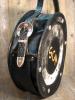
Tim, It is just as frustrating for them not to have it. The last shipment they got had spots on it. I like the DT for rope bag gussets - just the right mix of body to keep them from collapsing and flexibility to reach into the bag. I ran into the same deal on the black before Christmas. I had an order for a black rope bag. I ended up and hunted around and found some black oiltan at TLF that was a distressed type look. I overdyed it with black spirit dye and it really came out well. Hidehouse has some similar leather. I picked some brown up for a friend a couple weeks ago. The invoice calls it "velva oiltan".
-
George, I use something like 8/9 usually. Sometimes I will use light skirting, but skive the edges down to that thickness.
-
Luke, I will pass along your sentiments to Dave. We are driving down to Visalia Saturday night to see him. There is a little coffee joint they clear out and set up chairs. Seats about 40 and they get some pretty good entertainers in there between bigger shows. Very tight setting and worth the 3 hour road trip. Kevin, I go back to the Ian and Sylvia days, and the first song I think I heard was Un Canadien Errant. I don't understand a lick of French and probably spelled it wrong, but that one got me. The new Ian Tyson is different. He had a throat deal and ended up with a permanent gravely kind of voice now. It took a guy who always sang smooth as silk and gave him an earthy kind of edge. The writing is good and I am not sure if I like the new one more for the reality of his voice or the music.
-
Hand operated clicking press and clicking knives
bruce johnson replied to UKRay's topic in Leather Tools
Doug, No idea what brand. The only label is the safety deal - wear eye protection, etc. I think it had some stickers in the bag o' parts, but they are long gone. I have had it a couple years at least. It is Chinese, but that is about all I know. -
Mary, This is one of the few forums where suppliers are encouraged to join. Discussion about them and from them is allowed, including new products, contact info, and experiences. Feel free to post an intro about your self and your business in the introduction and supplier sections. If you have stuff to sell, there is a "Marketplace" section as well. There is a mix of people here from new beginners to those who have spent a lifetime in the business. We all buy and use stuff. Welcome. Edit: As Jordan pointed out, it is safer to either post your contact info in a hyper-link or spell it out (i.e. joesleather at domain dot com) tp slow the harvesters down.
-
Hand operated clicking press and clicking knives
bruce johnson replied to UKRay's topic in Leather Tools
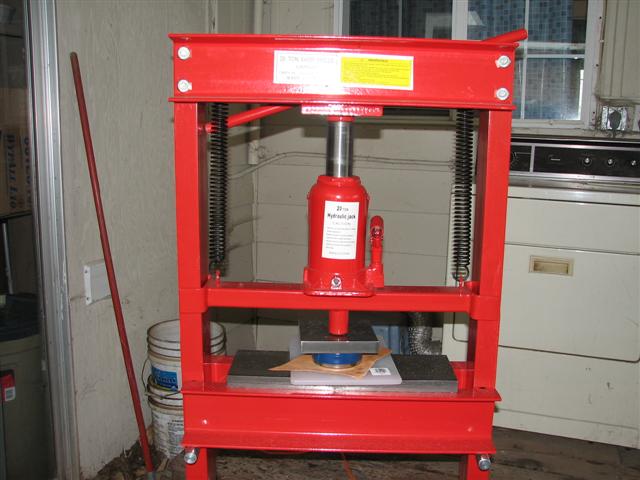
Doug, I would look it over pretty well. Seems like when I was looking the HF all had the ram welded on crooked. For me I wouldn't go hog wild on one. There has to be some other sources of them in "the cities" too. Check out "industrial supplies". Most farm shops have one, and a local farm supply/hardware supply might be able to get you one too. As far as size, I think the Weaver benchtop hydraulic press is 5 tons. I got the 20 ton because it was not much more, and someone on another list had recommended 20 tons. I think at one time I was told the general recommendation was 200# minimum per inch of rule. The other thing is to make sure the plate you put on top of the die covers the whole die or you could bend it. Mine are 1" thick, but I would bet a guy could get by with 1/2" easy enough. -
Hand operated clicking press and clicking knives
bruce johnson replied to UKRay's topic in Leather Tools
Doug, I bought it at a local industrial supplier, kind of like Harbor Freight without the line of bargain bins down the aisles and brands you have heard of. They are a one or two location outfit. It was about $15 more than HF. Thanks for the compliments on the site and work. It is all in progress. -
Buddy Holly, Boston, Louis Armstrong, Bachman Turner Overdrive, REO Speedwagon, Wylie and the Wild West, Dave Stamey, Bob Seger, Richard Elloyan, RW Hampton, Kandace Kalona, Adrian, Ian Tyson (really liking the new one), Juni Fisher, Eli Barsi. I have a few poetry compilations and a couple poetry CDs from Randy Rieman. I listen to those a fair amount too.
-
Hand operated clicking press and clicking knives
bruce johnson replied to UKRay's topic in Leather Tools
My press cost me under $200 at a place similar to Harbor Freight but better quality. It is more stable and the ram is true. The 20 ton was more solid and not much more cost than lesser ones. I put a piece of cold roll steel under a plastic HDPE cutting board. Leather on that, then the die, then another piece of cold roll over the top of the die. The scraps of cold roll were end cuts from a local steel yard. I figured that I'd have about $1000 for dies before I would have paid for a clicker. As it is, I have dies for cinch and latigo carriers, spur straps, and Rundi has two coaster dies. Once you have cut the first piece, you just have to let off enough to slide the piece out and replace the die over the leather. On skirting that is usually 4 strokes at the most. If you let it off all the way, then the ram will go all the way up and it will be like jacking a car up every time. I use mine for embossing plates and cutting plates too. I can also mold leather in press forms that would be difficult in a clicker. I just use the ram over the male part of a two part form. Makes molded cell phone cases and pliers pockets easier.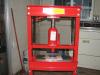
-
Hand operated clicking press and clicking knives
bruce johnson replied to UKRay's topic in Leather Tools
Doug, One of my friends has one of the Lucris ones and uses it a fair amount. With the cam action and mechanical advantage it is something like a 5 ton press. The bed is decent sized and the head is adjustable. He uses it for small clicking, embossing, and a cool thing is he can set his lettering stamps in place and press them all at once. He has a big clicker too, but this one is pretty handy. They aren't inexpensive though. I priced one a few years ago and they were about 1200 then. One recently sold on Ebay for more than that. For what I need to do, I use a shop press and steel plates over my dies to even the ram pressure across the whole die. Even on heavy skirting 3-4 strokes of the handle will go through it. Back off enough to slide the die and piece out and slide another in. Not as fast as a hydraulic clicker, but cost effective for what I use one for. -
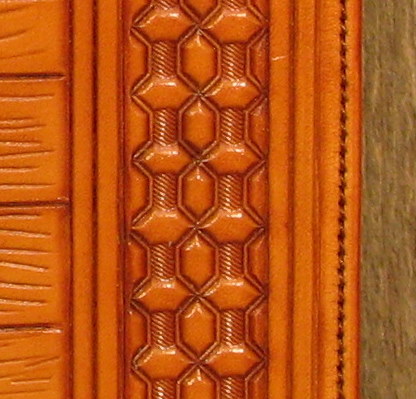
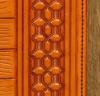
This is a border I have used a fair amount recently. I got the stamp pattern off a Porter saddle I restored. The original stamp was one of the McMillen patterns. Barry King made me one up for the saddle. I also had him make me up a couple in smaller sizes. I have done it single and doubled up between bead lines.

-
Skip, After I bought my first powered machine and it was not what I needed, I told LCSJ it would be nice to have a generic article on sewing machines regarding different feeding systems, flat-bed vs. cylinder arm, capacity, motors, etc. I had a supplier who volunteered to write the article or series of articles. It was ignored. At one of the Sheridan show we went to, I told the Reises that it would be nice to have a class in introduction to sewing machines. "Yeah, that's a good idea" and smiled at. I think that was the year the Artisan 3000 was introduced. When I mentioned it again at another show, I pushed the issue a little further. The explanation was the same as why some topics are omitted or seriously edited by the LCSJ. They don't want to tick off an advertiser. They are afraid that it could turn into an infomercial for or against a particular line of machines I guess. There are now several introductory priced machines that weren't available when I first got one. You only have to look at this forum to see the questions people have. Something that a little hands-on or show and tell could help.
-
Olaf, I read another forum for boot and shoemakers (www.thehcc.org). These guys are pretty traditional. In their archives there is some info on handwax (coad). It seems like they all make it up themselves. It sounds like the domestic sources for some of the "makings" are gone, and they have to import them.
-
A couple weeks ago Randy Cornelius asked me to post the purse pattern book I made up a few years ago. A little injury and some forced time out of the shop gave me the time to find my last remaining book and get it scanned in this morning. I think I printed up and mailed about 450 of these a few years back. These are some patterns I have used in the past, and still do. Some things I have changed, mostly the tooling patterns. The techniques have pretty much stayed the same. It is about 35 pages or so, and a big file - 15 MB. If I was more computer literate I could probably make it easier. Bruce_Johnson_Purse_Patterns.pdf Bruce_Johnson_Purse_Patterns.pdf
-
Sorry about the bad experience. I have had it happen from suppliers too. It looks like a tough business to be in, and deal with sources from all over the world and customers on the other. I am glad these independents are giving us a choice "B". Just to add a bit to my Hide House experience. Last week I took the morning and drove over and visited them in Napa. I had been a casual customer before. Roger had been my rep, and I had always got good service for my orders. I had recently ordered 3 sides, and it was some of the biggest cleanest sides I had got in a while. One reason for the visit was to see if they all were that good, or my order got "cherry picked". They mostly all were that good. The warehouse is pretty big and well laid out. Neatly organized and looked like a fair amount of labor pulling and filling orders. I had a few pieces I needed and Roger pulled them, then turned me loose to wander the aisles. He came back every so often, and the other workers would ask if we wanted anything pulled to look at. Just a very enjoyable experience, and I came away with more appreciation for what they have available. It also gave me a face to face experience. While not everyone has the luxury of living a couple hours drive from someplace like this, I'd recommend a visit to any suppliers you can. I also made a trip down to Buellton and visited Siegels a while back, another enjoyable trip and similar setup. Both of these are located in different "wine country" areas and could be destination get-aways too. ntex, Thanks for the heads up on the debit card deal. Something I hadn't considered before, and I appreciate it.
-
David, I think your time frame is pretty close. I redid one that has a very similar tree that dates to the 1920s. Some of the Pueblo CO saddles had that scalloped seat front too and that is a possibility it came out of Colorado.
-
Joanne, I want to say that "warranted" was on one of the production type saddles like Jumbo, one of the Miles City shops, or someplace like that. I just can't place which one. The tree style covers a bit of a time range. I think the seat front scalloped like that is very cool also. I don't know that it is peculiar to one maker though. The pattern looks to be wheeled on, so that tells me production too. One thing to consider is that back in the day this one was made, the production shops still competed with each other mainly on quality.
-
Jeremiah's edgers tend to run larger by number than most anybody else's. I would figure that a #1 would be pretty equivalent. That is the size I use the most for general work. Other than skirts and doubled reins, I mostly use the 3 and 4 for trimming rather than straight edging.
-
There is a link to an ebay sale of a stitching horse, and it got me thinking. I have that same Tandy model they sold several years ago. I have found it to be comfortable, the angle of the head right for me, and a good purchase that has paid back several times over. Some of you have heard me talk or write of the Irish harnessman who spent an afternoon and evening with me. A thoroughly enjoyable time, and I think about it a lot. He basically took over and straightened me out. He sharpened my "points" and the ones that didn't pass muster were turned into awl darts, a rousing game to play with Bushmills at hand. He showed me tricks of handsewing and tying in your buckles on strap ends, sewn or not. He took a horsehoeing rasp to my stitching horse's jaws to add a wee bit more taper to the top for finer stitching. He actually said it was much better to begin with than most of the pictured ones sold in America. The Tandy ones operate with the left foot. I had sat at some in other shops later that were right footers, and might as well have used some other part of my anatomy to run them after a few miles on mine. He said that traditionally the saddlers stitching horses were stood up with less cant to the jaws than mine, and were all right footers. Some had the strap to tighten the jaws, and some had a cam or other hardware on the outside of the jaws to allow deeper pieces to be sewn. The harness stitching horses had more cant, and were right or left footers, and most had the strap in the slot closure. He knew of no particular reason than that's just the way it is. Since we are pretty international and have a lot of traditionally trained workers on board here, I'd like to hear more about stitching horses and how they are ta' home, wherever that is......
-
Got your back, Shelley. I use a rotary knife a fair amount. I use one with my 6 foot ruler for straightening backs on up to skirting for straps. It just rolls right along. I use it to cut patterns out of chap leather. It seems to not kink up the really soft stuff going around an outside curve like my round knives do occasionally. I figure I am saving the edges of my good knives at the expense of a disposable blade. I use the pinking and scalloping blades on the rotary cutters for pinked and scalloped edges on chap and vegtan too. Now another confession. The first few chinks I did, I used a meat cleaver thinned down and sharpened enough to earnotch ants. I just set it in and rocked the blade to cut fringe. It worked out well until I dropped it and took a good sized chunk out of the middle of the blade. Now I use a round knife and the plastic straight edge. One other safety deal that hasn't been brought up about round knives too. Some people will rock them or "roll" the blade to make the cut. Some people are "pushers" only. My old pal gave me the warning several years ago about rocking. Some people will roll and make a cut from almost point to point of a round knife. If you are a rocker, never go past the most forward part of the blade (half way around) and you probably shouldn't even go that far. You are knuckled over and awkward. If you lose your grip or the knife slips or the piece slips, the opposite point of the round knife is quickly approaching your wrist. That knife is coming back towards you, and the downward and forward pressure you are putting on it will shoot that knife right back and up into your wrist. I guess nobody needs the anatomy lesson that cutting any of those things like tendons, ligaments, nerves, and blood vessels will be a bad thing, more severe than a string bleeder ever thought about doing to a guy's foot.
-
Joanne, I have seen "warranted" before and it is just escaping me. Don'tchajusthatethat?! They sure haven't increased any value on it with the cantle job and looks like the stitching holding the felt on is not very whippy either. Those might be fixable. The biggest detraction is the illegible makers mark. Most of the time a lesser condition with a good mark will beat out a better saddle with an illegible mark. If there is some provenance that always changes things, but I am pretty sure this saddle had some age in the 60s when he bought it. Too bad, it is a cutie.
-
Pete, If we were to vote on it, there would be some good company but yours would be the funniest today in my opinion.