All Activity
- Past hour
-
Bruce, that's the simplest solution. 15 cents at most yard sales. That said; Chuck, I like your stacked handle on that double-ender.
-
Both look good. Nice sunburst dye jobs.
- Today
-
I wouldn't deliver a flawed product in this case.
-
And here I just make them out of old screwdrivers...you guys are fancy!
-
Thanks but there are lots of Cobra users on here and it's not a very difficult question.
-
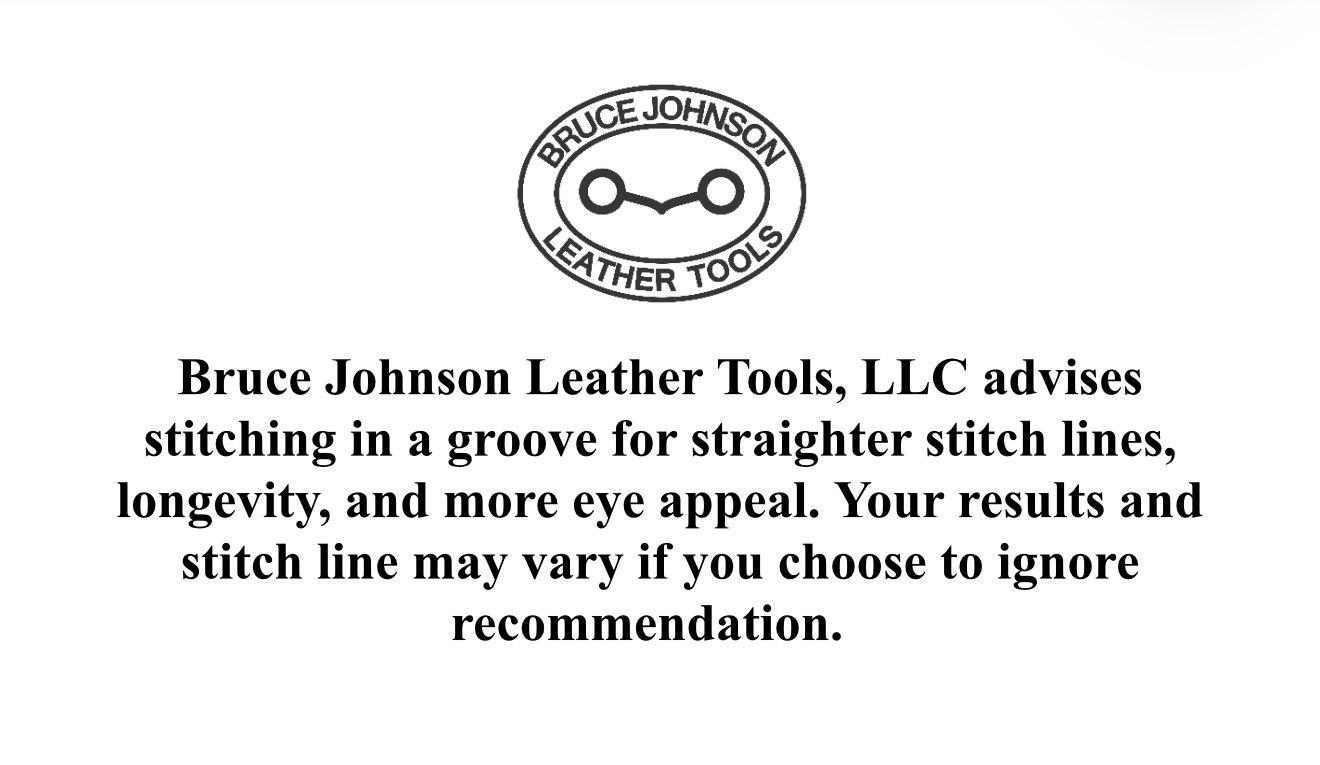
This right here. I am not picking on you but if I have to do anything more than once, every pass is a chance for error. It doesn't matter what. Two coats of dye on an edge, multiple hits on a stamp, whatever. Two or three passes with something with no steering like a wing divider - I am not that consistent either. Saddle divider with a wide flat inside surface to follow an edge then yes. Now the crabby old guy perspective and not pointed at anyone, just how i learned and was taught. I get this question a lot and here is my answer. The only place I did not groove was stitching into crease lines on wallet interiors with #69 thread. The purpose of a stitch groove is to recess the thread to prevent thread wear and/or add comfort to user in contact areas. They make different styles of groovers and different size grooving tips. You can match the groove width and depth to the thread size. even the amount of pressure you use can control depth and width with some groovers. You don't have to dig a 3x3 ditch for #92 thread and a scratch line for #346 is just a target line for straight stitching and not functional. For the people who say that you weaken the leather, I hear that a lot. The "strength of leather is all in the grain". OK, take that little spindle of leather you grooved off and pull it apart between a two finger grip. If that is the strength you need to keep your work together you have bigger problems. There is essentially no added strength in that little hair of leather. If there was then there would be instructions on how to make projects with it (actually you can make decorative miniature bird nests with it). The strength of the leather is all in the density of the dermis, thickness, and what part of the hide it comes from. That little sliver of epidermis is inconsequential. I have stickers made up (see below) on all the sewing machines in the shop for my wife and anyone who comes over and borrows some machine time.
-
ask here: https://www.facebook.com/groups/101589880193668
-
If this is something you are looking at as a show piece for your work replace it. Todd
-
yes they did, they look great.
-
yeah good job!!! I buy all the old books I can find.
-
Thats a cool build indeed. I take it you made the knife also.
-
I've been told the difference between a journeyman and a master is that the master can hide their mistakes. I would redo the strap if i couldnt make it totally invisible. I'm no master by any means. youve prolly spent more time and energy on this post than it would take to redo the strap. A gift should be perfect. Not something you couldn't sell, especially if you plan on getting more work from it.. Good luck to you and Merry Christmas.☺️
-

mountain man moccasins pattern #3 By Gene Noland
chuck123wapati replied to chuck123wapati's topic in Patterns and Templates
Thank you !! Now that I have a working pattern i can do some tweaking to make them even better. Right now I have some nice thick merino wool socks that work really well in these. -
mountain man moccasins pattern #3 By Gene Noland
chuck123wapati replied to chuck123wapati's topic in Patterns and Templates
Thanks dwight, I'm thinking a good long while on the soles they are 10oz and the insole is also 10 oz. I'll know soon enough I'm sure. What is nice is they can be resoled pretty easily i think. I'm also going to make a pattern for sandals, and the Roman type of sole is a great way to do that for sure. I I've been thinking what kind of leather crafter would i be if i couldnt make my own shoes lol. -

mountain man moccasins pattern #3 By Gene Noland
BlackDragon replied to chuck123wapati's topic in Patterns and Templates
Really cool! Just add some shearling on the inside and you have nice winter shoes. Just watch out for ice lol. -
It's hard to say really. Can the error be viewed by a potential customer as a scratch because of use? I wouldn't worry about it. I tend to focus on my mistakes and I don't like something that's glaring to me. Other's may not see it but I tend to catch it and it bugs me. If I want to show off a purse that I'm selling for $250 I don't want something obvious showing up. It's my name on the bag and the price tag warrants redoing a strap that will cost me $5 to replace.
-
It’s not necessarily “personal” nor a “sale item”, but a gift for a friend that I hope will also give business leads as he brags about and shows off the bag, so that line of perfection lies in somewhat of a murky area. If it were the body of the bag (already restarted twice), it wouldn’t be a question, but it’s “just” the strap. I would hope that the bag will steal the show and nobody will notice the strap, but I know it can also be the difference between a $50 bag and a $150 bag. Again, it’s only a gift for a friend, but he’s also a walking billboard. I want to roll with it, but my unrealistic demand for perfection says otherwise… — AZR
-
Come on you Cobra'ers! Is this normal or has it snagged in that position?
-
I have gone to just using a groover that puts an indent in the leather, doesn't scratch or cut the top layer. I found this works better oops situations and if I groove after I die there is not a white streak to possibly show under the stitches. Todd
-
mountain man moccasins pattern #3 By Gene Noland
Dwight replied to chuck123wapati's topic in Patterns and Templates
Good looking . . . wonder how long the soles will last . . . I'm gonna make myself a pair some day . . . using the 3 layer approach the Romans used on their sandals. Bottom layer is sole . . . thick . . . and they had kinda likd hob nails that gave them traction whenever they were worn. Middle layer actually is all one piece . . . toes and tongue would sew in like yours . . . sides and ends are all one piece Top piece is the inner layer that touches the wearer's foot. All three layers were sewn together . . . and if I recall correctly . . . may have been some rivets. That is what I'll do Plan on making mine to stop just below the knee . . . will put zippers in the inside for quick on and off May God bless, Dwight -
@AlZilla Thanks Al, that's exactly what I wanted to know, that someone has used the same or similar machine and can say, with some certainty, that it will most likely do the job I want to use it for(obviously I'm not holding you to account, machines, maintenance and operators are all variables). I don't think it's too high a price, I'm happy to pay a bit more for a properly serviced machine that will do the job. Hopefully I'll have some results I can share sometime soon.
-
 Curious Observer joined the community
 -
mountain man moccasins pattern #3 By Gene Noland
chuck123wapati replied to chuck123wapati's topic in Patterns and Templates
the good two tones lol. been wearing these for two days, and they are so comfy I forget they are on. Just 11.5 oz each. you can see the vamp on the dark shoe is kinda wonky, that's the third attempt, and really, when I realized you have to stretch the vamp into place. You also have to trim very close at the toe and heel awl holes and even cut out a V between the stitches in the toe and heel areas. Anyway, I have found my answer to sore feet and plastic garbage!!!


-
So after throwing a perfectly terrible pair of nearly brand new 100+dollar Chinese shoes in the trash. I set out on an adventure, or maybe a quest is better.. To find a pattern i can make and use daily until I die or until someone in the USA makes a damn shoe. I am so tired of the living by buying cheap plastic garbage mindset that we have been led into i could puke, especially when your feet hurt after ten minutes. Any ways i decided that a decent moccasin pattern is the answer, but I have tried and failed miserably in making my own pattern. I have about six patterns downloaded and even looked at the steampunk dudes driving moc pattern as an option. I looked at several mocs on the net and decided on the basic shape of a chukka-type moc with thicker soles. I decided that Genes pattern could work, so I set to work. First off, most moc patterns call for softer leathers than veg tan, usually moose or bison, so I knew the challenge would be to utilize the heavy veg tan for soles. I figured a form would be the answer, so I cut one out the basic shape of the insole, then also an outside form slightly bigger, double the leather thickness. So I glued in the insole, then wet-formed the sole. I used 2mm leather for the vamp and set about sewing it up as close to the exact pattern I could and followed the instructions. What I learned!!!! You need flexible or softer leather, the vamp started tearing at an obvious weak pointso was ruined before finishing, but i finished anyway to find all the bugs. There were holes in both sides at the tongue edge and there were wrinkles inside and out at the toe and heel so uncomfortable, also to small and just ugly. I also learned that you need to stretch the vamp as you go in order for the stitching holes to line up properly or your stitches wont be tight. The stitching holes were so far from the edge that big wrinkles were formed inside and out. Plus the sewing just looked like s@#t. What i did Changed the vamp from a one-piece to a three-piece design, widened the tongue so there would be no open holes in the sides of the mocs As I formed the sole, I took a ballpeen hammer and pounded out all the wrinkles and bumps on the heel and toe section. Then, after drying, I trimmed up the sole evenly all the way around. After forming i doused the sole in NFO as well as the vamp to get some flex, skived the edges of the sole, burnished, then used a round awl to punch the stitch line up closer to the edge like 1/8" or so. I did the same on the vamp, moved the holes to 1/8th inch from the edge that gave me enough room for my foot plus i lost all the insde bumps and wrinkles. Stitching was the key to a nice loking job, and i now understand why the particular stitch was used. The process to sew these is simple: but not explained in the pattern!!!! you do about six stitches, then go back and tighten them up, then do a few more. There are places where the holes get way funky but if you use a needle as a lever and stretch the vamp as you go then they all line up and the shoe forms perfectly. Any way, here are some pics and my two-toned shoes lol, I used a piece of hide that had been partially sunburned, so after screwing one shoe up i had to use the lighter stuff, which will darken up with time lol. I now have a usable pattern, and my next pair will have a gusseted tongue as well.


-
Looks like about $140 US. If I'm going to part with one that I've gone through and made good as new, it takes at least $100 US to pry it away. Most people would rather go the Walmart and drop that same money on a less capable, low end plastic machine. The difference is a couple years of service vs a couple of lifetimes. Here's hoping this works out for you. I've made a lot of denim bags on 237's and similar Kenmores.
-
spring flowers and good food
chuck123wapati replied to chuck123wapati's topic in All About Us and Off Topic
whats interesting is understanding why a certain stitch was used and how they work in that situation. It's rarely mentioned in patterns why the pattern maker used the stitch and how to sew the stitch correctly. In my case, the holes seemingly were way off, but as I tightened the stitches and stretched the leather into place, the holes made sense and the moc formed perfectly.