bruce johnson
-
Posts
4,401 -
Joined
-
Last visited
Content Type
Profiles
Forums
Events
Blogs
Gallery
Store
Everything posted by bruce johnson
-
Speeding Up The Making Process
bruce johnson replied to anester05's topic in Saddle and Tack Accessory Items
Adam, Good advice so far. Just adding my 2 cents worth. Most of the time there is a time savings to batching things up but I learned a few things along the way. . Plan your work so you get at least some items completed in a reasonable amount of time. Ten years ago right now I was looking for anything that paid. I had an order for 35 leather toilet lid covers for decorator working for a guest ranch. I cut all 35, stamped and tooled them all, oiled them, finshed them, tacked them on. It seemed like it took forever and I was bored out of my skull. After that I had an order for 80 hide-inlay spotted belts. I did the same thing - each piece a step at a time on all of them. That about killed me. I was sitting there out about 20 days on an order that was due in a month and I hadn't actually completed the first one. I did but man that ate on me that they weren't getting done. My small business advisor told me to batch things in some kind of numbers that could be completed in 6 days. That way I could have an extra day if something came up, but mentally I could tell myself that I had actually accomplished something that week. I had something tangible to look at. Most of the time that is how I scheduled my work. I get to tweaking it around later for some things. I would cut one day, stamp half the next and leave them sit, oil those the day after and stamp the other half. Next day oil the second batch and line the first and so on. That way I wasn't doing the same thing each at each work session. Mixing things up but keeping the work flowing helped the sanity some too. -
New To Leather Need Advice On The Tools I Need
bruce johnson replied to nichovaladez's topic in Getting Started
It is called a Bluegrass Easy Edger or somethng close like that. They also make a larger one with 4 wheels. Might try Weavers. -
There is a 15 piece or so set of stamps that Lonnie at Gomph-Hackbarth puts together that is probably the best bargain going for quality and price. It beats trying to find things a piece at a time on Ebay.
-
Looks great. That will be a fitting addition to any cowboy commode or buckaroo barcalounger.
-
The Champions seem to go for around $1000-1500 around here if they run alright. The Singers are kind of common and anywhere from $150-400 buys one that sews at some level. As far as the 8 inch skiver, there are a few varieties of them in that width. Something that is complete and has at least some blade could go for anywhere from $250 up to $600 or a bit more. It just depends on what model it is and how much blade is left.
-
I have listed a lot more leather tools on my website today. There are some splitters, rein rounders, knives, edgers, and a lot more handtools up today. I have expanded the number of pages and separated the tools out more also.Any suggestions for making the search easier is welcomed. Here is the link to the launch page of the leather tools - Leather Tools For Sale . Thanks,
-
That looks great!! He'll be happy with it for sure.
-
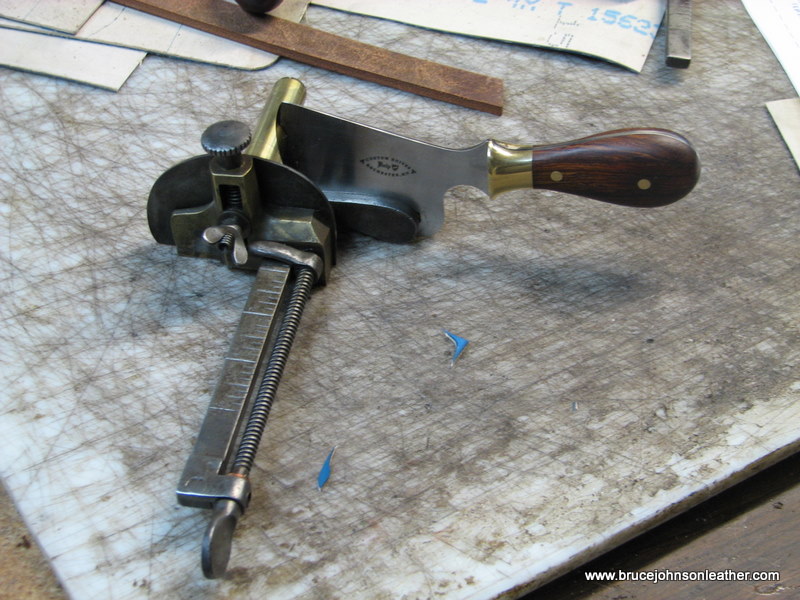
Old Plough Gauge With New Knipschield Blade
bruce johnson replied to bruce johnson's topic in Leather Tools
Bill, I haven't found anyone that has known of a plough gauge ever being made in the US. It surprises me too. I got this screw adjusting one a couple years ago. I bought a pile of plough gauges and this one was in the picture with them. That boat couldn't get here fast enough. I've got a few favorite tools and this is one of them. There's a few of them around, but not many. -
Old Plough Gauge With New Knipschield Blade
bruce johnson replied to bruce johnson's topic in Leather Tools
Ferg, Yes, these are a strap cutter. They are a European tool and used to push rather than pull. The blade is in line with your hand so no matter the width there is no torque like a draw gauge. I have a monster one I cut 8" wide strips with. The leather lays flat on the table and just push these along. The shoe of the plough gauge is on the table. With a draw gauge you are working with the leather off the table. The plough has a roller to keep the leather from riding up the blade too. -
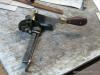
I got my plough gauge blade from Terry Knipschield today. It is beautiful. Gotta be candid, I use three plough gauges and didn't know which one to put it in. I finally decided it needed to go in the screw adjusting one. I figure that the potentially oldest one I use should have the newest blade. Kind of a May-December relationship.I had some doubled latigo to cut and it did that without a hitch. I ran it though some pretty hard skirting to test it there and it sailed on. Besides being a good using blade, this knife is beautiful. It is a classy looking piece and a workhorse to boot. Thanks Terry!
-
Laser Attachment To Drawdown
bruce johnson replied to lottarope's topic in Saddle Supplies, Tools & Trees
Buck, I have one of the Ron's stands and have not regretted it one bit. My wife talked me into buying one at a show. She's a keeper. I really like cantle binding attachment. I can set the heights and lay to one side or the other to see into the corners or underneath with out going upside down. I have light in there and stab myself a lot less. Ron used to have a little testimonial on his website I wrote to him after a long session of sewing bindings on a few saddles. I have the laser. It is not an absolute necessity but I'd get it again probably. It is alright once you get the tree center marks and the laser lined up over it. Basically it is a magnetic base laser that sits on the arm above. It can shoot lines or crosshairs. That arm is not 100% solid, and can wiggle or shift slightly if you move against the stand or reset a rigging and go back to check. I found that I spent as much time resetting the laser as I did setting the riggings. I was faster with my tack and string and rulers for drop. I do use it for a final check. It is also good for the saddle that comes in for repair to check if the rings are even. -
Nick, If they are friends and good with making 25%, that's a different story. That doubling the wholesale cost to determine retail is called keystoning and a pretty ingrained formula for a lot of retail pricing. It all depends on the overhead costsand profit expectations of the business how much money they need to make.
-
Nick, Been there/done that. I did it on a small scale for some people, but a big scale for me at the time. Yes, doubling the whloesale for retaill pricing is a pretty common rule of business. On some things, the retailer can go even higher. They have overhead to consider and other costs the guy who works for himself with no retail location deals with in their defense. The reason you see a lot of lower end or foreign made things in these shops is that nobody working for themself can match the wholesale price without using cheap materials or talking a cut in labor. Don't cut yourself short. I did work for a few resellers, and here are a few things off the top of my head. I used to figure my prices to them at cost of materials + waste factor + accounting for incidentals like thread, small hardware, finishes, oils, etc. and added a markup percentage. Then I added on the labor. At that time I decided I could do the labor for $10 less/hr. for the wholesale. A few things to the positive side. I had a lot of cash flow, which I needed. I made things they ordered that I probably would not have tried otherwise, and with that side of the business gone - still make pretty often. I learned how to batch and work efficiently. On the downside. They have "need to have deadlines" usually and that can interfere with your other orders and personal life if you let it. If you are working on wholesale for less, it grinds on you to look at the order board and see other things sitting that will pay more. It can be tedious to make 60 of the same thing for an order. If they can find another source cheaper, you are out. What do you do when a customer finds out who is making this stuff and then calls you directly? Do you take the high road and kick some back to the retailer for being "their customer" or just take on the customer yourself? Even with a shop's stamp on something and not yours, customers can find out who actually made it. Sometimes they are wanting a better deal than the shop charges, and sometimes they just don't want to go through a "middleman" when they can buy from the source. What do you do when one retailer decides that your stuff might sell for more than you are asking? That is a sure fire way for customers to call you directly. Consignment - The rates are less that sellign wholesale because the seller doesn't have anything invested in it. I did a little of that too. First one was a trainwreck. Stolen examples (maybe were sold), shopworn and need replacement, use your examples as high end to steer customers to things they sell cheaper but make more margin on - "You could pay $300 for this, but we have this for $220 that is pretty good too". I did do consignment with one seller that worked out well. He sets up at a really good trade show. I sent him stuff that fit the preChristmas market and it sold that week. It wasn't anything that competed with other things he was selling. That's a little I can think of right now, Bruce
-
That is some kind of pretty now. Talk to you tomorrow! That will really class up the joint. The only problem I am going to have is deciding which gauge gets the new blade.
-
Chancey, I don't actively look for them, and most of them time they are already spoken for when I do get a set of tools that has stamps or swivel knives. The stamps usually stay on my bench. Swivel knives are one of those things that I believe for the most part the best ones are being made right now. With the choice between Barry King, Chuck Smith, Leather Wrangler, Bob Beard, Henley, and couple others a person can pick a barrel size and blade in configurations that were not available before. Probably the best old ones are the Ray Hackbarth ones. I have had a few of them and like them well enough, but that would be my only real pick of the litter on the old ones. I used one of the old heavy Tandy Pro models and liked it at the time. I am not sure I'd jump to get one now though.
-
Was it Weavers who said the Horseshoe Brand is US made?
-
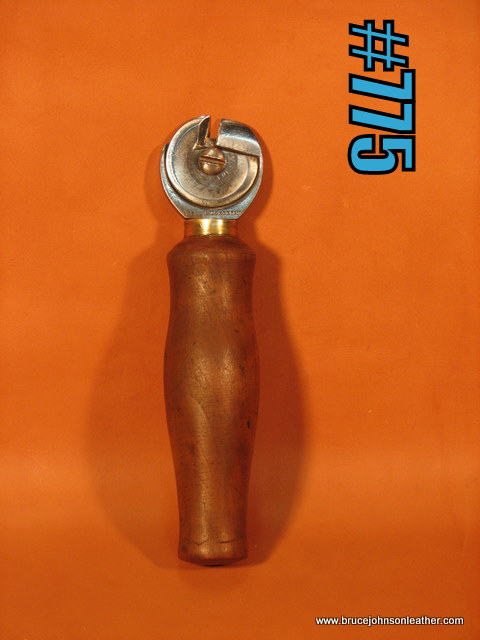
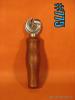
I was having a little trouble with the description too. If you are looking for a circular welt knife - I have this one available -
-
Strap Cutting - Alternative Methods
bruce johnson replied to Toadflax's topic in Leatherwork Conversation
Brent, I never got the splitter. I had cash money in my pocket for one at Sheridan that year and planned to drive to LA and pick one up when I got home. I got a crappy demo and insulting sales spiel and decided I didn't need one that bad. -
Strap Cutting - Alternative Methods
bruce johnson replied to Toadflax's topic in Leatherwork Conversation
Brent, I didn't know Barnsley was back to making them unless this is still some of the old stock, but that picture looks pretty new. If you ever want to try one, here's a link to a few I have ready to go -plough gauges for sale . I'll have several more in the next month or so. -
Rope Stitch? Any Tutorials Out There
bruce johnson replied to Brad Johnson's topic in How Do I Do That?
I have heard a backhand called a rope stitch by some people. Basically you use a single needled thread. Go forward two holes and down, then back up one hole and up, forward two and down, and back one hole and up.... One side looks like a normal saddle stitch. The other side is an alternating every two hole stitch that sort of looks like a rope if you keep passing on the same side of the thread each stitch. It is easier than it sounds. I used to play around with it some for the decorative effect. Big thread looks kind of cool. -
Several years ago Bob and I were talking about these and he cringed when I said I was a potato peeler (black skivers). He told me then the three sizes I should look for and I thought that there was a skip in the sequence for one of them. He said that one would probably need a handle taken off on one side. I can't remember off the top of my head that size. I'd talk to Bob and see for sure. You might try one size to see how you like it and then work around with whatever you use now. I eventually got some and played with them, but just couldn't break the habit of the black skivers. Aside - One night in Sheridan an old guy paraphrased one of Baxter Black's poems (People Are Funny Critters) about different types of people using the alphabet - "There's mayonnaise dippers and Miracle Whippers..." The only parts I remember is "There's old heel shavers and potato peeler wavers..." and "rawhide tree users and Ralide tree losers". Ringing any bells with anyone?
-
Yes. I am using a mixed set right now - I have a few Adams, I think some HF Osobrnes and filled in with Newark and a few Harrison marked CS OSbornes.
-
I spin the mini and maxi punches in my drill press. I drive old Osbornes.
-
Strap Cutting - Alternative Methods
bruce johnson replied to Toadflax's topic in Leatherwork Conversation
Brent, I have the same experience with the wooden strap cutters. On your gauges- plough gauge or draw gauge? The plough gauge is pushed and the blade is in line with your hand and no torque. There is a roller to keep the leather down and feeding into the blade. I have one that will make an 8" cut as easy as it cuts 1". I use a draw gauge too, but not for much over 1-1/4" since I was introduced to a plough gauge. -
Thanks for the picture. I guess I was expecting the blade was hollow ground since that is what seems to be the trouble. That vertical grind is on my BK and the Ol Smoothies too and is kind of a loose use of the term "hollow ground". It shouldn't affect how the blade should sharpen though since the cutting bevel is flat. I use a jig on some of my new blades to make the bevel a little flatter. I know I did it to the BK and two of the Ol Smoothies I use. I have one Ol Smoothie I left original to open a wider ditch and my Leather Wrangler is a slim blade and makes a nice narrow cut as-is.