


fredk
-
Posts
5,976 -
Joined
Content Type
Profiles
Forums
Events
Blogs
Gallery
Store
Everything posted by fredk
-

Veg tan tooling with chrome tan projects
fredk replied to Blitz Thunderlungs's topic in How Do I Do That?
I'd stay with basic brown. Chrome tan pre-dyed in brown and veg tan accents dyed any shade of brown -
I've never been really able to extract NFO after a real bad case of over oiling However, on modest over oiling I use 1. another piece of veg tan which needs oiling to leech out the oil. Laid in contact and left for months (cos I usually forget it) 2. a piece of brown wrapping paper to leech it out. I find brown wrapping paper work best of all papers
-
You can get knife blades for larger bandsaws Build a support table to hold the work. I made extensions to my 10" sq table, front and back, so I could cut long lengths of beech wood. The extensions were about 18" front & back, afair
-
Certain leather work or crafting has titles; ie cobbler = repairing footwear, cordwainer = making footwear, saddler, and others. But what about bag-makers, leather armourers, board-game makers, and such. We need to make up names to cover those crafts
-
How much would a basic laser engraver cost? Just one to burn simple things into the leather. Not too deep or anything
-
Well thats better than the funny looks I get when I say 'I model', or 'make models'. Now reduced to 'I build Airfix model aeroplanes, I've never growed up'
-
sorry, sorry, sorry, I called the tang the scales I'm sorry did I mention that I apologise and I'm sorry
-
Is that the Tandy/Stohlman and others book? If it is my version says Leatherwork on the cover
-
Where to get swivel for a holster
fredk replied to Randy Cornelius's topic in Gun Holsters, Rifle Slings and Knife Sheathes
Thats a clever idea May I add; just an idea, punch a hole larger than needed and fit a sail eyelet for the C/S to bear on rather than the leather -
All my first books were titled Leatherwork or Leather Work So I mostly use that word or those words Some ppl on here are shure Leather Crafters, which is far above my mere status as a simple stumbler
-
The scale will be any metal beyond the blade forming the basis of a grip. Contact glue the 3-4mm leather on to this, either side. Skive and shape the leather to make a firm grip. Tuck one end of the thonging betwixt the leather and the scale. turn it right angle to wrap the grip. Apply weatherproof PVA to the leather on the grip as you wind the thong around tightly. The PVA will give you a little working time and pull apart if the thong is not tight and needs to be done again. If you want, coat with thinned w/p PVA after its finished. If you don't have or cannot get weatherproof PVA you can make it by adding 'Mop N' Glo' (or similar) to ordinary PVA. About 10%. But it also thins it
-
I would tuck the start of the lace under the leather covering the scales, turn at right angle and start wrapping, using weatherproof PVA glue to hold. At the end, tuck the loose end under the lacing wrap, sticking with the w/p PVA, come up about 4 turns of the wrap. Takes a bit of dexterity to do it. I've done sword grips this way.
-
I would pack the grip with some veg tan leather, about 3-4mm, shaped and beveled, then wrap it all in leather thonging/lace, from hilt to guard
-
I work in millimetres. Its easier to divide by two. No fractions of inches to divide
-
My posts keep disappearing
fredk replied to DoubleKCustomLeathercraft's topic in Feedback and Suggestions
This hasn't disappeared; its here, Perhaps you asked in the wrong section and its been moved -
Wot he said It must have taken you ages Thanks for doing it and sharing it I'll peruse it all properly later when I have some more time spare
-
I get 'lift-the-dot' fasteners from a sailing supplier. I don't need no special tool. They have wee tabs which go through the leather and a backing support plate which I bend over by pushing on them with a screwdriver than lightly finish by tapping them down
-
@GerryR a good way, but when trying to find the centre point to put a snap on a leather flap say a ruler is handier
-
btw, the magnet is glued on the inside of the leather 'key fob' pieces
-
I've been watching 'Rawhide'. Its sort of set about 1870 They too use the SAA. And the '73 Winchester. Sometimes you see a character using an older style Colt pistol
-
I've been using a metric centre-finder ruler for several years I don't really bother with the actual measurement; I just get the ruler onto the line, get the same distance number on each side and voila, the centre be found
-
Same, I use a small brass brush followed by metal polish
-
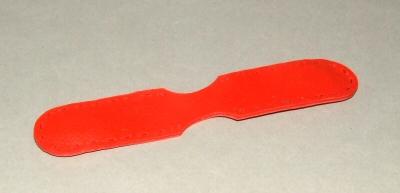
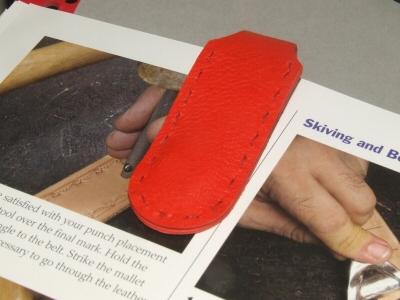
Don't use any mallet directly on the die. Thats a sure way of ruining the mallet and possibly damaging the die. I lay the die on a hard surface with the blade upwards. Find my leather and press it into place with my thumbs. That sort of 'locks' it in place then I use piece of off-cut wood or a piece of round nylon I have and hit that with my mallet. About a minute later I have the cut out. Pop it out of the die are start again. In about 10 minutes I have a dozen or so pieces to make key fobs If you cut 2 key fob pieces, glue a magnet on each end and sew the leather fob pieces together you have made a magnetic book mark! Two of these sewn together with a magnet at each end Make one book mark They are mildly popular at the moment
-
Here there are different levels of Spam; from the downright awful you wouldn't feed to your dog to the quite tasty stuff. All come in tins. The awful kind has loads of jelliefied fats but the nice stuff has minimal fat. I mostly avoid eating it as it reminds me of taking a packed sandwiches lunch to primary school This may be a measure of how it is disliked here; In the 1970s we had a national strike for 3 months. Everything became near impossible to buy due to shortages. But not spam. The shops always had plenty of stock of that!
-
Two boards and some C clamps or a solid surface, a mallet and a sacrificial piece of wood