



fredk
-
Posts
5,939 -
Joined
Content Type
Profiles
Forums
Events
Blogs
Gallery
Everything posted by fredk
-
I still cannot buy via post/mail, not even from Amazon
-
Can't buy via mail and they're out of stock anyways
-
btw, I did check out that place you linked to; they don't have the correct blades
-
I suggest a return, but for a replacement. You may have got a Friday afternoon bogey
-
This may seem strange to you lot; but I can't buy blades by post/mail. Its illegal to do so. I have to buy locally
-
I think I might buy one and try it. They are cheap enough. One problem I foresee is replacement blades; I can't seem to find any like the one fitted Although it looks nasty the way the point of the blade is right up to the grip hole the blade actually sits in a recess
-
Easy easy, very lighty taps. The smaller your mallet the lighter it is and thus lighter taps. I mean really light taps, just use the weight of the mallet to drop down, no extra force required. I use the rubber side of this type of mallet, its pretty useless for anything else; I use the plastic head, the yellow part, for tapping down glued edges, when required Some times I use a lightweight tack hammer, it weighs less than 3 ounces; Again, just very light taps, mainly just the weight of the head dropping on the threads, no extra force. Hold either mallet or hammer in a grip using just your thumb & forefinger and let the hammer pivot there, let the head drop, your almost open palm will stop the tail end. I guess I'm used to holding this way and the motion as that's how I held the grip on my sports swords during sports fencing.
-
Has anyone tried one of these carpet cutters for cutting leather ? Its meant for carpets and floor lino so it should cut thru leather like the proverbial hot knife Obviously not for detail cutting but for roughing out maybe. It looks to be a giant version of the safety cutters used by scrap-bookers for cutting paper or the ones you use for cutting wrapping paper at Christmas time It appears to use a 2-hole box cutter type blade. In use, the material is lifted off the working surface along which the cutter is run. So cutting above the surface will save your cutting mat or table top. In fact you could cut the material anywhere, anytime without having to have a cutting mat down
-

Made these arm guards for a raffle
fredk replied to dhaverstick's topic in Archery Quivers and Bow Cases
Very nice. You put a lot of work into those. I hope they do raise some good $$ for your club -
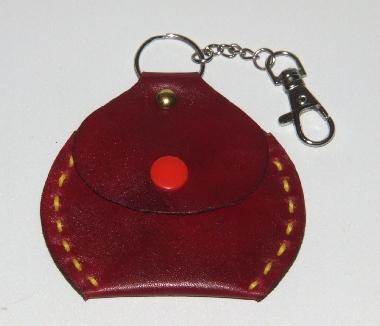
Agree. OT now; I'm making up some basic kits for the ladies & 1 man in my 'Knit & Natter' group to make up coin purses like the one in the earlier picture. I'll be pre-punching most of the holes, but to my standard. Thus, assembly should be speedy @SUP One other thing to do which helps the leather close up and grip the thread is to go over the stitching tapping it down with light-weight mallet or hammer. A small plastic and/or rubber headed hammer is good. Just lightly tap down the sewing line. Leave no marks on the leather. You'll notice a difference
-
Not necessarily, the size of the hole must match the size of the thread and the size of the thread must match the size of the hole. On this thread the tools we are discussing cut a slit in the leather, they do not remove any leather, but still if the slit is too big for the thread some of the slit will still be seen.Ideally the thread should fill or just over fill the hole. The leather will grip the thread and close over it. Other tools which make holes for sewing remove leather and if the thread is too small the hole will always be seen. Even when the the thread is the same size as the hole the hole will be seen. The thread needs to be oversize to fill the hole as the leather will not close up to grip the thread unless it is forced to do so On these wee coin purses I use a punch to make the sewing holes. It removes leather, about 0.8mm diam hole. I used 1mm waxed cord to sew. The thread is too big for the hole and needs tugged through. It hides the hole pretty well On this Tandy kit the pre-punched holes are too big for the thread or lace and the sewing holes still show and also give an uneven 'jagged' looking sewing line(photo picture taken from an Amazon listing)
-
Nice variety I think you're getting the hang of making these Carry on
-
An addendum to the main discussion; Tandy has. or had, in their library two books, 'Leather and Wood' Volumes 1 and 2. Vol 1 is by our hero Al Stohlman and Vol 2 is by Jerry Jennings & John Drake ( Ha ha, it takes two to compete with the Master! ) Many of the projects in the books are rather dated and old fashioned now but I thought youse might be interested in them and maybe get some inspiration Leather and Wood Vol. I.pdf Leather and Wood Vol. II.pdf
-
Good idea But are they steady enough? I would use pipe joints to put lengths of pipes running between all the legs, to make them all dependent on each other to stay steady
-
On June 1st I placed an order with buyleatheronline UPS delivered my order at 15.00 12th June. I had to buy much more than what I wanted as the minimum order value from the UK is £135. My eventual order totalled £244. I was warned there would be customs duties etc on the order when it reached me. However, there were no extra charges Overall. I'm please with the quality of the hides and pieces of shearling I received. Even the Grade 3 or Grade B quality is very good I'll definitely be heading to them for my next top up of leather
-
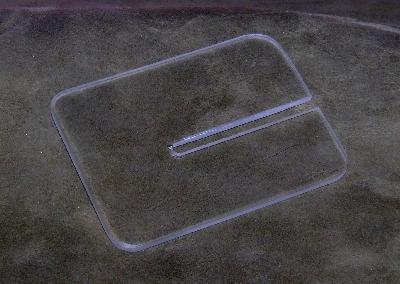
btw, highly recommended for use with the chisels is one of these; they are easily made so don't be tempted by the ones costing £20! I made mine out of an off-cut of acrylic perspex which I had laying around (I'm always on the scrounge for bits of stuff like this, )
-
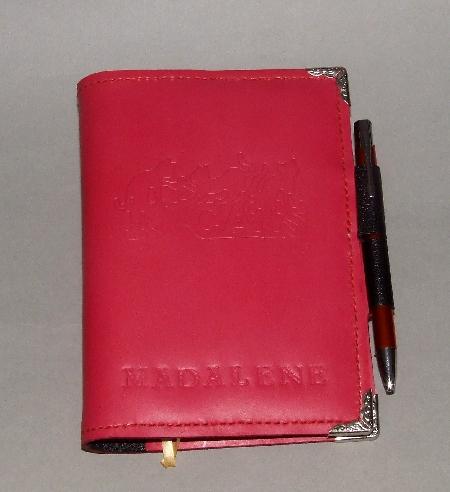
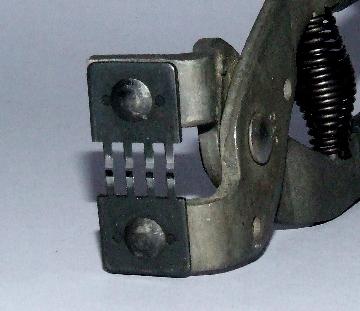
I have these in 3mm and 4mm. Cheap ones, Cost me about £6 or £8 for a set of 4. Never bent yet. Sharpening and polishing them helps them cut. The 3mm set matches quite closely but not 100% the tooth spacing on my pliers type. These are useful for where the pliers cant reach. Also, even with these chisels or the pliers a good sharp diamond awl is required as the holes may be 1. not perfectly through, 2. too small, 3. have closed up a bit When I recently did this book cover I used my pliers type to punch the sewing holes almost all the way around, but they could not reach over the pen holding loop, that's where the chisels were used. As I sewed around the perimeter I had to use the awl a few times to open up the holes
-
That is one way. Its easier to work on the leather on the flat. But you may loose some definition in the tooling. On this pen case I stamped after it was wet moulded to shape;
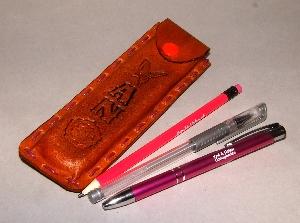
-
The stitching near the edge; the leather could have been skived very thin. folded back on itself and stitched. Those big round things which go through the stitching might be some sort of upholstery nail, although a ready rivet stem with head, ie one part of a double-headed rivet, can be used. I've done that on some of my game boards
-
Interesting technique. Nicely carried out Carry on
-
Acetone problems
fredk replied to LzCraft's topic in Dyes, Antiques, Stains, Glues, Waxes, Finishes and Conditioners.
It should be fine. Acetone is used as a cleaner and degreaser. If I have any doubts about the cleanliness of a piece of leather I wipe it over with a generous amount of acetone. Nothing bad has ever happened to the leather. If anything, the leather takes dye better and more evenly -
So many ways, so much advice we'll have the poor wee lassie's head spinning like a Highland Reel !
-
btw; something to watch out for; UK shoe sizes are quite different to US shoe sizes; eg In the UK I buy a size 10 wide but in the US I'm an 11 regular, and size 10 UK is covered by 3 different EU sizes Your father's lasts will probably be all standard UK sizes, no EU or US ones edited to add in this guide https://www.pediwear.co.uk/chart.php
-
Help to identify a vintage machine please
fredk replied to PaulineSul's topic in Leather Sewing Machines
Slightly off topic; I started my personal campaign to get people to stop throwing away old items because they were 'old' and the people didn't bother to find out what they had back about 1977. Back then a friend and I collected old photography items, One day we spotted a brass plate in an antique shop window. the plaque had come off a certain camera. We asked the store owner if he had the camera. 'No. I burnt it. The wood was no good and it was too old' We showed him a recent auction report in a magazine we had just purchased in which a similar camera had been sold. His plaque was off a Louis Daguerre camera of 1829 and was numbered 7. The one in the auction was of 1830, numbered 15 and the camera was described as in very poor condition. It had sold for £12,000. And this man had burnt his. He had burnt money. At that time my sister had bought a very nice modern semi for under £10,000, those houses sell for £250, 000 plus today -
Help to identify a vintage machine please
fredk replied to PaulineSul's topic in Leather Sewing Machines
Please don't even scrap those. They might be useful as organ donors for other machines. The manufacturers tended to use their own screw threads and getting replacements to service other machines is near impossible. If you were to trawl (not troll,) this forum you'll come across a great many requests such as 'Where can I get a plate/screw/bolt/ . . . for a Singer 29K or a xxx . . . .?' I and my son started with one 1930 Austin 7 Ulster. We now have a large shed full of spare wheels, engines, seats, chassis. We bought spare parts whenever and wherever we could. We have helped a few fellow club members with spare parts. All these old parts are organs for our old cars to keep them on the road. Just like your old 'dead' machines