Mablung
-
Posts
576 -
Joined
-
Last visited
Content Type
Profiles
Forums
Events
Blogs
Gallery
Store
Everything posted by Mablung
-
A friend is a mechanic, and while he seems to think SnapOn is a bit overpriced, he is a firm believer in getting good tools, from the tools of his trade to guns to watches and other gear. The man can drop some money on a tool, but not until he's researched it to death and saved his money. DieselTech, I'm starting to think I need to upgrade my edgers. Those look awfully nice. I do some of my edging with my round knife, if I only want to take off a very small portion of the corner for a short line and for some curves, but that's not as easy to do consistently.
-
'Murican here, who drinks a decent volume of coffee each day. That's quite a testament to the British dedication to tea-drinking. It seems to rise to the level of ritual, in addition to enjoyment.
-
Nice to have some breathing room financially, so I'm glad to hear that. +1 to burnishing the sandal edges before gluing the sole, unless you're concerned you'll not get the sole quite true and need to do any last trimming. Looking forward to seeing the finished product.
-
That's fair. The threads can be tough to find easily. I got a decent watch recently, want to make a black strap for it alongside the brown one I got with the watch, and am resisting the urge to allow my watches to be fruitful and multiply, lol.
-
There are also a good number of threads addressing watch straps, too. They seem to require some heightened precision, including some smaller-than-usual pricking irons or stitching chisels, as well as finer thread and needles. Additionally, they seem to require some skiving skill, for things like the strap end keepers (since most are very gradually lap-skived and then cemented and stitched). I haven't tried making any yet, although I intend to. First I need some different chisels or irons and a much sharper stitching awl.
-
I wonder if it had something to do with the razor having a guard that provided some additional resistance. A head knife has to rely solely on the edge being able to slide through, whereas a razor has an additional surface helping the blade out.
-
Huh. I had not thought of using a double-edge razor. I’ll remember that. Also interesting that head and round knives didn’t do the trick.
-
I’m coming to agree. I was elated last night, when I finished it and tested the edge. I think there’s a spot near one of the points that I need to smooth out, due to some skipping on one cut. I’ll look at it with my loupe to see. In any event, it’s got a wonderful edge on it now.
-
A resounding success. Two and a half hours on my stones, then stropping on jeweler's rouge, and it's got a mirror-polished edge and cuts 7 oz. shoulder like butter. Skive is smooth as glass. This was $59 well spent.
-
It’s also good for skiving. Gives a very hard, smooth surface for the leather to sit on and a knife to glide over (especially with a head or round knife: the point can glide along the slab).
-
Got the new-to-me Osborne. It’s large, but I think I’ll be able to maneuver it well (I have large-ish, “extra-medium” hands). Blade rings like a bell and has a decent bevel at places. Unsurprisingly, I need to reset the secondary bevel near the points, but otherwise it just needs some honing and plenty of polishing. It’ll take me a while to get it up to snuff, but I’m quite optimistic. I’m looking forward to seeing what it’s capable of.
-
How are these coming?
-
+1 to such a thread. Phrased appropriately, it will explain why you do what you do and how you learned to do it that way, and invite others with more years and (presumably) more skill to contribute. We all stand a chance to learn something that way.
-
TandyPro - 35mm Japanese Style Flat Knife - Any Good?
Mablung replied to CalgaryJim's topic in Leather Tools
Norton makes a good 8000-grit waterstone, which I use. You can also consider a hard Arkansas stone. I have a couple Arkansas stones as well, one of which is an Ultra-hard black stone I use for final polishing on blades I want exceptionally sharp. Those aren’t measured by grit but by specific gravity and separated into hardness grades that correspond to the specific gravity. A single bevel is helpful for something like skiving, where the back of the blade can lie more flat to the surface of the leather and slide along it while the cutting bevel pushes the cut leather up and away. A double bevel pushes the leather away in two directions, which is also workable for skiving. However, some people like a single bevel for skiving for the reasons I mentioned. A single bevel can also make it easier to cut along a straight edge, arguably; I do fine with a double bevel along a straight edge, but some people like having the flat blade back to place along the straight edge. -
TandyPro - 35mm Japanese Style Flat Knife - Any Good?
Mablung replied to CalgaryJim's topic in Leather Tools
Appreciate the vote of confidence, and the point about the heat treatment is an important one that I omitted. If the heat treatment is like that of my Stohlman-branded round knife from Tandy, it's a bit finicky. That knife requires a great deal of polishing to get a really good edge. I'm not sure whether it's 9Cr13MoV like the skiving knife you're looking at, @CalgaryJim, but the characteristics are very similar to a 8Cr13MoV folder I have (only slight differences in chemistry, but enough to make the 9 a bit tougher). Something else I thought to add to my explanation, above, is to make sure you check the back side of the blade for a burr. Be very consistent with the main bevel, but also be sure to remove the burr from the back of the blade. Because the bevel is a chisel-grind, i.e., a single bevel, you won't take the burr off when you sharpen the other side of the bevel, because there isn't a second bevel. Leaving that burr will cause issues swiftly. As long as you're careful with the sharpening process, it ought to sharpen up decently. Whether it retains the edge is a different matter, but smooth skiving seems to require a mirror-like polish on a carefully tapered edge. -
Look up the Simple Ecological Shoemaking site. A lady by the name of Sharon (whose surname I cannot recall) put a blog post on there about making lasts out of polyform clay molded to the foot over nylon hose. I haven't done it personally, but the method looks simple. That said, the method is best if you're fine with making a foot-shaped shoe rather than one shaped to a more conventional last (pointier, more tapered toe, depending on the style of shoe, arch support, depressions in the top to compress the bones of the foot more, etc.). If you don't want to make more minimalist, potentially clumsier to the eye, shoes, then a conventional last purchased on eBay or 3D-printed ones would be better (assuming, of course, you aren't interested in trying to get a custom set of lasts for lots of dollars).
-
TandyPro - 35mm Japanese Style Flat Knife - Any Good?
Mablung replied to CalgaryJim's topic in Leather Tools
Those kinds of high-ish carbon stainless steels generally benefit from a higher-grit polish before stropping. I don’t know exactly why, but the ones I have used respond better to one more polishing increment before stropping. So, I’d polish it on an 8000-grit stone before taking it to the green compound, as you’ll reduce the scratch size imparted by the 4000 and then be able to smooth them out better on the strop. Also check the bevel angle to make sure it’s consistent. A loupe is very helpful for an edge like this that needs to be uniform. -
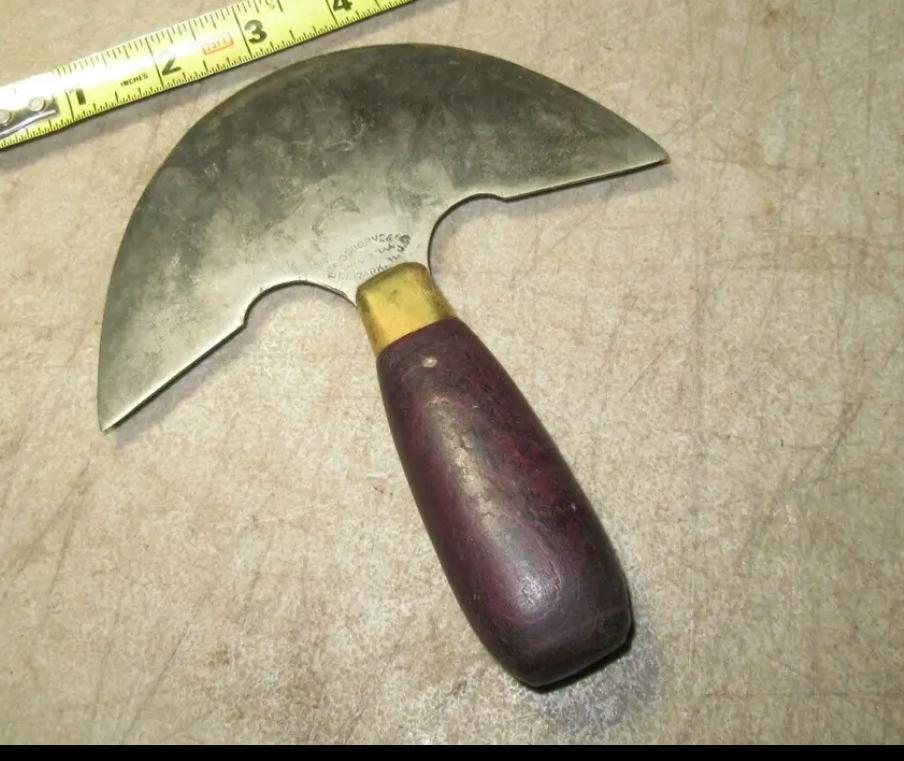
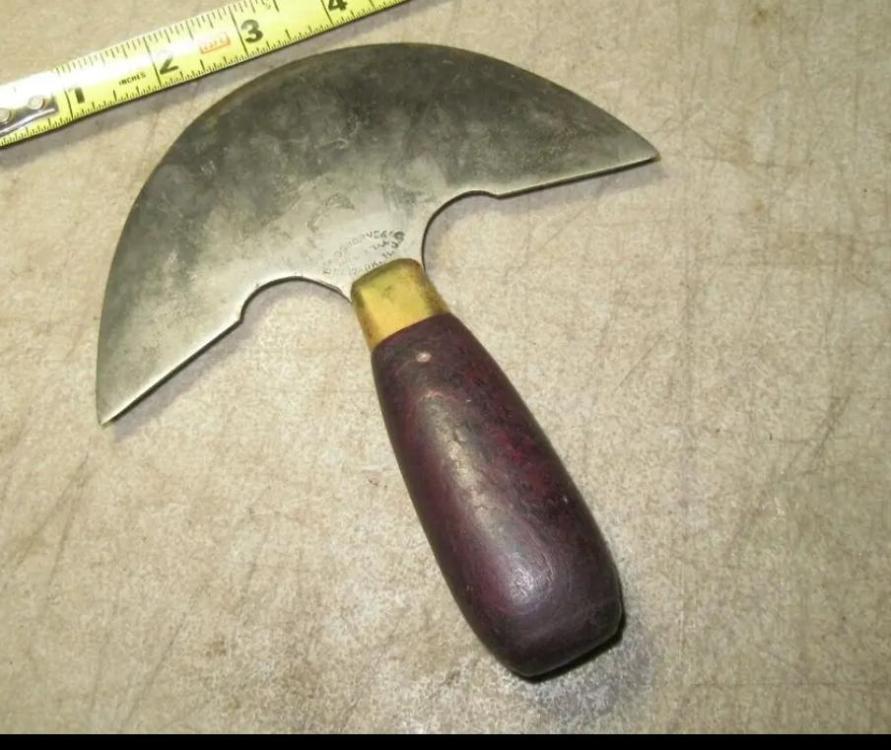
It is. Pic attached. Stamped “Newark,” so while I’m not sure of its age exactly, I’m fairly confident it’s an older one, based on my research on here. It’s on the larger end, but I don’t think I’ll necessarily mind that.
-
Ha, the handle at least is in good shape, that is true. Got the offer accepted on the other one, so we'll see how that one does, once it arrives. Looking forward to dialing in the edge.
-
I made on offer on another one that is in much better condition, with only very minor rust damage and a very clean edge. Figure I can fix any issues with an edge like that more easily.
-
That bubble sounds like it needed to be burst. Thanks for the advice, and I’ll run from that one. I was having a tough time judging how deep the pitting is. That’s much too deep for that knife to be much good.
-
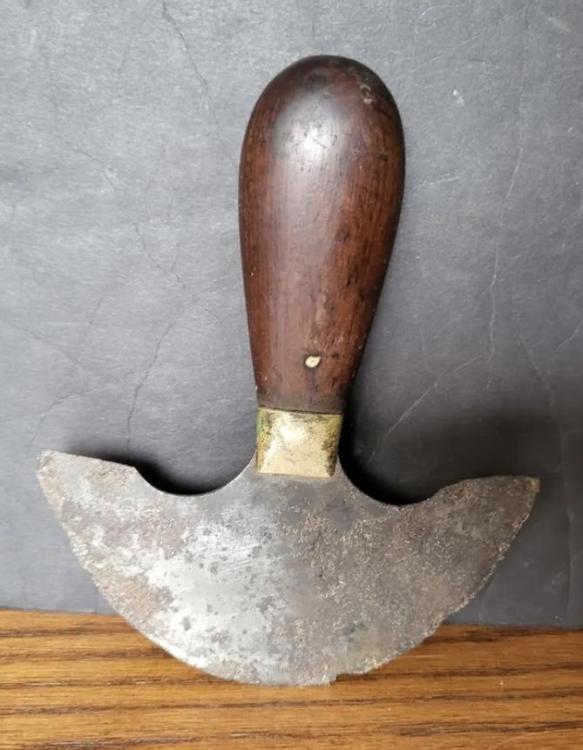
It’s the rust damage and evident abuse that gives me some pause. Those nicks look fairly deep. If I can get the edge smooth again, great; I can deal with rust pitting, as long as it doesn’t cause me too many issues with things like skiving. I’m just wanting to make sure I’m not signing up for more frustration than is truly necessary.
-
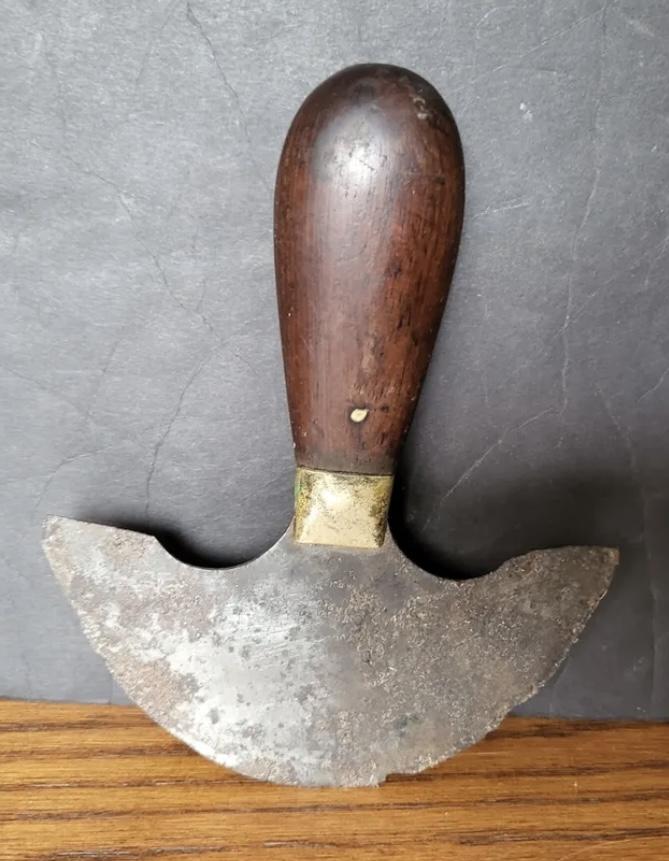
This is the knife. Bit grainy because I had to crop it down to reduce the file size, but there it is. It’s beat up but seems redeemable.
-
Thanks for tagging him. Meant to and forgot. I've got some pretty coarse grits I use to restore edges. I redid the broken points on a couple knives made of O1 tool steel, some pretty tough stuff. I guess in theory the high-carbon steel in the old C.S. Osborne knives can't be too much harder.
-
How difficult would it likely be to restore the edge of a vintage C.S. Osborne round knife? I found one on eBay that is quite old, so likely with the better steel of the old ones, and has a pretty dinged-up edge. It's a good price, and while I'm pretty handy with a set of waterstones, I'm concerned the steel might be hard enough that I would have difficulty restoring it well and end up wasting my money. I would be doing all the edge work by hand, as I don't have a grinder.