Spinner
-
Posts
1,373 -
Joined
-
Last visited
Content Type
Profiles
Forums
Events
Blogs
Gallery
Store
Everything posted by Spinner
-
Thanks Sam, even after a couple of days I still sit back and just look at it for a few minutes before starting tooling. Almost makes me want to turn the other, larger blocks of Amboyna Burl I have lying around the shop but then I remember I have burnishers to turn first. LOL There's probably close to $1000 worth of it scattered around my shop but I loathe to sell any as it's getting harder to find in good qualities.
-
-
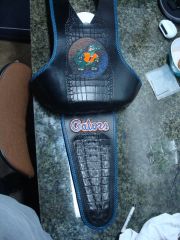
From the album: Three Mutts Customs pics
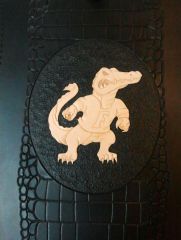
Florida Gators themed whaletail bib and rear fender bib set. The "Gators" and Albert the Gator were tooled in and then painted with Golden Fluid Acrylics. The inlay on the fender bib is black Caiman (tail section of the hide) and the gator 'hide' on the tank bib is tooled in to continue the theme. Requested for a '07 Honda VTX1800N. Herman Oak 5/6oz. with Royal Blue Kangaroo triple loop lacing for the edges.© © Three Mutts Customs 2011
-
Thanks folks. The good news is as of this morning we have full power back and the shop as well. Now time to clean up, figure out where everything is (made a mess trying to find supplies in the garage/shop with no lights) and get orders rolling again.
-
Hey Tina, If it helps, they sell their products direct from their website as well. If not, let me know and I can hook you up with a few of the .75oz sample sized ones I send to clients. A little goes a long way with this stuff. Chris Here's the link to the motorcycle products in their store: http://pecard.com/mm5/merchant.mvc?Screen=CTGY&Store_Code=Pecard&Category_Code=motorcycle
-
Hey Tina, The process I use on my bibs after tooling is apply a light coat of neatsfoot oil, let rest. Apply 2 coats of Pro Oil Dye, wait for an hour or so and then apply a second heavier coat of neatsfoot oil, let rest overnight. Apply 2-3 coats of resolene or super sheen (spray). The super sheen spray is used on pieces where I have done acrylic painting. I haven't had good luck with resolene over acrylics but the super sheen spray works nicely. Now that I can get Aerosol Neat-Lac in California again, I plan to switch to that for most everything. Let dry 10 min between coats, overnight after the final coat. Next day, I apply Pecards Motorcycle Leather Conditioner and a good coat of Pecard's Motorcycle Leather Dressing (Natural). Buff to a nice sheen with a clean cloth & wrap it up. I also include a sample size of the Pecard's Motorcycle Leather Dressing in the box for the client so they can be sure to use the same product to clean it as I do when making it. The Pecard motorcycle line is pretty weather-resistant (not going to say water proof) and they're a great company to work with. I've been told a few of my steps are backwards and such but with a ton of these bibs on the road, no complaints and some pretty harsh tests like gasoline being accidentally poured down the bib and another being subjected to a white-out conditions blizzard I think I'm going to stick with it. Cheers, Chris Cheers, Chris
-
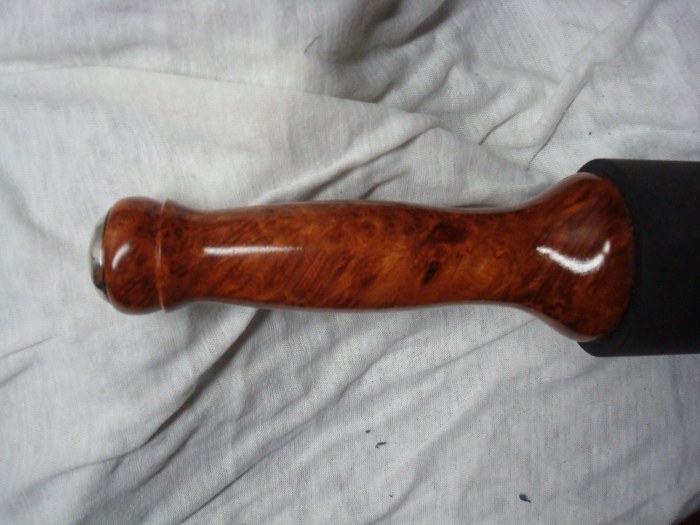
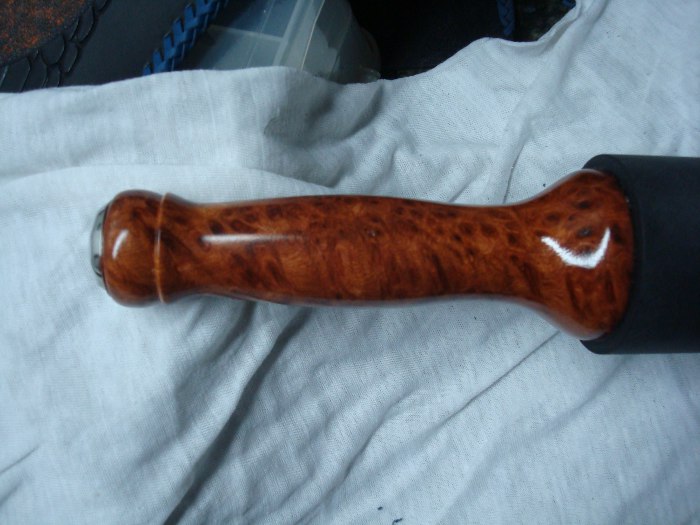
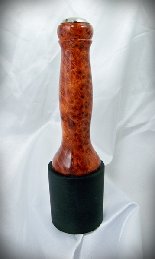
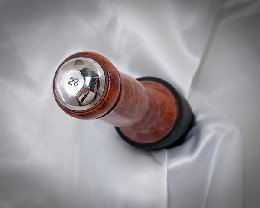
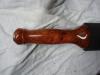
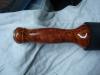
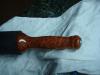
Thanks guys, I got a chance to use it last night and man what a difference a good heavy maul makes. I will say though, there is no such thing as a light hand with 28ozs. Was nice to have another option when tooling though and found switching back and forth between the two weights wasn't a big deal and made a big difference in tooling details. Here's a couple of bigger pics of the handle:
-
Some folks, especially the ones looking to buy burnishers have noticed I haven't been online anywhere for almost a week (highly unusual for me) so I thought I'd share some photos of the goings-on. Last week So. California was hit by a freak wind storm, the largest in 10 years, with winds at my house topping 80mph. The area I live in, San Gabriel/Pasadena area, has a lot of large trees including pines, redwoods, palms, deodors, walnut, sycamore, etc...not lightweights by any means. Anyway, long story short, the wind knocked down a metric crap ton of them taking out roads, houses, power lines & poles and reaking general havoc. We were without power and heat for about 5 days and now have 1/2 our power and our furnace back. The other half is lost somewhere between the line that was repaired and the house so I might be looking at 10+ blown breakers once I get a chance to check it out completely. The shop is the biggest part affected so I still can't turn but my wife was nice enough to help me figure out which of the exterior outlets still worked so I could at least plug in a florescent light bank and keep my leatherworking orders flowing. Hopefully burnisher production will resume this week. Here are a couple of pictures just for fun... Cheers, Chris Our driveway the first morning...took 30 minutes and my chainsaw to get out. Local apartment building near the only store (7-11) that was open the first morning Baldwin Ave - had lines of gorgeous sycamores, now all gone. 3'-4' diameter trunks. Looked like someone played dominos down the street. First night after I got the family settled with a fire & candles, headed into the shop to do some lacing Third night, found a store with some cool lanterns so the shop got a lighting upgrade
-
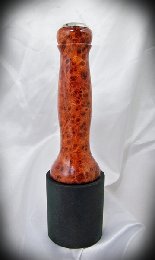
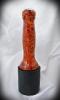
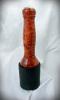
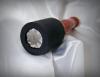
Just got my new Beary maul this last week and am finally able to share pictures of it. I ordered up a 28oz. maul from Beary and while talking asked if he would work with wood I supplied. The handle is made from a gallery grade blank of Amboyna Burl I bought at a woodturning symposium about 8 years ago and could never decide what to make out of it. Turns out the blank was the exact size Beary needed for the handle so I knew it was fated to be part of my new maul. Beary did a great job making it and it feels great. Now that I have partial power back and can charge my camera I'll see about taking some larger/closer shots of the handle, these were the photos Beary sent me as a preview. Happy drooling! Chris

-
That's a nice little binding attachment Joy. I'm getting ready to look for one for a Techsew 2700 soon, good to have a contact if I can't find one reasonably priced.
-
80-100 mph winds last night...I thought Chicago was supposed to be the Windy City?! No power for 2-7 days according to power co. ;(
-
Acrylic Painting
Spinner replied to Spinner's topic in Dyes, Antiques, Stains, Glues, Waxes, Finishes and Conditioners.
Here is a great tutorial on mixing advanced skin tones using variations of the 5 base colors: http://www.paint-sculpt.com/tutorials/skintone_pallet/skintone-pallet-page-1.html This link is a color mixing guide put out by Golden paints that allows you to see what color and how many parts of it to mix. The chart is based on their 8 color artist set. Notice the set doesn't include black! (but the chart shows how to mix black). http://www.goldenpaints.com/images/ColorMixingGuide.pdf -
I've had the question come up a couple of times lately via PM and email about what brand of acrylics I use and what colors to start out with for newbies. I'll start out by saying that my collection of colors is a little on the obsessive side, mainly because I come across projects that require odd-ball blends & such and if I can get around custom mixing a color by buying something I will. The reason being is if you ever need to do a touch up or recreate the piece/color, having it premixed in a bottle is much better than trying to re-mix it. Some things you can't get out of a bottle though, like skin tone since it varies so much. very few companies produce a skin tone and even fewer produce a good one. As you can see in the picture below, I prefer the Golden Fluid Acrylics brand but also use Angelus Leather Paints as a second choice. Here is a good starting line-up for folks looking to start acrylic painting on a budget with as few colors as possible: Black (Carbon or Coal) White (Titanium and/or Zinc) Naphthol Red Phthalo Blue Hansa Yellow Burnt Sienna Burnt Umber For Brushes, my favorites are the Scholastic Wonder White Taklon brushes (with the long handles) from Dick Blick Art Supply. They are great brushes at a very reasonable price and are made for water color & acrylics specifically. My go to types of brushes are: Round size 0 for fine details Bright size 4 & 6 for large flat areas and for working color from/to edges Flat Foot Wash size 1/2" for doing washes and large fades/shadows Script size 2 & 4 for doing pinstripping, and hair that involves long highlights Fan size 2 for various effects Another handy brush that can be found at craft stores like Michael's is a "stippling brush" and is great for water spray, foam, clouds and similar effects. They can usually be found with the stenciling and tole painting supplies. Back to the colors...the first 5 should be pretty self explanatory. Those five are the basis for pretty much any other color. Red + Blue = Purple, Blue + Yellow = Green, Purple + Yellow + Black = Burgundy, etc. it's all a matter of how much to mix and that's entirely up to you and what you're after. The last two are used for tonal changes. A common mistake is to use black to simply make a darker version of a color. This isn't quite true in fact, some art instructors won't even let you bring black into the classroom until you've mastered color mixing without it. Umber and Sienna are used for shades & tones. What's the difference? Easiest way to explain it is to look at your own skin. Notice the various tones of color between your face, arms, legs, belly, etc. All started out the same color at one time but with age, sun, etc. there are a variety of colors now. These are "tones". Now, stand in the sun and hold out your arm so something is blocking the sunlight. This new area is "shade", literally and artistically. Sienna is used for the tones, which are generally lighter variations but still have a 'warm' aspect to them. Umber is used for shadows, shade, or darker tones...basically where you would normally think to use black. Due to it's brown base though, Umber has less a tendency to wash out the underlying colors and gives them a more natural brown/grey aspect to the underlying color suggesting shadow or shade. If you really want to paint with a minimalist set of colors, do yourself a favor and buy a good color wheel. The type that move and allow you to see what the base colors for all the secondary & tertiary colors are the best and only cost about $8 but will uncover the mysteries of how to mix somewhere around 45 colors using just the 7 colors listed above. That's the primer for now. I'll add a bit more on specific mixing when I have some more time later this week. In the meantime, here's what I meant about obsessive color collecting: Enjoy! Chris
-
I Need A Source For 1/4 In Metal Lace
Spinner replied to alb's topic in Saddle Supplies, Tools & Trees
That's kind of what I was thinking dirtclod...funny thing is, while I understood the "it's used in saddlemaking" part, the rest was as foreign to me as the inner workings of a woman's mind. LOL -
You definitely can. USMC is spirit based so the water based dye underneath will have no effect on it. It may take more than one application though as a single or light application will give the black a 'golden' tone versus the gray/blue tone a true black has.
-
I Need A Source For 1/4 In Metal Lace
Spinner replied to alb's topic in Saddle Supplies, Tools & Trees
No worries, thanks for the reply and explanation. Just thought it sounded like something cool to explore. -
Gimp is free & easy to use: http://www.gimp.org/downloads/
-
I Need A Source For 1/4 In Metal Lace
Spinner replied to alb's topic in Saddle Supplies, Tools & Trees
Having not needed or seen any yet, I'm curious...is this actual SS metal lace or something like the metallic lace that Y-Knot sells? If it's real metal lace, how does it braid (like triple loop) compared to say, kangaroo? If it's similar, I might be interested in buying some from you for a project on my motorcycle. Cheers, Chris -
Hi Bob, I use the straight chisels for doing triple loop lacing on edges. It may not be technically correct, but I like the way it creates a linear border next to the angled lacing and helps create the "forward motion" look that using an angled chisel doesn't quite create. Chris
-
Clay and Tinneal have it right as far as the "Best" way to do it. The main problem isn't in re-casing it for the wet forming, it's the forming itself that messes with the tooling. The leather stretches a bit anywhere you form it and if there is tooling there it will want to pull apart and show the cut lines more which makes the tooling look very shallow. I've had to do this on a tank bib before where the client wanted flames tooled the entire length. Unfortunately I don't have the option to make a hard shape (9 different gas tanks I work from) so I cut and lightly tooled the piece on the bench, then wet formed it to the tank. Once dry on the form, I quick cased it and retooled the majority of it to the proper depth and blended it into the unformed area so it all looked correct.
-
Green Gun...check It Out..
Spinner replied to Rayban's topic in Gun Holsters, Rifle Slings and Knife Sheathes
I must be missing something...I see the links to the green laser sights for those weapons but not the demonstrator green guns? -
Green Gun...check It Out..
Spinner replied to Rayban's topic in Gun Holsters, Rifle Slings and Knife Sheathes
Nice find! -
Sorry I haven't gotten back to this post in a while folks, it's been busy as heck lately. I did order a hide from Goliger and one from SLO and both of them were excellent quality worthy of A grade status. I meant to get pictures of them but orders required they get cut up pretty quick and 1 1/2 hides are already turned into tank bibs and out the door. I couldn't tell the difference between the two; the temper, color and clarity of both hides were equally nice and price was almost identical including shipping ($200 each for 22-24 sq. ft of 5/6oz. including shipping to L.A.) Now the personal dilemma comes in...as it turns out HO is excellent for carving and I have literally had the best time carving, cutting, etc. on both hides. The problem came in with the temper being a touch too stiff for the type of wet forming I do. So I'll have to choose when doing projects, HO for the flatter projects and W&C or something similar for the large formed tank bibs. Clair - that is not what my recent A grade hides looked like. Yours appears to have a lot more stretch marks in the belly area and definitely more marks/scars on the body. I'd guess that either that's an A grade from a lower tannery or someone grabbed a B/C off the pile by mistake.
-
+1 to Ostrich Market, fast shipping and nice selection of many types of exotics.