


.jpg.e13e7809a690335a89b8a4ed2e876db1.jpg)
Northmount
-
Posts
6,539 -
Joined
-
Last visited
Content Type
Profiles
Forums
Events
Blogs
Gallery
Store
Everything posted by Northmount
-
.thumb.jpg.6e903dd66163ad5672f00f144058c571.jpg)
Durkopp Sewing Machine - but which model?
Northmount replied to Andy Stoneman's topic in Leather Sewing Machines
Please post your photos here. 3rd party hosted photos frequently disappear due to changes in the host's policies, host out of business, users moving files, deleting files, closing their account or the account expiring. When this happens, the post becomes worthless to all future users who are researching or looking for help to solve a problem. Post your photos in jpg or png format. They display automatically. Many members will not download unknown files or file types. If your files are too large to post here due to file size restrictions, you need to resize your files to fit. Follow this link for some helps and suggestions. https://leatherworker.net/forum/topic/15122-how-to-post-pictures-on-lw/?do=findComment&comment=551171 There are lots of Apps, software, and online tools available on the web, or even built into your device to enable you to reduce your file sizes. 800 pixels in the longest dimension is quite adequate. Smart phone screens and many monitors don't display high res files in high resolution. People that live on the fringes of the internet appreciate smaller file sizes and high res photos may take from 10 minutes to hours to download. -
You need to list a price in US$ and shipping information, who pays, how much, any areas you won't ship to, etc. See the marketplace rules here https://leatherworker.net/forum/forum/70-announcements/
-
See the marketplace rules here https://leatherworker.net/forum/forum/70-announcements/ You must post a price in US$
-
And you have a dark cloth to cover both ends so ends of the rolls of leather don't get suntanned. (daylight or indoor lighting)
-
@PastorBob Anyhoo, if anyone may be interested, here is a link to it. https://pastorbobleather.com/product/cross-draw-j-frame-revolver-2-barrel-holster-template-acrylic/ Please post your template on the 3D Printer forum too! https://leatherworker.net/forum/forum/223-3d-printers-and-lasers/
-
Moved your post to leather sewing machines. This is where the machine guys hang out. So you'll get answers here. Instead of the term 'free arm' look for cylinder bed. You can get table attachments so can have a flat bed as well.
-
Moved your post to leather machinery.
-
These are leather conditioners and don't seal the surface.
-
Reduce profile fragments and increase messages per page?
Northmount replied to AEBL's topic in Feedback and Suggestions
Reduce your browser screen/window width and the left side disappears. -
Moved your post to stamping. Wanted is where you are looking for tools or equipment you want to buy. There are tools posted on eBay you could use as a reference. You could go back through the old/sold archive looking for past posts, or try a search for craftool prices.
-
Moved your post to "wanted". You should include your approximate location in your profile so you get response related to where you are.
-
Techsew 860 post bed walking foot machine
Northmount replied to Samer's topic in Leather Sewing Machines
I have a Techsew 2700 cylinder bed machine. Reliable, no problems with it. Doesn't get used heavily since I don't do a lot of work. -
nippy skimini Nippy Skimini - Portable Skiving Machine 95% Condition
Northmount replied to badaxjava's topic in Old/Sold
His post says "I’m selling it at $1200, exclude shipping" Note the seller is located in Indonesia. -
I don't see your note about whether you ship will ship and any restrictions as to where. Also question why your IP address says New Zealand and your profile says Ontario? Please update this thread else I will be locking it and archiving it.
-
Specs in the opening post says foot lift is 13mm, about 1/2". So should be able to handle 3/8" thickness.
-
On Google, use site: leatherworker.net followed by your search parameters
-
If using pliers, use flat jaw type. No grooves that may mark the needle and begin a crack causing a break if slightly twisted. Straight pull, no bending action.
-
Moved your post to sewing leather.
-
You need to state if you will ship, where to, who pays. See the marketplace rules here https://leatherworker.net/forum/forum/70-announcements/
-
Out of stock on both sites. Hasn't been on his Facebook site since 2022. https://www.facebook.com/profile.php?id=100067802724697
-
Maybe you could provide a little more information and pictures to help identify it and see what condition it is in. Here is some information from an old thread.
-
It was privately printed by/for Bob Park, not by a publishing house. No ISBN number.
-
Best way to tighten Chicago Screws?
Northmount replied to DeWayne Hayes's topic in How Do I Do That?
That is similar to mine. Below is the style my Dad used (for valve in block). Neither of these would make a good tool for Chicago screws.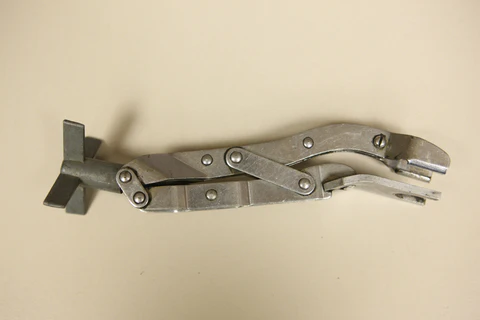
-
The 25 kV line down my back lane (Calgary AB) is 3 conductors only. Drops are made to transformers along the way. The transformers are connected between 2 phases (resulting in single phase delivery) on the 25 kV line, and deliver 110V - 0 - 110V via 3 conductors. (The 0V lead is the N (neutral typically white) conductor.) Overhead drops to houses are via triplex cable. Connection across the two 110V conductors provides 220V which is typically used for heavier loads like electric stoves, clothes dryers, air conditioners and shop tools like table saws and air compressors. As the 25 kV line continues down the lane, transformers are connected to the next pair of phases, and onto the next pair, providing a balanced load on the 3 phase system. It is more economical to use 3 phase transmission as currents flow counter to each other as you look at the actual current flows, reducing the cable diameters versus what would be needed in a single phase system to transmit the same amount of power. In commercial and industrial applications, utility power (110V lighting, receptacles, small motors, etc.) is often distributed as 208V three phase wye connected. 120V power is available by connecting to one phase and the center tap of the wye connection. 120V and 110V terms are used interchangeably, as is 220V and 240V in many discussions and specifications as they are within design tolerances. During my electrical education many years ago, what we now call 110V or 120V was simply called nominal 117VAC.
-
Moved your post to leather sewing machines. You are much more likely to get help here than in leatherwork general conversation.