


bruce johnson
-
Posts
4,401 -
Joined
-
Last visited
Content Type
Profiles
Forums
Events
Blogs
Gallery
Store
Everything posted by bruce johnson
-
I am going to join the parade and say that the beam is original, the blade maybe, and the fence is probably not true to the time the other parts were made. I have about 20 of the Dixons in the wings and few variations besides what has already been shared. Dixon was proud back in the day - the blades were variously marked with Dixon names, "Warranted" with a name, etc. According to at least one family member they changed up and recycled markings every so often so you can't trust age by the marking. Also the English made blades were pretty universal. You could have T Dixon frame and a knife by Butler, Adams, Brindley, Barnsley, or Joseph Dixon would go in it. With this blade not having a marking - might be a late version. The fence looks too modern to me compared to all other versions. Does the brass roll or is it fixed? Hard to tell from the picture, but have not seen one that didn't have a loose roller.
-
 I've got quite a few Barry King and other stamps for sale on my website. Here is a link to the page of carving and stamping tools - http://brucejohnsonleather.com/leather-tools-sale/leather-carving-and-stamping-tools-sale/ . No Barry King handled tools right now, but have a bunch of others. Thanks, - Bruce
 -
Frederick, I don't get the hollow backs very often. I am on a stay at home vacation this week and working in the shop to catch things up. Two of things on tap for today are edge shaves and purse creases. I don't know if there are any more hollow backs but if so, they go to the front of the line. I will be adding the tools I have worked up either tonight or in the morning. Thanks! - Bruce
-
I don't have a full blown complete how-to but I have a mini-tutorial on my website about making rounds, using a rein rounder, and some tips and tricks. - http://brucejohnsonleather.com/tutorials/
-
Most every stamp maker back in the day made these. Currently for sure Barry King makes them - they are listed on his website as "round grounders" - about 3/4 of the way down the page - http://www.barrykingtools.com/groundersbevelers.htm
-
W.J. Budd Splitter and Y-Knot Lace String Cutter
bruce johnson replied to Nevadan's topic in Old/Sold
Sent you a PM, I want them both -
How to adjust/setup Saint Louis Skiver
bruce johnson replied to Svey302's topic in Leather Machinery
Also it looks like your blade is sitting pretty level. You didn't mention about changing that angle to make different angled skives so I don't know how much you have played with other adjustments. If not, it adjusts on either side. Behind that elongated wing nut is an adjuster. Loosen the wing nut, move the little "handle" in either direction. It is an eccentric that will raise or lower that side. On the outside is the hex bolt with a knurled round doodad under it. Loosen that hex, turn the knurled piece (also an eccentric) to raise and lower the outside aspect of the blade rest. That one can be sticky and a little PB Blaster or similar is your friend. -
How to adjust/setup Saint Louis Skiver
bruce johnson replied to Svey302's topic in Leather Machinery
You can sure minimize but probably not totally eliminate the marks. You can get them to a manageable level to where they will rub out. Three things - 1). blade should be super sharp to minimize drag. More drag = more pressure needed to push the leather through. 2) Enough space between the top and bottom roller to just grab the leather without compressing it much between the rollers. It adjusts with the hex head bolt right there in the picture 3) This follows along with the space in #2, but just enough spring tension to put enough pressure on the rollers to feed. Back off or tighten the square head bolt below the compression spring. And....after all that - some people will machine down the grooves on the top roller to minimize marking. I've had them with smooth rollers on top and they still feed. On the B the bottom roller does most of the grabbing. Some other models only the top feeds and the bottom is an idler. -
If it is something I plan to use or sell to use - I'd save the mark and clean up the rest. If it is going into my corner of cool S**T Tools, then I mostly leave patina but remove rust. Even the cool tools get used for their intended purpose at least once before they go on the wall..I put enough of an edge on the knives to cut something for fun. The draw gauges get to cut a strap or two. I have an old willow leaf blade I keep around just for that purpose. I'd like to think those old boys who made these old gems and those that used them to make a living before me would appreciate me using them "one more time" before they get hung up. Besides, when you cut some leather with a 150-175 year old tool, you feel history in your hand.
-
Ken, I've had a few. I did get one with instructions and it was made by JHE Enterprises or something like that in UT. I think Timberline used to carry them too. They do show up every now and again, but I don't think they've been made for a while. And in one of those "you shoulda been here yesterday" deals - one sold on Ebay yesterday. - Bruce
-
I just got in an unused Hansen as well. The blade will need a lot of sharpening for sure. I expect yours is the same.
-
Thank you! I have had the 2x36 for a few years. It gets used daily and a great tool. There are times where a 4" wide would be good to have. I will check with the US supplier. I like the shroud and dust collector you have on yours - I'd still be masking up but shop cleanup would be a lot simpler. Several good ideas in your post and I sure want to thank you! - Bruce
-
Is that a MultiTool attachment that you are using for the sanding? If so, where did you get the wider width model at? Thanks! - Bruce
-
One thing I am seeing in your pictures is the blade is sitting a little back. On the black yoke that holds the feed roller the outside has a "stop" to slide the blade up against. On yours I can see a gap of maybe 1/16" between the blade edge and stop. What I do is slide by blade up to touching the stop. adjust my back screw to hold it there. Then I back off that screw maybe 1/4 turn so the blade edge is very close but not binding against the stop.The closer to the stop the blade edge is then the better they will feed directly into the blade. Sometimes you may have a blade that the bevel is uneven and not centered in the thickness of the blade. the thinner leather wants to ride over or under the blade. Try flipping the blade and see if that makes a difference.
-
I got my big one from Grizzly a few years ago. They had/have a freight agreement with FedEx and it was surprisingly cheap to ship. I just picked a smaller one up at WoodCraft last week for a sharpening surface in the tool shop. It is a pretty good bang for the buck I thought.
-
Sure should be able to, the adjustment screw on the back goes from the frame up through the yoke that holds the bottom feedroller. Loosen that adjustment to raise the bottom roller so it will engage the thinner leather. You might need to take a turn or so on the spring tensioning screw to add a but more pressure, might not need to depending on how tight the spring is adjusted now.
-
This brief clip shows the grip I use on a draw gauge. Middle finger on the trigger, index finger pointing down the right side and pushing back against the front. This counteracts any torque from blade drag and gives me a solid grip. My thumb naturally falls into place to hold the leather down. -
-
All Metal Jaw Stitching Horse
bruce johnson replied to Possumbreath's topic in Leatherwork Conversation
I haven't seen one like that, any patent or marking info on it? I have attached pictures of one of mine. It is a Doering patent and sold by Randall at one point.
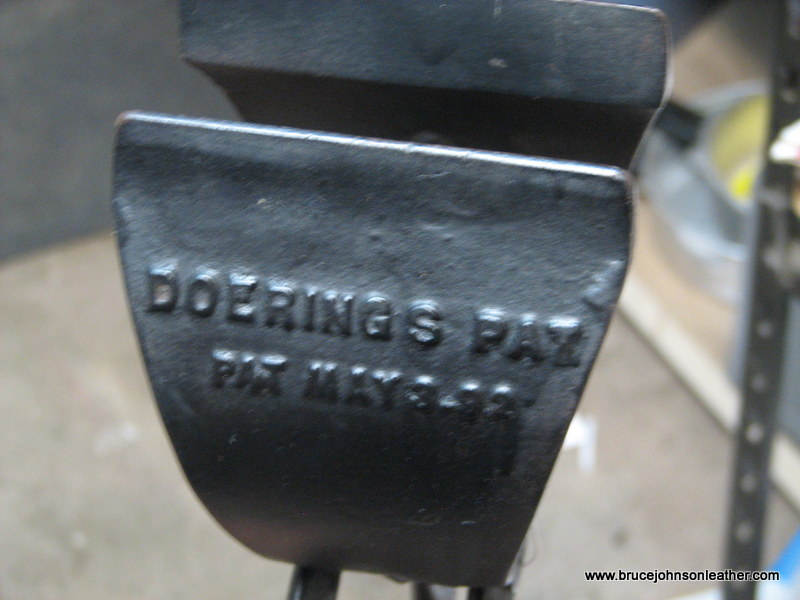
-
Some people think it was a quality grade - umm, no. In the old catalogs it was a size mark for the #70 round knives. I work from a 1897 copy mostly. The "small" was 5", the "usual" was 6", "X" was 6-1/2", "XX" was 6-3/4", The "XXX" was 7". They also list extra large knives to order.They do list a 2nd quality knife but only in 6".
-
I am thinking Robert Jolley - Montana
-
Reliable splitter to split leather to 1mm thickness??
bruce johnson replied to thekid77's topic in Leatherwork Conversation
Bob, IN a word "yes". The crank splitters have a feedwheel and the leverage of the handle and gearing to allow more force than a simple pull by hand. The common crank splitters were designed for the shoe repair trade and are 6" wide (shoe soles). The downsides of the cranksplitters - more expensive, they push the leather into the blade instead of pulling so the leather needs some body or it will wad up against the blade and split unevenly, . -
Reliable splitter to split leather to 1mm thickness??
bruce johnson replied to thekid77's topic in Leatherwork Conversation
I've had a bunch of 10" pull through splitters and the occasional 12". Problem is that most people can pull about 3" width pretty easily and it gets exponentially harder once you go wider than that. The extra blade width just gives you more blade to use before you need to work the edge up again. I've probably got a brother Randall to the 18" Big Sioux has in my shop right now. It is here to get a new blade put on and adjusted. It literally took two men and one large boy to unload from their pickup. I expect he paid more than $1000 just to get the new blade made for it. The old rule of thumb on the tried and true big splitters was $200 per inch of blade. That has weakened some, but not a lot. I know of a motorized 10" splitter in a local shop that is closed, but nothing is for sale. The Artisan is a 20" and one of the best favors ever done for me was to get a crappy demonstration and condescending sales talk one year at Sheridan. I had money in pocket to buy one, and Jerry didn't think I was serious. Cobra Steve has a 14" motorized splitter modeled after the Landis #30 crank splitter, not sure where the pricing is now on the Artisan or Cobra. . -
I'd guess a push beader and cleaned up on the ends with a beveler. They look pretty rounded up to me. Darcy is a really good maker and i'd bet he'd tell you what he used.
-
Some are just jammed in and friction fit. Some are glued in. Some have a small wooden wedge on one side or the other of the tang.
-
Vintage Head Knife, New Barry King Swivel Knife, and more
bruce johnson replied to SantaFeMarie's topic in Old/Sold
I'd go that. Please message me. Thanks, - Bruce