
Constabulary
-
Posts
5,806 -
Joined
-
Last visited
Content Type
Profiles
Forums
Events
Blogs
Gallery
Store
Everything posted by Constabulary
-

Claes 30 patcher - foot not walking?
Constabulary replied to MegasHockeyShop's topic in How Do I Do That?
Please post some pictures of your machine - first thing I woulds guess is that the stitch length is adjusted too short but that would be too obvious I think. Or (just from pictures I have in mind) the Transportkeil (sorry no english word for it in my dictionary for it) "popped" out of place. The Transportkeil is handing on a rim on the needle bar bushing in which the needle bar is going up and down in. But thats a rough guess at the moment. -
$100 just for the wiring? WOW Can you post a picture of the wiring he did in the motor junction box? Hope he did not forget to install the capacitor.
-
YES! We have the same plugs in Germany.
-
Hope this helps:
-
Singer 111w155 or the Consew 225 clone
Constabulary replied to unclebubba's topic in Leather Sewing Machines
I´d most likely would buy the Consew and add a servo motor as is is in better condition and for sure the newer machine with "less milleage" -
Must be an amazing and very secret process. I´m sure they are using some miracle "outer space" sewing machine oil too. WHAT A JOKE - this very thin needle (#90 metric) OF COURSE will "punch through" the shown leather and almost any type of fabric - most likely even double the thickens. But this has nothing to do with how well this machine is set up by the seller or what ever. That's plain ans simple physics - A very thin needles combined with a very thin thread will punch through this OF COURSE like nothing. Guess why your Doc is using a very thin needle with his syringe and not a 1.4mm one. But try this machine with a 140 (22) needle with 30 (138) thread which is approx the lower end of thread and needle combination being used for sewing this type of leather "under real life conditions" f.i. when sewing a proper leather belt - it will not work. or try to sell a belt which is sewn with a #90 needle and #50 thread (metric) - not that it only looks stupid and the seam has a very low breaking strength - almost any customer would point you a finger when he is looking at that belt - I bet. This machine will not ne able to handle a 140 needle with 138 thread. Talking some bla bla while shooting a video with a short piece of thick leather and producing serious leather goods is a whole different thing. Years ago I have killed 2 domestic machines until I figured / understood what it really means when people are taking about domestic and industrial sewing machines. And by far not all industrial sewing machines are meant to sew leather with - weight of a machine has nothing to do with its ability to sew leather / producing leather goods. So right!
-
table mounted winders for industrial sewing machine usually don´t have springs on the axle - at least I haven´t seen this before. There are some type of machine mounted bobbin winders that may have a small spring if I recall correctly.
-
usually the axle is split and you can simply bend the 2 prongs with a screw driver to fit the bobbins - the shown modification is not necessary.
-
You cannot put everything in a museum - I love vintage machines too (oooh yes I do!) and I had a few very pristine machines I wanted to keep (just because of their condition - for no other reason) but in the end if I don´t use it is just collecting dust and takes space. I also have a nice 132K6 (yet head only) and I for sure will use it when its setup is done. But I most likely will never wear it out. Machines that you don´t use sooner or later end up in a barn or shed or attic where they sooner or later will be forgotten. Then one day a scrap collector shows up and takes it for nothing (I´m sure a lot of machines ended like this) - so better use it or sell it to someone who can use it. But really think twice if you really have no use for this beauty!
-
Pfaff and Adler also made left standing machines of this type. I also wondered why left standing at all have been produced - but seems there has been a demand for them.
-
Hand Crank Mechanism for Singer 29-4
Constabulary replied to micktx's topic in Leather Sewing Machines
Do you just need just a knob for the hand wheel or a complete conversion to a front crank as Yetibele it has shown? The complete conversion kit (if it will fit at all) for sure will cost a lot of money - not sure if it is really worth converting a 100 years old machine that way. However - you only can convert to front crank if a gear is mounted on the top shaft in front of the drive cam. Open the rear cover and check. If there is no gear you have to pull the top shaft and install a gear. Pulling the top shaft means disassembling almost the complete machine. And thats really not worth it - in my opinion. -
BTW - just checked my records and found an Adler 48 (same machine class) brochure - it says the bobbin can hold 22m of size 40 (metric) thread.
-
hooks and bobbins are available (same as Class 17) some other bits may work from other machines (Class 16, Class17...) but you have to look for them. You sometimes even find these machines with a wheel feed mechanism. These are rather light duty sewing machines, designed for sewing shoe upper, decorative stitches, sewing wallets and hats. They are by far not as heavy as the 45K. The bobbins are rather small and they usually can handle up to #30 / #25 thread - maybe #20 (Metric) but you will not get much #20 thread on the bobbin. Machine has nor reverse. Comparable machines from other brands are Pfaff 23, 25, 28, Adler 48 (all right standing but the same class). Hope this helps a little bit.
-
Need help. Which machine is this.
Constabulary replied to spaz12gg's topic in Leather Sewing Machines
if it is Russian I cannot make further commends regarding parts - sorry! Never touched a Russian sewing machine. -
looks like a Singer 18 - left version of the Singer 17.
-
Need help. Which machine is this.
Constabulary replied to spaz12gg's topic in Leather Sewing Machines
This is not a walking foot machine. This is a "plain" drop feed machine with with Roller foot and they often have a quite aggressive feed dog so it is possible that the feed dog will leave marks on the underside of the leather. Just keep that in mind. -
a Metric size 180 needle punches a quite large hole for 138 thread - I usually run a 140 (metric) needle with 138 thread. Canvas and vinyl are "healing" the needle hole where as veg tan leather is not so the too large hole is probably the reason for not forming a proper thread loop. Hope you know what I mean. Try a 140 or 150 metric needle with you thread and I´m almost sure it will work.
-
Need help. Which machine is this.
Constabulary replied to spaz12gg's topic in Leather Sewing Machines
without problem - foot lift should be approx 12-14mm so it should be able to handle 10-12mm thick materials. This type of machine works best with thread from size 20 (metric) onward. Don´t buy it untested - check with the seller and test sew it with the thread and leather you want to sew with. This type of machine usually is very reliable and long lasting. Equivalents are the Singer 45K, Adler 4, Adler 104, Claes 212 - just to give you some comparable models. You probably want to add a speed reducer pulley system for reducing the sewing speed. -
Need help. Which machine is this.
Constabulary replied to spaz12gg's topic in Leather Sewing Machines
I would assume a Singer 45K clone made by NECCHI in Italy. Why NECCHI? Because their hand wheel is distinctive but thats just what I recall. I´m sure Singer45K parts and accessories will work with this machines. Machine has reverse by the way. -
what about STRIMA in Poland - they seem to have lots of Pfaff parts Or check with Nähtechnik Kaiserslautern GbR Im Erfenbacher Tal 16 A 67661 Kaiserslautern Germany Phone: 0049 (0) 631 3507818 Fax: 0049 (0) 631 3508202 E-Mail: info [at ]naehtechnik-kl.com Their website does not exist (anymore or not yet) but I bought parts for my Pfaff 345 from them and they were WAY (!!!) cheaper than any other Pfaff dealer I contacted. But not sure if they ship outside Germany. They are listed as Pfaff dealer on the Pfaff website too: https://www.pfaff-industrial.de/db-partneradressen/europe/germany/03-dap-dealer-ntk
-
Thread path looks good. Your tension unit looks a bit different to what I have seen. There should be 2 screws - one is for the spring rest (front screw) and the rear screw is holding the tension post in place. If you have to adjust the regulator spring travel you have to loosen the front screw. The spring rest usually it a curved metal tab that is mounted behind the silver disc with the long nut. You can slide the curved tab back and forth when you have loosen the screw. Check if you have that cured tab but maybe the spring rest looks different on your machine - can´t really tell from the pictures. One more thing - do you have a knee lifter for lifting the presser foot on your machine? It sometimes can happen that you slightly push the knee lifter (even if you don´t want to) while sewing and that already can cause a top tension release and the thread knot shows up on the underside. If you are using a foot pedal for lifting the presser foot take your foot off the pedal while sewing.
-
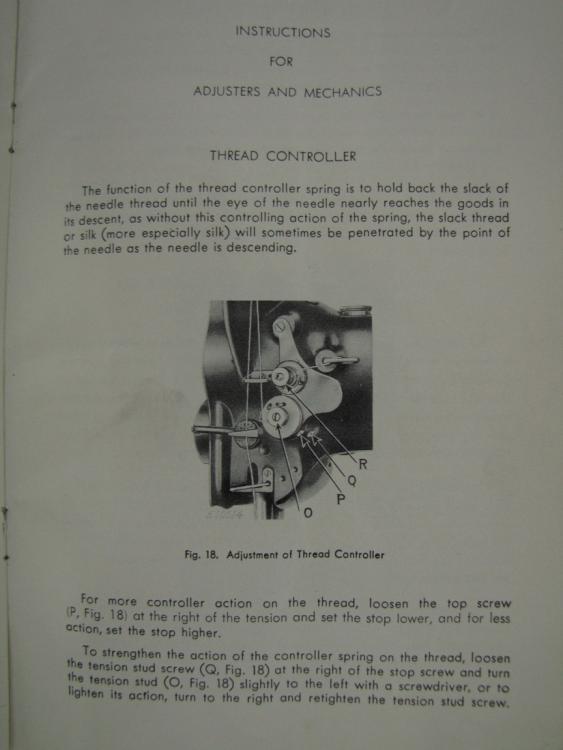
II would check the thread path and maybe try to in crease the top tension a little bit and probably check if the thread regulating spring is well adjusted. (just a guess). See picture for regulating the spring
-
Not possible to explain this any better - again great video , Uwe This works for any sewing machine rotating hook who have a bobbin case opener similar to the one shown in the video not just Juki 341 (Pfaff, Singer, Consew, Seiko, Adler... you name it) so it´s worth watching.
-
very cool bag - very nice texture - I really like it
-
See my above post and the red circle - seems the parts are present - in the circle I see the shuttle race, shuttle hook and race - missing parts (or outside the picture) are the screw for the brace and the spacer. EDIT: Mr. 45K hit the send button a moment earlier EDIT II: seems the spacer is still installed so the only parts would be the screw for the brace / spring that fold the shuttle race in place.