Ole South
-
Posts
237 -
Joined
-
Last visited
Content Type
Profiles
Forums
Events
Blogs
Gallery
Store
Everything posted by Ole South
-
I've rebuilt a "parts machine" 111W155. Initially it sewed well but I tried to adjust the alternating presser foot height by the manual and things went in the crapper. The vibrating foot lifts 3/8ths -1.2 inch. the alternating presser foot (outside) barely clears the material being sewn. This makes it difficult to sew across height variations like seams. The mechanics appear to pivot the outer foot off the inner.... but when I adjust them for the same lift (standard) the inner foot binds on the feed dogs and locks up the machine. The manual doesn't specify where/what their starting point/position should be. Anyone else experienced this? Thanks. (Needle bar height is set correctly)
-
Yep Conny, I beat the beejeebers outa that pin (from the back) to the point I was afraid of mushrooming it. The end started out rounded and now is pretty flat. Yessir, I've heated it ("it" being the lever pivot area{driving rack arm} not the head casting), torched it, frozen it and doused it with penetrating oil all to no avail. But the good news is that I got the roller pivot out (my original objective)... I finally just clamped a pair of vice grips on it and gave a hefty heave-ho and lo & behold it broke loose and rotated out. Then the other shoe fell... The new roller pivot O.D. is a mic or two larger than the one I removed (~7mm) AND... about 5mm longer. Now the roller pivot is out I can run a pin punch down the lever hole and there seems to be an obstruction. It could be just corrosion buildup but if it's the casting then drilling and punching from the hand-wheel side wouldn't have worked probably and my new roller assembly will bottom out before seating. Does anyone know if that hole is drilled thru and thru? Aussie I didn't ignore your advice... I just can't get to the backside of the roller pin since removing the needle bar lever has been a no-go. Btw, this being a 29k-30 I found the driving rack pivot pin is a significantly larger diameter than on my 29-4. I really need to get this poor orphan sewing. Thanks guys for all the advice and help!
-
Weellll, that didn't work. Three days under pressure and only the clamp gave. The pin didn't even move. I guess I'll have to grind off the end of the roller pivot and punch it out from the needle bar lever end. Or drill it out :\
-
Thanks Ndn.... what we forget... a brilliant suggestion. I'll take a C-clamp and a couple sockets over to the shop tomorrow (I've actually used this technique before I got an arbor press. ' must be getting old, dang it.)
-
Thanks for all the help guys!! Okey-doke.... center pin (needle bar lever/big pin) is frozen in the needle bar lever. It oscillates freely front and back in the main casting but won't budge when trying to drive it out (back to front). I've heated it, froze it, doused it with penetrating oil all to no avail; hammered the back of the pin until it's gone flat. I'm afraid to beat on it any more for fear of mushrooming the tapered end of the pin (note: the front side of the pin was already flattened). All I can think of now, is to try and find a small bearing splitter/separator tool and see if that will break the roller or roller pivot free from the end of the lever. Anybody got another idea??? Additional notes: Circa 1945 machine and... Is there supposed to be a pin securing the cam/drive pulley to the main shaft on a 29k-30? The clamping screw was missing and only a pin held the drive pulley to the shaft.
-
We have to remove the arm to replace this roller?
-
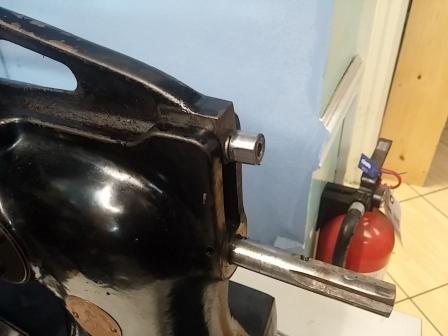
I've acquired a 29K-30 Patcher. Works okay but I found a flat worn on the cam follower roller mounted at the end of the needle bar lever. Ordered and received a new roller and pivot assembly from Pilgrim (p/n 1801) but the drive shaft is so worbled up at the end I can't pull/hammer the cam/pulley off. I can pull it back enough to free the roller but don't see how to pull the pivot. The original roller appears to be peened or swedged onto the pivot shaft so I can't just replace the roller. Any advice? I'm taking a couple wheel pullers to the shop today to remove the pulley but there's no place I can see to clamp onto the worn part.
-
Tandy just released flyers advertising Tippman Boss' for sale this month. I spoke with a Tandy Regional manager a couple months ago who said the patent was expiring. I imagine they are trying to expand their base before clones begin hitting the market.
-
puckers in waxed canvas stitching
Ole South replied to georgeandgracie's topic in Leather Sewing Machines
Consew 28 or Singer 78-3 are needle feed designed to do canvas (read Model A curtains and tops) and pop up from time to time. No reverse but poor mans spin and sew or lift foot and needle and draw back 2 stitches works well with upholstery. Why not just swap out the head and drive belt as you need it on your current table? http://denver.craigslist.org/for/5587457264.html - Consew 18 Looks like there's a double needle singer for sale in Co Springs too ($500) -
I need to make a pair of toe caps for a little girl's faerie boots. I'd like to use black patent leather; any ideas on how best to form them?
-
I ran across a semi-tutorial posted by one of our members on a blade forum. Nice post... he uses some alternative techniques not documented much here but worth a look. Nice results. http://www.bladeforums.com/forums/showthread.php/568981-Some-tips-and-thoughts-on-folder-sheaths
-
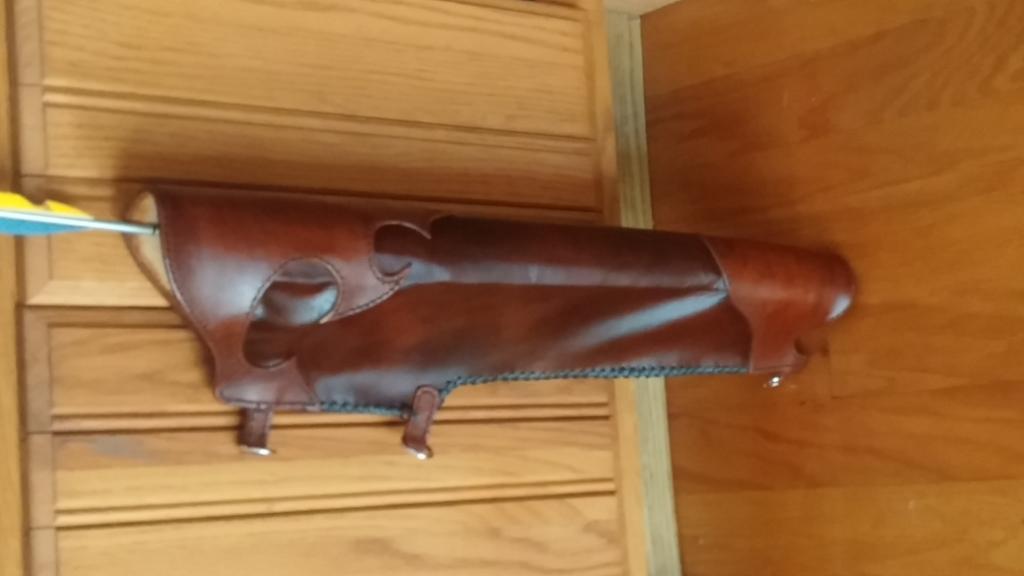
Start with arrow length, then balance the circumference with the number of arrows she will carry to the look she's going for. Factor in a method of a "Keeper" so they don't spill out every time she bends over to tie her shoes. There are lots of examples on Etsy as well as Pinterest. A quick and dirty convertible back/waist quiver I made for a tutorial. 25" high x 12" circumference (arrow holding capacity not actual width) made for a 28-29" arrow. There is a 1" foam block in the bottom to bumper arrow tips.
-
My Blue Daily Bag
Ole South replied to olenawills's topic in Purses, Wallets, Belts and Miscellaneous Pocket Items
Are the handles stitched through the pocket by design? Men under estimate the importance of feet on purses for women... I did... a friend (several that is) corrected me until I learned it, now I just have to remember to remind myself to include them when I build a bag. -
It's not the feed dog motion that causes problem. If it's too high, as the dog begins to return it will still be engaging the material from beneath thus dragging the piece backward a little or a lot shortening the next stitch when the needle pins the fabric. Lower the dog to half a tooth (or a quarter tooth) above the plate, then raise dog height an 1/8 of a tooth at a time until you get where you want to be.
-
My Blue Daily Bag
Ole South replied to olenawills's topic in Purses, Wallets, Belts and Miscellaneous Pocket Items
Nice interpretation, great execution. Good job! -
I got a really nice English point from our own Texas Custom Dies sponsor back around Christmas. Don't know what shipping/vat's might run but the quality is spot on! Came sharp, stays sharp and very nicely made.
-
Ya think that hole was punched to make sure the drip pan could be adequately oiled?
-
We are manly men here... neither shy nor timid.... we prefer to consider ourselves "Reserved and Dignified". Bwahahahaaaaa.... Please leave us our delusions... please, please?!!?
-
Perhaps its own section in the forum??? MatchStitch.leatherworker.net? You could be on to something here Art... charge admission and you've a new source of revenue to keep us running.
-
Isn't the tip of the hook broken off in that picture?!!?
-
@Colt: Rockler only carries up to 3/4" wide with centered ribbing... our tables are 1 9/16"-1 5/8" thick AND the ribbing is not centered; it's a 5/8" drop from the table top. @Shoepatcher: got a call into Jones... waiting for a reply So far the closest match is Outwater Tinker's link above but looks like that's a minumum 250' order @ $.44/ft. Comes in three colors, Black, Brown & White. Thanks everyone!
-
111W-153 Stitch Length... Wear Or Adjustment?
Ole South replied to Ole South's topic in Leather Sewing Machines
Thanks Bob... that's what I finally did. Everything works, it's just the exponential gain in stitch length as you pass 7 on the dial that I've been fighting. I found a set of photo's Constabulary posted of the regulating mechanism (can't find them on review) and tried to get inside per his example but the collar holding the spring wouldn't budge. So I washed it out with WD40, verified externally everything was moving and re-oiled but 7=7, 8=10 and 10+ = tiny to miniscule to line cutting. The feed dog height and matching it with a proper feed plate was what was limiting less than 6sti. I'd like to say the -155 I've got works properly but I had to steal parts to get the -153 working. I'll verify when I get the new dog and plate installed. -
@DrmCa Oil? Liquid? Polypropylene/polyethylene glycol?... is that better? Sorry, I misspoke from too quickly responding, I thought the concept of the wetting agent was more important to the OP. There is a liquid or wax of some form in almost every run/start cap depending on its age/manufacturer. I'm guessing this motor is from the late 60's or 70's so either might be the internal wetter.
-
111W-153 Stitch Length... Wear Or Adjustment?
Ole South replied to Ole South's topic in Leather Sewing Machines
Got to work on this machine tonight. Noticed the feed plate was deflecting as the feed dogs rose so got underneath and replaced the felt wick on the lift eccentric and adjusted the feed dog height.. While I was down there I gave the under carriage a good going over with a wire brush and WD 40 paying particular attention to the feed eccentric assembly. Things turn so much easier and faster now. I get a good 5 sti but the measured stitch out paces the stitch indicator still. Back to the eccentric mechanism. I found this post... lots of good 111 info http://leatherworker.net/forum/index.php?showtopic=64816&hl=%2B111w+%2Bstitch+%2Blength -
Rhapsody in Blue.... erases EVERYTHING!!!