



Darren Brosowski
-
Posts
761 -
Joined
-
Last visited
Content Type
Profiles
Forums
Events
Blogs
Gallery
Store
Everything posted by Darren Brosowski
-
Does it look like this? http://www.sewingmachinesaustralia.com.au/shop/buy-spare-parts/protex/protex-ty-twi-2b
-
The Chinese 253 machines are usually a clone of the 132B6B so to adjust the stitch length you hold down the lever on the front - roughly where Constabulary is pointing to - and turn the hand wheel until the lever clicks into one of the slots on the internal wheel. Keep holding the lever down then turn the handwheel. Cannot remember which but turn the wheel one way and the stitch length increases, turn it the other and it decreases. Watch the feed dog to work out the direction
-
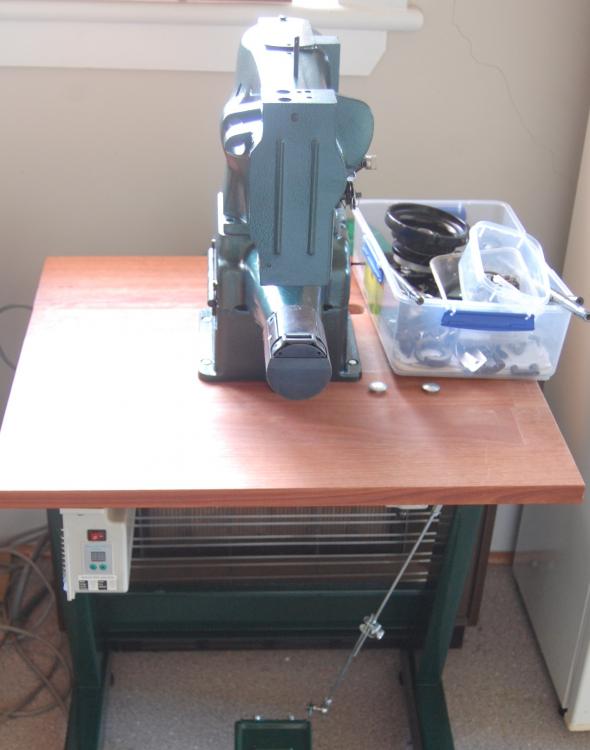
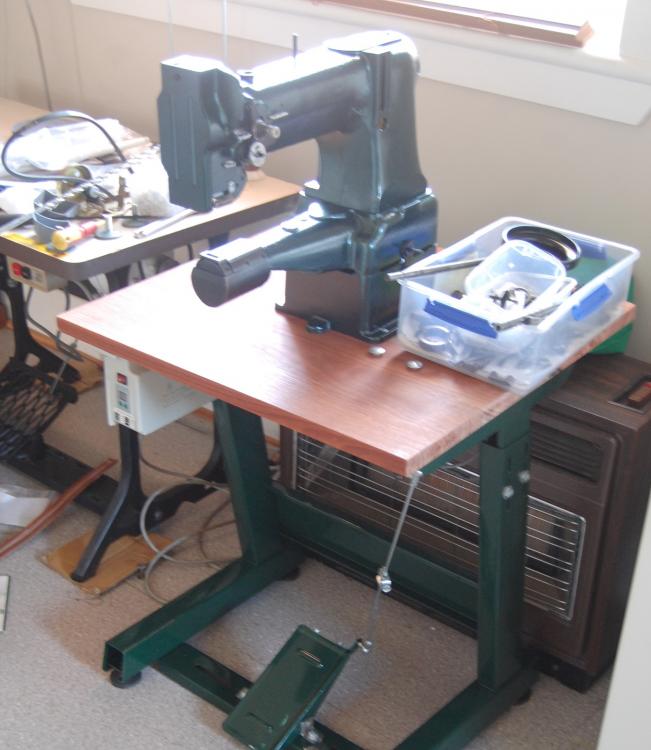
 One of my toys for a darning machine.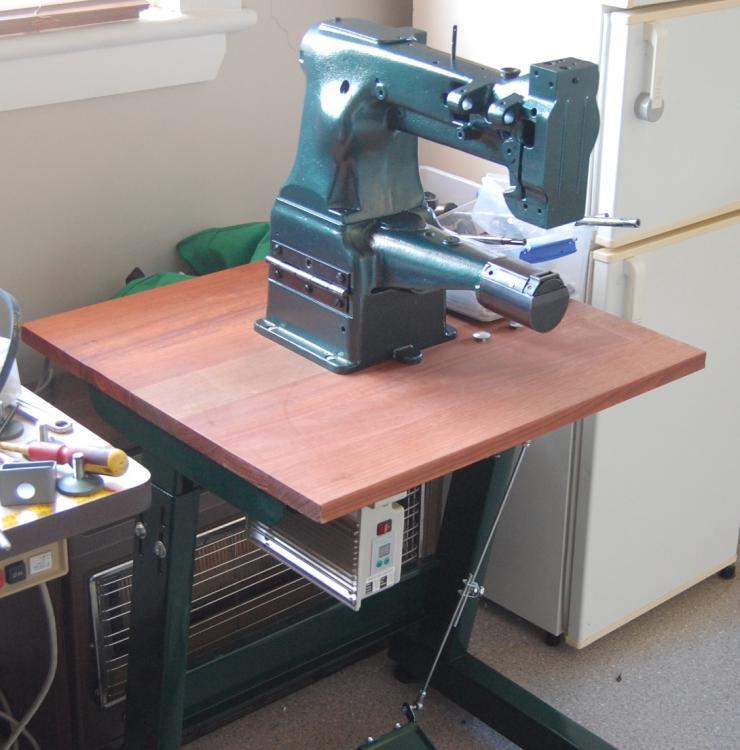
-
Leather point needles are available in 21/130 which at hand crank speed is more than enough for 138/M20 thread. Some of my 29k customers use the 21/130 needles for 138/M20 in their 29k patchers. If you asked I would tell you that the bed of the Chinese patchers is adjustable and you could use the 134 class needle which is readily available in 22/140 leather point. Needle length is the same so no need to adjust the timing.
-
Hi Axeman, The answer is........ not really. 20oz is about 8mm and that is way more than any patcher can do! There are five different patchers from China starting with the basic one that will do everything a 29k will do, three bigger versions of this machine up to the Chinese 29k variant. The basic model will, depending on the individual machine, punch through 14oz all day long. Generally the Chinese 29k is limited to 10oz but someone like Bob Kovar at Toledo can probably make it sew through thicker material. Then there are the other three machines that use the same system of cam driven arms as the 1860's Wertheim machines. They are bigger, heavier and use bigger needles BUT they are not designed for heavy leather. There are many limitations as they are designed to sew through thick soft material. Save your pennies and buy a CB2500 at the absolute minimum.
-
Cowboy has a dealer in Australia and we carry a wide range of machines in stock. If we do not have it then we can bring it in for you. Contact Darren Brosowski - ABLE Sewing - on 0415 353 748. We also ship to NZ so email me on darren@ablesewing.com.au
-
The Consew 227/Seiko CW8 and all horizontal hook machines have the same issue that confounds new owners; When threading up the bottom it is absolutely critical that you get the thread under the tension spring by pulling it firmly to the left and then making sure you have tension. If you fail to do this then you will have exactly the problem that you are experiencing!!
-
It is most definitely a Singer 15 class as the tension and take up are on the faceplate. The 201 also has a different slide plate.
-
Singer 114W103 Chainstitch Embroidery Machine
Darren Brosowski replied to GPaudler's topic in Leather Sewing Machines
It is still a lockstitch zig-zag machine but there is a special cover plate that replaces the three used for standard sewing. -
Singer 114W103 Chainstitch Embroidery Machine
Darren Brosowski replied to GPaudler's topic in Leather Sewing Machines
You can achieve the same thing using the Singer 20U class machines. There are two positions for the knee bar - one lifts the foot and the other swings the needle bar for embroidery. -
Quilting cotton on this leather machine
Darren Brosowski replied to m9andg27's topic in Leather Sewing Machines
Try contacting Meta in Taiwan sales_c@miketony.com.tw for parts and feet. The machine uses the U192/U193 feet and there are many types available Price is dependent on supply and demand so if there are very few machines on the market that may well be a reasonable price. -
Not a 31k as the tension is on the face plate and not the front. Body shape is totally wrong for a 31 class.
-
That machine looks like a Singer 9 which is the Weeler and Wilson 9 that Singer kept building after they bought the company. It was popular because it was a rotary shuttle when Singer built oscillating shuttle machines up until the introduction of the 101/201 class. There was a rotary shuttle 15 class but they are as rare as rocking horse poop.
-
I generally suggest oiling AFTER you finish sewing for the day then clean it up next time you sew. ALWAYS run a bit of scrap through first. The first thing I do with every old machine is a good clean up to get the built up oil, lint and crap out of the machine. Pull off all of the covers, take out the presser foot bar and needle bar and anything else easy to put back in. If the machine is really cruddy I also remove the two feed dog bars so I can clean out the bearing surfaces. It might seem daunting but start with a Singer 15 class machine and if you can get that working again then you will have no problem with a 16, 17 or 18 class machine as they are essentially the same. Even the 31 is essentially a super heavy 15
-
I have an S2 sitting around here and it is a lovely piece of engineering. Normally I try to get machines running but the Reece is not something I am willing to spend time on as it is too complicated and there is no market for them!
-
The 42-5 and 16 class use the same top casting but the bottom is entirely different. The 42 uses the long beak shuttle
-
Singer Leather Sewing Machines
Darren Brosowski replied to Trevor Baret's topic in Leather Sewing Machines
Parts Lists; http://www.parts.singerco.com/IPpartCharts/ User Manuals; http://www.parts.singerco.com/IPinstManuals/ Service Manuals; http://www.parts.singerco.com/IPsvcManuals/ Note that Singer has made a number of errors when uploading this data such as the "45k101 & 45k102" user manual is actually the 451k101 & 102 manual. Hi Trevor and the other Aussies -
Lucky I was on at the right time!
-
Singer 7-33 Stitching problem & parts
Darren Brosowski replied to hackish's topic in Leather Sewing Machines
I have seen this before in a machine with a long take up stroke. What you have is a little bit of thread left on the top that the take up lever has not pulled through but the bottom stitch looks fine. The problem has to exist between the tension discs and the eye of the needle. Look for anywhere that the thread could be getting snagged between those two points. -
The screw is under the frame - below and to the left of the tension
-
Steve Bonnet might still have one in stock Barra
-
Old Singer Sewing Machine
Darren Brosowski replied to LeatherWerks's topic in Leather Sewing Machines
There is not a lot to "service". If you are going to get more into sewing machines then I suggest you give this baby a good clean then look for anything loose that can be adjusted. You cannot break it!!! -
Where are you based Tim?
-
SINGER 807 - LIKE A BERNINA 217
Darren Brosowski replied to amateursewing's topic in Leather Sewing Machines
Sorry, I was a bit grumpy last night. Not every Singer machine fits the proper nomenclature system!! -
Old Singer Sewing Machine
Darren Brosowski replied to LeatherWerks's topic in Leather Sewing Machines
It is possible Steve but at that time the majority of production was electric. Most variant numbers specify the type of drive but the sewing machine is just a head that can be treadled, hand cranked or electric so the "-" number really only applies to most models after they left the dealership as the dealer may have had several electric 66's and someone wanted one as a treadle base. The dealer would swap out the balance wheel and drop it in a treadle cabinet. The whole Singer model number system is odd!! A 45k21 is the same as a 45k25 but the 21 has a fixed foot and the 25 a roller foot but the feet are interchangeable so why have two machines in stock that are the same?


